Monday, August 30, 2010

Theistic Evolution is nothing but compromise with the world

I've settled down a lot in the last few weeks. I no longer feel a need to answer the outrageous claims of evolutionists or anything else that comes at me from this world that contradicts God's word. I quietly know they are wrong, that God is in charge, and no matter what names they call me I'm content with the Biblical revelation. It is the power of God unto salvation for everyone who believes.

Got this in the mail recently, an article on the folly of Theistic Evolution showing it to be just another sad compromise with the world some Christians fall into:

The folly of Theistic Evolution preachers is that in following such heretical teaching, the adherents are preaching against the authority of the Bible. Either the Bible is the Word of God or it is not. The Bible is clear in the Genesis account of creation that God created the heavens and the earth. "In the beginning God created" is an absolute proclamation of who it was that created all (Gen 1:1). This is an account given that makes a dogmatic point that God created everything in six days. The Bible says that God formed Adam from the dust of the earth and Eve from Adam's rib. God breathed life into them after forming man in the image of God (Gen 1:26). God did not form man as primordial slime and set it on a course to develop into man. God made man and all the animals in six days, not 4 billion years. To say otherwise is to say that the Genesis account is not accurate. What many of these Theistic Evolutionists say is that we can't take the creation account literally.

If that is true that why should we take the Biblical account of the resurrection literally? How about the necessity of being born again by the regeneration of the Holy Ghost literally? How about the literal belief that Jesus is the way the truth and the life, and that no man comes to the Father but by Him? How about the literal virgin birth? Should we really believe that Mary was with child by the Holy Ghost?...One could find a way very easily to spiritualize these points into symbols and make them say whatever they want to.

The entire Soteriological (doctrine of salvation) position of Christianity is based on the authority of the Bible. Once the Church allows itself to give in to secular pressure to change something as basic as creation, we destroy the authority of the Scripture and thus have no absolute ground to stand on in any Biblical Theology. One could twist them into a pretzel and make a good natural Devil pleasing argument for why it would be ridiculous to believe that Jesus is the only way to heaven…after all, are there not many other great religious figures who taught great moral lessons? In fact if the main goal is to get more people in the church by pleasing their human intellect, certainly one could twist any passage of Scripture by reducing it to a symbol of something else than what it is.

The Bible says"

1 Corinthians 2:14 "But the natural man receiveth not the things of the Spirit of God: for they are foolishness unto him: neither can he know them, because they are spiritually discerned."

Friday, August 20, 2010

Faith itself is the evidence

The determination with which all evidence for creation is dismissed by evolutionists does eventually discourage one from continuing to try to produce it. Perhaps it's necessary to face the possibility that this is simply not the way a believer should go about it.

We apprehend God's truth by faith, not sight. Converts are also to be won by faith in God's revelation, not in extraneous evidence even if in support of that revelation. God occasionally supplies such evidence for us, such as in various archaeological finds, the Dead Sea Scrolls for instance, to buttress weak faith when the challenges are severe, but the call is always primarily to faith.

Faith is the evidence of things unseen, the substance of things hoped for, the royal road to knowledge unreachable through the five senses and forever unavailable to those who reject God.

Of course this mostly melancholy musing expresses my own discouragement right now with continuing to try to make the case for creation against evolution, but it also has the superior virtue of turning me to things unseen where the greatest blessings are to be found.

Tuesday, July 27, 2010

Yup all those random mutations just hit it right every time, don't they?

Enjoyed this post by "Bolder-dash" at EvC.

Oh sure, they'll have "answers" to it, and maybe I'll try to answer their answers eventually, but I just wanted to put this up here because he gets the point across well and hilariously well.

Concerning the totally hypothetical evolution of the eye that is nevertheless treated as fact by evolutionists:
So let's do imagine we are in that pre-Cambrian era and noticed some creatures with light sensitive patches some where on their body. We might remark, well, that sure is odd, you don't see that very often, and even more fascinating, it really seems to help those creatures navigate better than those without that little patch.

And then if we waited another very long time (or as Dr. A wants to suggest we only have to wait less than 40 years, we would see those same creatures now, all with the light patches, and even more fortunately some of them have gotten a little depression in their bodies, EXACTLY where that little light patch happens to be, and amazingly enough that little depression (I mean little depression in animals bodies happen mutationallly all the time I guess right) ALSO happens to provide a small little concave surface which helps focus the light every so slightly more, such that now those with the depression are even better at navigating than those without the depression. Mutations are much more fortunate now in this scenario than we first thought. But don't worry, there will be more of these fortunate little depressions. And then after than a cornea will pop up. And some time after that, rods will pop up, and then cones, and then a retinal nerve, and then of course an iris and then a pupil..or will it be a pupil first, and then an iris?

But of course we are just getting started, because two of them will certainly be better than one. And if they are perfectly symmetrical, so much the better. I wish we could also get a tear duct. Whoa, viola! You got it. Would you like an eyelid? great. It will help if that eyelid is extremely rapid, so rapid that it can move at the speed of a blink. And you know what, its not just one form of liquid we get to luck into our tear ducts, its two!! Bonus time.

We could of course go on and on with these fortunate beneficial mutations which are so rare, but let's return to the present for now. Where are these light sensitive patches that pop up now and again like they used to during the pre-Cambrian? Or how about microwave sensitive patches. I could sure use a night sensitive patch on my forearm, for those times when I get up in the middle of the night and trip on my slippers. That would be an advantage.

How about these random mutations for new tear ducts? Corneas anyone? Because supposedly they just pop up spontaneously every once in a while in some mutants, but we just never noticed-at least they did in the pre-Cambrian-oh, how times have changed. I sure do miss those days of spontaneous rods and cones. Especially if they happen to happen in a place I could really use them. I mean, I get spontaneous rods all the time, but not always in the backs of my eye.

But heck, if a lizard can change FOUR fundamental parts of its body in 40 years, if I just lived to be 60, and have a few kids, and they have kids, who knows, they might just end up with 6 retinas instead of two, plus that night patch we so desperately could use.

Ah, its a dream.

Tuesday, June 22, 2010

Del Tackett's list of reasons to believe in a global flood

Click on the picture and then again to enlarge it to the maximum, to appreciate the distances shown here, as well as the clearly water-sculpted shapes, including the mud pillows in the foreground. The gouged-out canyons are better seen in the picture at the bottom of the post. All global flood evidence for sure.


=============================================
Del Tackett of the Truth Project has a blog entry today about Why I believe in a global flood. He covers all the elements of it pretty well. I wish he hadn't allowed for the possibility of an old earth, which plays havoc with scripture, and I wish he hadn't ended by saying that he knows some don't believe but "that's OK." How is it OK not to believe what God said? Anyway, the blog covers the main reasons for belief pretty well.

Here are the geological reasons he gives:

-All over the world there is clear evidence of a global flood. Huge, vast sedimentary layers cover the earth. I’ve seen them in Israel, in South Africa, in England, everywhere.

-Fossils represent creatures that were buried rapidly, not slowly.

-The sedimentary layers are laid down on top of each other in tight layers just as we see in hydro-sorting as occurred at Mt. Saint Helens and in the lab. The layers do not show signs of erosion or long periods of time between them.

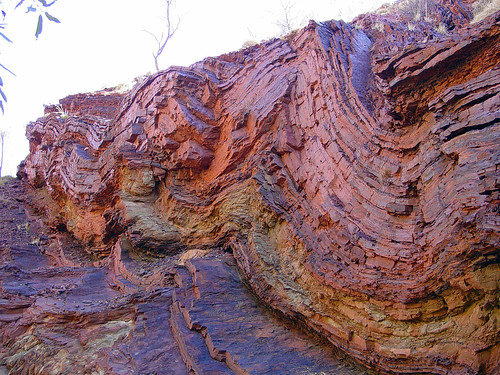
-Smooth bending or “folding” of sedimentary layers show that the layers were soft, not hard and brittle.

7. The standard geological story doesn’t fit the observations.

-The story that the land sunk and was covered with a large placid ocean in which particles of sediment slowly built up on the ocean floor, then the continent rose and the sediment became hard, then the continent sunk again and a placid ocean covered it with more sediment, then rose, then sunk, rose, sunk, rose, sunk, etc. to form all of the layers defies the evidence and even my imagination. The Redwall limestone layer is 550 feet thick throughout the Grand Canyon. Picture a large placid ocean. Where did all of that sediment come from to form this layer? The Coconino Sandstone layer is 350 feet thick. The Hermit Shale is sometimes 1,500 feet thick. That is a lot of particles over vast areas that had to somehow sprinkle itself over the bottom of the ocean for millions of years.

-I’ve mentioned the fossils, but plants and animals don’t normally fossilize over millions of years. Instead, they decay. This is especially evident when we find fossils like bees whose wings are exquisitely preserved, or fish in the process of eating another fish or an ichthyosaur giving birth when it was rapidly buried.

-The use of radiometric dating of rocks is suspicious to me. Fossils that should be void of any carbon-14 because of their “old” age, are still full of carbon-14. The great assumptions that provide the foundation for radiometric dating leave it ripe for miscalculations.

-By the way, look at the picture here. Notice how the the earth has been vacated, not because of a river. It just looks like someone pulled the plug on all the water and it just washed big caverns in the earth.


[Click on it, and then again, to enlarge it to the maximum]


Much later note (October 2010): I keep coming back to look at the two pictures in this post. They are at least as good evidence for the Flood as the Grand Canyon, and in a way more obviously so. Consider the buttes and cliffs in the background, rising from the relatively flat surface into which the canyons in the foreground are cut. That flat surface is reminiscent of the Kaibab plateau that forms the upper rim of the Grand Canyon which is also smooth and relatively flat for hundreds of miles in all directions except where uplifted by volcanic action and earthquakes. This flatness is the upper surface of one of the layers that were previously laid down in the earlier stages of the Flood, the layers above it having been gouged out and washed away in a later phase of the Flood as the waters were receding. Those upper layers had to have climbed at least to the current height of the highest butte, and probably much higher as layers above them were no doubt also washed away. So the buttes indicate that the entire area was at one point completely covered to quite a depth of layering, then a great deal of it washed away and the last of the flood waters carved out the striking canyons in the pictures, leaving only a meandering river.

Monday, May 31, 2010

The proper way to teach geology

Just as evolutionist biology does, evolutionist geology also presents its mystifications -- its fictions -- as its subject matter, instead of the simple observable visible phenomena it supposedly studies. Just as we can hardly find a simple description of a new species without a thick fog of interpretation about its alleged evolutionary history obscuring the simple facts, so we can hardly find a description of a fossil find or a rock formation without its being obscured by pronouncements of its supposed age and supposed history, all interpretation, all fictive.

If it were possible to talk to the believers in evolution about creationist ideas without always having to debate, being misunderstood in the most zany ways, and being subjected to abusive namecalling and accusations, I'd just like to talk about the basic facts, the phenomena involved, the observable phenomena, completely apart from the interpretive schemes. What sort of rocks are to be found in a particular area, what sort on the surface and what sort at some depth if known, and what sort surrounding it. That would be a start to an understanding of the geology of the area. I don't want to know its "age," and I don't want to know how it supposedly got there. That's all theory, interpretation and in the end nothing but fiction. I want to know what IS there.

You can't even find a geologic map that shows this, they all label the geographic areas as "time periods" instead of observable visible phenomena.

Here's a case in point and this is an older map so not as bad as modern ones. I link it because it's nicely detailed.

It's utterly meaningless to have a section of a map set off in a boundary labelled "Jurassic" or similar designation. It's mystification, the opposite of edification. The first thing you should get from geology is an accurate picture of what actually exists, and the maps should reflect that.

I haven't even been able to find out what physical phenomena are included within the boundary lines in any consistent way. Here and there are discussions of particular rocks associated with particular "time periods" but there's no systematic treatment of the rocks as definitive of separate areas that I've been able to find. In any case that's where any geological discussion should start, it shouldn't start with the purely fictitious time periods and then later add some information about the actual geology of the place.

I don't even know if the boundary lines in any way mark off topological distinctions, altitude differences (they'd have to be rather slight differences since official topographic maps show a maximum height of around 1400 feet for Britain). What DO they mark off? Distinctive rocks? Different altitudes? Layers? What? Are layers in any sense visible in the terrain? The time periods of course suggest stratification, but I want to be able to SEE what their boundary lines are meant to describe. And isn't this what a beginning student of geology SHOULD want?

===========
Some references for future consideration:

A study of the geology of Britain written in 1878

And here's a story about creationist geologists. I'm SO glad these guys exist and are out there looking at the actual world apart from the mystifications of establishment science.