Showing posts with label Evolution defeats Evolution. Show all posts

Sunday, November 4, 2012

Some ponderings on Darwin's views of domestic variation, showing again how the processes of evolution are naturally limited

In a copy of Darwin's Origin of Species that I have from 1979, a heavily abridged "coffee table" type book featuring lengthy commentary by Richard E. Leakey and lots of glossy pictures of animals, Leakey gives the following introduction to Chapter 3, Variation Under Domestication:
Darwin's idea that domestication can, in itself, cause greater variability to arise between individuals is now known to be wrong.  The greater varaibility which is seen in domesticated plants and animals is the result of their not having been subjected to natural selection which, if the environment is stable and the species well adapted, tends to eliminate those which depart from the norm.  Gene recombination and mutation are what give rise to variation, and these will occur at the same rate in the wild as under domestication.  But in the wild, variations will usually be far more ruthlessly weeded. out.
Thus goes the evolutionary explanation of 1979 and it sounds pretty familiar so I have no reason to think things have changed much if at all since then.  Of course he's right that Darwin was wrong to think domestication in itself causes greater variability than occurs in the wild, but his own explanation is just as wrong.  It's basically a recitation of The Creed, which is what an awful lot of evolutionist writing really comes down to.  "Not having been subjected to natural selection" is nothing but The Creed.  So is the inclusion of "mutation" in the explanation of what gives rise to variation.  Neither such drastic weeding by natural selection in the wild state, nor variation as the cause of such weeding, nor mutation as the basis for normal variation, is supported by actual evidence.  It's all speculative assertion.  The Creed.  Gene recombination, yes, that IS what gives rise to variation in both nature and under domestication, and yes, this WILL "occur at the same rate in the wild as under domesticatiom."  That much IS known for sure.

This topic particularly interests me because I've had my own explanation of how variation occurs for some time now, and it differs from both Darwin and Leakey's view, although it is quite compatible with some observations by evolutionists -- it just depends on which source you are reading. 

Darwin's discussions of variation, both in domestic plants and animals and in nature, are interesting because he had no knowledge whatever of genetics. Although Mendel was his contemporary, Mendel's studies of inheritance were not known until after both were dead.

So here's Darwin from this chapter:
When we compare the individuals of the same variety of our older cultivated plants and animals, one of the first points which strikes us is that they generally differ more from each other than do the individuals of any one species or variety in a state of nature.  And if we reflect on the vast diversity of the plants and animals which have been cultivated during all ages under the most different climates, we are driven to conclude that this greater variability is due to our domestic productions having been raised under conditions of life not so uniform as, and somewhat different from those to which the parent-species had been exposed under nature.  It seems clear that organic beings must be exposed during several generations to new conditions to cause any great amount of variation;  and that, when the organization has once begun to vary, it continues varying for many generations.  Our oldest cultivated plants, such as wheat, still yield new varieties;  our oldest domesticated animals are still capable of modification.
I'm sure breeders today could answer Darwin on this point if they were not brainwashed with the evolutionist notion of mutation as a major agent of change.  Genetic recombination explains it all quite nicely and all mutation does is interfere.  It may occasionally produce an unanticipated but benign anomaly (I'm not really convinced this happens though), and that could be exploited if one wanted it to be passed on, but it is hardly THE method that gives rise to variation, or even A method.

What brings about variation or change in the phenotype, change, that is, in the appearance or function of the creature itself, is REPRODUCTIVE ISOLATION.  Period.  Reproductive isolation simply means that a specific number of individuals of any species are separated from others of the same species and gathered together in an exclusive population of themselves alone, so that they only breed among themselves, and so that therefore their offspring carry only the genes and traits of the members of their relatively smallish circle, which over generations of such inbreeding can intermix all the genes/traits of all the original individuals so as to produce a very specific and unique appearance or set of traits that becomes characteristic of that overall population.  This is recognized in the field called Population Genetics but it gets confused with too many irrelevancies it seems to me and therefore isn't given the emphasis it deserves.  Natural Selection, which probably occurs to some extent but nowhere near the extent attributed to it, is just a form of reproductive isolation. 

Reproductive isolation is what happens under domestication, and it's THE reason for the development of a characteristic new breed.  Originally I'd suppose a portion of a wild species was brought under domestication, say of herd animals, cattle, sheep, goats or whatnot, some smallish number I would assume, or at least small compared to the original population, and the new domesticated population would then inbreed for generations until a new phenotype or particular set of traits would come to characterize the domesticated herd. 

This would occur over and over in different places as different portions of the wild herd were brought under domestication by different owners, or split between them so that they got isolated and inbred over time.  Their different gene pools eventually develop into separate herds each with its own characteristics that differentiate it from both the original wild herd and those of the other domesticated herds taken from that same wild herd.  This occurs over some number of generations of inbreeding.

THIS is why there are so many varieties of domesticated animals even when special breeding programs are not pursued, not Darwin's notion that somehow domestication itself produces variation, but simple reproductive isolation of a part of the original wild gene pool, which naturally occurs as part of that gene pool gets selected out for the purpose of domestication.  It's interesting to look up various animals on Wikipedia to get a list of the domestic breeds of each species.  Cows, pigs, sheep, goats -- there is an enormous number of varieties of each species.  Variation of course also happens in the wild but not nearly to such a dramatic extent as there is so much more intermingling of the individuals in larger populations, known as "gene flow" which is what DOESN'T happen with reproductive isolation.  Nothing to do with Leakey's affirmation of the Creed of Natural Selection as "weeding out" variations that arise.  The variation in nature is of course also due to reproductive isolation, which probably most often occurs through migration that leads to geographic separation of portions of a population from others, such as for instance the successive populations of ring species demonstrates.

It's nothing but reproductive isolation of the newer part from the older main population that brings about the many interesting differences between the different populations.  The smaller the new population and the more complete the isolation the more dramatic will be the differences. 

What's going on here GENETICALLY is that reproductive isolation of a small portion of the original gene pool brings about a CHANGE IN THE GENE FREQUENCIES in the new smaller gene pool (sometimes also the "parent" gene pool as well if it's not extremely large) so that new traits or phenotypes emerge in the new population as it inbreeds over some number of generations, mixing the new frequencies.  That's another well known principle of evolution. 

SIDE POINT ON INDIVIDUAL VARIATION:
{Clarification:  Rereading this post (Wed Nov 7) I realize Darwin was thinking of variation among the INDIVIDUALS and I haven't said enough about that as I've been thinking of the amazing variety of BREEDS that occur under domestication and focusing on explaining that.  But I think an explanation of greater individual variation is implicit in the discussion in that the first few (how many?) generations of genetic recombination within the new herd or population would naturally turn up new traits among the various individuals because of the new gene frequencies in the population as a whole, and this individual variation should increase until at some point the gene pool starts to get more blended through continued inbreeding, and starts tending toward the establishment in all the individuals of the traits that eventually come to characterize the breed as a whole.   It's this final blending I've been thinking of as taking some number of generations to get established, but it's in those early generations that new variations would keep appearing as the new gene frequencies get played out.  I mean there are going to be fewer of some alleles and many more of others for many different genes so there will be more pairings that don't fit the blended trait picture of the original wild population, or whatever population was the parent.  I'm sure the word "blended" isn't the best but I don't think it's far off the mark of what must really happen.}

Founder Effect or Bottleneck are the most drastic examples of what happens genetically with the inbreeding of a new gene pool of new gene frequencies, although it happens in any isolated population that starts with smaller numbers than the original, it is just much more dramatic an effect when the population starts from extremely few individuals and has a drastically reduced gene pool that gets inbred.  Founder Effect or Bottleneck is when there are only a very few individuals that are the basis for the new population.  This has often happened in domestic breeding when a particular trait is sought and the elimination of types without that trait are carefully eliminated in favor of breeding only those that have the trait.  This has proved to have genetic drawbacks over time as it multiplies the opportunities for genetic diseases to occur in a drastically inbred population, but the principle is clear enough:  new phenotypes emerge to characterize a new population when competing phenotypes are kept from breeding with the desired breed or stock.

It seems to me that Darwin's observation that this occurs over generations is true and important.  It takes the inbreeding within the new gene pool to bring about a new reliable breed or variation.  How many generations this takes I don't know, but breeders may. 

I was reading up on some of the breeds of cattle and the Hereford is an interesting read.  Apparently it took a while to develop its characteristic appearance, at least a hundred years, its white face for instance.
Until the 18th century, the cattle of the Herefordshire area were similar to other cattle of southern England, being wholly red with a white switch, similar to the modern North Devon and Sussex breeds. During the 18th and early 19th centuries, other cattle (mainly Shorthorns) were used to create a new type of draught and beef cattle which at first varied in colour, different herds ranging from yellow to grey and light brown, and with varying amounts of white. However, by the end of the 18th century the white face characteristic of the modern breed was well established, and the modern colour was stabilised during the 19th century.[7]
Of course usually what breeders want is a breed that "breeds true," so that all the individuals born among the herd have the same characteristics.  Apparently this takes some number of generations to get established.

From other things I've read on this subject, for a breed to "breed true" means that there is a large proportion of genetic homozygosity in the gene pool for the breed's most desired characteristics.  This can happen in any population but again the most dramatic example of how it happens is the drastic bottleneck or founder effect.  A huge number of homozygous genes is characteristic of an inbred population that began with a very few individuals but again, the same condition can develop over successive population splits into new reproductively isolated populations.  It just gets there faster in the drastic cases, such as what happened with the cheetah and the elephant seal.  As long as they don't succumb to genetic disease they can be quite healthy and produce large populations but they lack the ability to vary further. 
Darwin's final line that many of the oldest domesticated varieties "are still capable ogf modification" suggests that they retain sufficient genetic variability, which really amounts to sufficient heterozygosity, to develop new varieties from further splits into new reproductively isolated populations and it suggests also that there is such a thing as reaching a point where further modification or variation ceases to be possible -- which occurs when there are a great many fixed loci or homozygous genes such as are possessed by the cheetah and the elephant seal.

A point IS reached eventually along any such line of continued "selection" of a relatively small portion of a population from a larger, and it must be reached if the process continues, where variation simply cannot occur further because of the great percentage of homozygosity, or lack of genetic variability, in the breed.

This is how EVOLUTION DEFEATS EVOLUTION, or in other words, how evolution comes to a screeching halt simply through the very processes that bring about the variations, or through evolution itself.  Variation can occur within a species, but that's all that is allowed by the laws of genetics built into the organism.  Simply due to the nature of genetics, Evolution Writ Large, or "macroevolution," or evolution/variation beyond the boundaries of the genome of a particular species CANNOT occur. 

======================================

Later:  Still rereading this post to try to clarify and correct and felt like adding this You Tube video of a wonderful breed of horses I only recently learned about, The KFPS Royal Friesian Horse, a horse with such an amazing natural elegance it's like something not born of this planet, truly a Royal breed, a heavenly breed even.

Monday, May 21, 2012

No novel features, no new information, no evolution

There is another thread at EvC which is basically about the question of whether evolutionary processes can produce new genetic information, but this one is not on the level of the genetics but the phenotype or the traits governed by the genetics. The question is How do "novel" features evolve? I've pretty much lost interest in this question from either angle but thought I'd note this post by Taq which more or less summarizes his view of the whole dispute:
Zaius has once again shown us why creationist claims are useless. They claim that novel features must emerge through evolutionary mechanisms in order to produce the biodiversity we see today. So what would happen if we were able to travel back in time to watch every single generation from the first life to modern life, mapping each and every mutation? At every step the creationist would claim that no novel features evolved, ever.
This pretty much shows that the whole argument is on such a hypothetical level that all the calls for evidence are simply futile -- no evidence could possibly exist for such fanciful guesswork and either side can say anything at all in defense of his position.

So I might as well give my own view of what would happen in the case he describes. If we COULD go back to the beginning of life and map each and every mutation we wouldn't see evolution at all, we'd see exactly what we see today, separated Species or Kinds that vary among themselves and never produce novel features or new genetic information because they never produce anything but their own Kind or Species. From the beginning of life we would see the same Species we see today though perhaps very different varieties of them, plus some Species we don't see today because they've become extinct. On the genetic level at first we wouldn't see many mutations but as the generations succeed one another we would start to see an increase. Mutations alter the genetics of the creature, either producing a genetic disease or not affecting the phenotype in any observable way. Yes, we WOULD claim that no novel features evolved ever because they don't. They never did.
The truth of the matter is that evolution does not need to produce novel features, as defined by creationists, in order to produce the biodiversity we see today. In their attempt to falsify evolution they have moved the goal posts off the field. "Novel feature" is a meaningless term as defined by creationists. "Novel feature" is a hole in the sand where they place their head.
Actually it's not. This particular question really ought to be focused on whether or not mutation is observed to produce new genes, not just new alleles but whole new genes, because that is at a minimum what "new information" implies -- again, at a minimum -- and what is needed if "novel" features could emerge. And novel features must emerge if a Species or Kind could evolve into another Species or Kind.
What does evolution need to produce? Heritable phenotypic change. Does it do that? Yep. Mutations produce changes in phenotype that are heritable, and the frequency of these new alleles is controlled by environmental pressures. Whether anyone names this change "novel" or not is completely irrelevant.
So here we are back at the evolutionist's reiteration of the evolutionist creed: what we observe happening is all that is needed to bring about evolution from one species to another, the great Faith or Fantasy that runs the whole show. They see normal variation within Species and make the mental leap that can never be subjected to evidentiary proof, that evolution is simply normal variation continued without interruption for millions or billions of years.

But let's unpack this statement. He says evolution needs to produce heritable phenotypic change and that it does that. How does he know that EVOLUTION does this? He sees heritable phenotypic change in nature and simply subsumes it under his evolutionist preconception. He assumes evolution and appropriates observable facts of nature to it. That's how it always works. That's the "scientific" procedure of evolutionism right there. Evolution is assumed and whatever is observed is mentally jammed into it. Evidence for any of this is nonexistent, it's all mental gymnastics. But heritable phenotypic change is just as well explained by the creationist assumption instead. Such change is simply the variations that occur within Species, or sometimes known as "microevolution." There is no evidence whatever that such change is open-ended as evolutionists assume, and as I will argue below, as I always do, there is evidence that there is a limit to such changes that confines them to the boundaries of a Species or Kind.
Mutations produce changes in phenotype that are heritable, and the frequency of these new alleles is controlled by environmental pressures. Whether anyone names this change "novel" or not is completely irrelevant
Mutations do produce heritable phenotypic changes, but it is one huge unproven assumption that the mutations create new alleles for viable healthy phenotypic traits; what HAS been proven many many times is that mutations have produced thousands of genetic diseases. It is pure unevidenced theory or assumption that mutations do anything that could further evolution.

The actual cause of NORMAL variation within Species is not mutations but the built-in genetic material that has been there from the beginning, such as genes for the traits that define the Species, plus a variety of alleles for the different genes. Alleles are just different forms of the genes that produce different qualities of a given trait in the phenotype. A gene may govern, say, eye color, and the various alleles for that gene will determine which color the eye will be. Mutations do not produce such viable alleles, they only interfere with these normal genetic variations and often produce distortions that cause diseases in the organism.

Mutations do not create new alleles, this has never been observed, it is something merely assumed by evolutionists, there is no evidence for it. The frequency of existing alleles may of course "be controlled by environmental pressures." Such as natural selection which could wipe out a part of a population, thus reducing the genetic variability and creating a new phenotype from the new gene frequencies thus brought about. Or a simple migration of a portion of a population to a new locale where it becomes isolated from the original population. Again new gene frequencies will be established and a new phenotype emerge. All this occurs from the simple shuffling of the alleles pre-existent in the gene pool. These alleles are pre-existing, built into the Species. There is no need for them to be formed by mutation and there is no evidence that any such thing occurs at all. Again, what there IS evidence for is that mutation is a destructive process; it alters the normal genetic formula, sometimes to the point of destroying its function altogether -- at which point the destroyed gene most likely becomes part of the great genetic graveyard known as Junk DNA. This is an UNhealthy process. Mutations not only do not do anything that could possibly further evolution, they contribute only to the deterioration of a Species.

As for what one CALLS new traits that emerge in new populations as a result of the "environmental pressures," they aren't called "novel" because they AREN'T novel, they are simply selected particular expressions out of the normal range of variation built into the Species. Except for the diseases of course, which ARE novel.

So as usual the best answer to all of this is that in reality what we observe happening IN ORDER to produce heritable phenotypic change is the DECREASE in genetic variability that ultimately leads to inability to vary further at all. Normal variation, or microevolution, has built-in genetic limits. This IS subject to evidentiary proof as I've also many times explained. If I were forty years younger and had a few million dollars I'd set up a scientific project for the purpose.

Normal variation comes about through changes in gene frequencies from population to population, which come about as populations become isolated from other populations, each having their own set of gene frequencies. This produces new phenotypes, especially in the smaller populations. If the new population is appreciably smaller than the original, which is often the case, the phenotypic change can be quite dramatic but the genetic variability of that new population will also be much less.

And so it goes until you can get what is called speciation or the development of a new phenotype that can't interbreed with the others of the same Kind, AND has drastically reduced genetic variability, which is the opposite of what it would need in order to vary further. Meaning: the very processes that bring about evolution lead to a genetic condition in which evolution is ultimately no longer possible at all. That's the end of the trail. Evolution defeats evolution.

Tuesday, March 13, 2012

Yes you DO get loss of genetic diversity with evolution Part 7

So let's turn to Rahvin for a bit:
Hi Faith. Welcome back.
The problem behind your theory is that it's contradicted by real-world observations. Your predictions are invalidated, because observed evolution has not been reducing genetic capacity for variance.
What are you looking at? If you are looking at the phenotypic variations you may very well see lots of variance. That's microevolution, that's phenotypic microevolution. But if you look at the DNA you should start to see fewer alleles for the selected traits or even population-wide homozygosity for some traits.

The confusing thing is probably that in most cases you don't get any appreciable reduction in genetic diversity. That is, new gene frequencies from a population split just means that you get more of a different kind of allele for a given trait than the other population had, and less of the kind that dominated in the first population, it's mostly a reshuffling. But the fact is that you DO need to reduce or eliminate alleles that produce the "wrong" trait in order for a new trait to become characteristic of the new population, and over a number of selection events and population splits this will show up as a reduction in genetic diversity along with the production and establishment of the new phenotypic trait. IN THE NEW POPULATION. The old population, assuming it's appreciably larger, will no doubt retain the higher proportion of the "wrong" alleles that are lost to the new population because there they aren't "wrong."

It's down any specific line of variation of the phenotype that you are going to encounter this loss of genetic diversity, but since it is down any specific line of variation that you are seeing the production of new traits, that is, evolution, it ought to be clear that the process of production and maintenance of new phenotypic traits, or variation, or evolution, requires this loss of GENETIC diversity.

Even a population split in which the new population is appreciably smaller in number is going to show a lot of phenotypic change along with the genetic reduction, but ANY actual selection of a trait could completely eliminate some alleles and that is where you will REALLY see this formula in operation. Selection definitely reduces genetic variability. Selection is how evolution proceeds. Put two and two together.
Year after year, undergraduate students directly observe evolution in action as they show changes in allele frequency in fruit flies. Other students observe the case of drug resistance spontaneously forming in a population of bacteria.
Are you really looking at the DNA to see the changed allele frequencies or are you inferring them from the "evolution in action" that you are observing, which would of course be the usual microevolution. Drug resistance is the phenotype, what's going on in the DNA?
The process doesn't stop. Variation continues, unimpeded.
And so it may. VARIATION may continue and continue a long time. You are talking about PHENOTYPIC variation here. In some species you can get lots of new variations of the PHENOTYPES, but my claim is that you will eventually reach a point where you can't get any more because the process requires genetic reduction. REQUIRES it. If you are only looking at the phenotypes you aren't necessarily going to be aware of this. But also, since you are dealing with fruit flies and bacteria you may be getting a lot more phenotypic variation for more generations just because they are likely to be genetically more variable than higher animals. Bacteria have a lot less junk DNA for instance than higher animals, which suggests a lot more genetic variability. It's really not a valid comparison with dogs, cats, mice, and humans.
There is no reduction in the possibilities derived from mutation guided by natural selection. At no point to we reach an evolutionary "endpoint" where no more change is possible.
You have apparently not reached it in the laboratory with fruit flies and bacteria (though I suspect you have), but it is reached every day in the wild, with the elephant seals and the North American bison and the cheetah as the most extreme examples. Yes, they are examples of this process, they are not exceptions. Limiting the numbers of a population is what one does to produce a new phenotype, though it doesn't always happen to the extreme of a bottleneck which of course can threaten the survival of the whole species. But even in these cases they seem to be thriving. Nature does this to many degrees all the time, and nearly depleted genetic variability is the result in the case of a bottleneck or founder effect. Again, this is not merely an extreme, it also demonstrates the pattern I'm talking about.

It's based on the well-known observation that you get new species with reproductive isolation and altered gene frequencies. But what is generally overlooked is that altered gene frequencies NEVER means an increase in variability. It may not change the variability much at any given point, but it certainly does not increase it. For that you would need, yes, mutations, but for many reasons that doesn't happen except as an interference, and even if it did happen it wouldn't change anything outside the parameters of the Species, it would only alter the character of the built-in pattern of traits, it isn't going to produce new traits, new genes themselves.

Preserving a breed, preserving a species, requires reduction in genetic possibilities.
And that's just the examples that we directly observe. The fossil record and the other extant life we see today has variety beyond comprehension.
You are talking about PHENOTYPES, and yes you get phenotypic variety "beyond comprehension" -- especially back before the Flood, which is what the fossils are a record of -- but you get it within the Species and you get it only along with reduced genetic variability. Again, the reduction may be quite minimal in a genetically rich species, which is perhaps what you are looking at, and which must describe all species before the Flood, and even many still, but it is still a reduction.
The genetic and morphological evidence for common ancestry of virtually every living thing on the planet is overwhelming,
You are looking at similarities and ignoring the differences and not thinking about what would have to happen genetically in order to produce those differences. You are looking at patterns and imposing your belief that genetic inheritance is the explanation, you do not actually have evidence of that inheritance. Again, look at the differences between one species and another and genetic inheritance isn't going to be the explanation.
to the point that it's better established than the Theory of Gravity. Given that this is the case, and populations continue to diversify into distinct sub-groups before our very eyes,
Yes POPULATIONS continue to diversify, that's the PHENOTYPE. What I'm talking about is something that happens way down the road in most cases, or suddenly when populations are severely reduced. It isn't going to happen in populations that have a great deal of genetic variability and where population splits occur in great numbers -- you'll get some change and you'll get some reduction in genetic variability but it will be negligible in those cases -- it WILL occur, however, just minimally. Many population splits as in ring species, migrations of small numbers -- this is where what I'm talking about will become apparent.

Whenever you get SPECIATION for instance you should see the genetic reduction I'm talking about, certainly NOT the genetic variability that would be necessary if speciation were the springboard to macroevolution you think it is.
it would seem that your premise, that evolution should grind itself to a halt through some sort of genetic entropy, is falsified.
It is happening every day, you are just looking at the wrong end of the phenomena and you are looking where it is occurring least obviously. Conservationists see it every day and so do breeders, it's what they are both working against all the time, trying to prevent it from happening because it is so often accompanied (in this fallen world) by disease -- disease caused by mutations I dare suppose.

Yes you DO get loss of genetic diversity with evolution Part 6

Percy's 6th:
Faith writes:
I’m simply repeating the FACT that selection and isolation, NOT MUTATION, are what bring about the new phenotype that characterizes a whole new population.
Faith, as long you continue to assert that mutation plays no role in speciation there will be no peace for you in this thread. People would not find it outrageous to argue that changing allele frequencies and permutational recombinations of alleles are a more significant factor over mutation in speciation. That would actually be a very interesting discussion. But to just declare that mutations have no role at all is once again to simply deny the real world, and assertions denying what is obviously true tend to draw many responses.
I suppose it could have gone in that direction except that people kept bringing up mutations. But there isn't really much more to say anyway. Changing allele frequences IS the formula for evolution after all, mutations only get stuck in there by debaters. If they are going to define my argument to say that changed allele frequencies are a "more" significant factor than mutatios this is going to keep requiring me to think about those nonexistent mutations anyway. How about just considering the situation without any mutations at all in the mix? They can pretend they are there but only being kept out of the discussion for now if they want.

But even by this point of the thread it's pretty clear my efforts at EvC are all over. And so endeth my last stint at EvC. Oh it limped on for a while but after this there is no point in going back. Ever. And of course they are going to go on ignoring my blog as well, although I'm sure some of them read it from time to time.

I've made the basics of the case: You don't NEED mutations to get new phenotypes, change in gene frequencies does that, and if you kept getting mutations after the breed was established you'd lose the breed. That much ought to be obvious to anyone -- except of course it isn't to evolutionists who are allergic to the implications of it.

But beyond those points, there is simply no such thing as a mutation that can form a healthy allele and they have no evidence for such a thing -- This is, again, merely an article of the faith that's necessary to the idea that phenotypic variation is open-ended, not limited to the Species. Again, all they have is theory, and they treat the theory as fact, without the evidence to justify it. But at least there is an existing stretch of DNA, the gene, for the mutation to work on, which gives them the illusion that it COULD be the source of healthy alleles, but there is nothing at all that can create a gene, the whole sequence of DNA itself that is the basic formula for a given trait.

My whole argument is pretty basic and obvious and would be recognizable IF they didn't keep throwing in the irrelevant baggage of evolutionism.

Breeders should recognize it, conservationists should recognize it. You don't get phenotypic change without a reduction of genetic diversity.

And that spells FINIS to Evolution.

Sunday, March 11, 2012

Yes you DO get loss of genetic diversity with evolution Part 3

We continue with Percy's third message:
Faith writes:
This is what must have happened with each of the finch types. A beak type got selected for its usefulness with a particular kind of function, and that got passed on and came to characterize a whole population because the alleles for the other beak types were eliminated from the reproductive pool. The same thing happened with other beak types as each found its peculiar adaptation and became isolated from the other types.
This isn't the way it works. For Darwin's 15 different tanager species there were not 15 different alleles for the shape of beaks, one for each species. Bird beaks are controlled by the expression of the Bmp4 gene. All the different beak shapes are the result of different timing and spatial controls on the expression of the Bmp4 gene. Expression of the Bmp4 gene is under the control of regulator genes with names like Shh and Fgf8.

In other words, beak shape is under the control of more than one gene and more than one type of gene, and bird gene pools of any species possess a great deal of variation. This is why beak expression is so plastic under the influence of changing environmental pressures.
How does this change the FORMULA I'm talking about? It doesn't matter what the specific mechanisms are, you still have to NOT have whatever "expression of the Bmp4 gene" would bring about the wrong kind of beak for the particular variety under discussion.

And I'm aware that some traits are controlled by more than one gene, in fact it has occurred to me that the original "super Genome" that is a necessary assumption of Creationism may have been characterized by more genes per trait among other differences from today's genome, on the idea that junk DNA is genes that were once alive but died down the centuries, probably most of them all at once in the Flood.

But the same principle I'm talking about has to apply no matter how many genes are involved. You still have to SUPPRESS the expression of whatever the underlying genetic formula is for any traits that would compete with the selected trait of the population under discussion. This is a reduction in genetic diversity, and it is NECESSARY in order to get a particular phenotype, and it has to STAY suppressed, OR be eliminated altogether, if that trait is to be preserved.

Yes you DO get loss of genetic diversity with evolution Part 2

Percy again:
Faith writes:
[I'm] constructing an argument to show that selection and isolation single out a particular trait by eliminating all its competition and ultimately make that trait characteristic of a new population that emerges from these processes.
This argument couldn't be more wrong. The alleles for a gene are not involved in a competition where only one is left standing.
Sigh. The main problem seems to be getting it said so that we all at least know what I'm saying. I often use the most extreme example of the point I'm trying to make to indicate the DIRECTION that ALL these processes move in, I'm not trying to hang EVERYTHING on the extreme. Sigh.

It's the PATTERN I'm trying to focus on. Getting a new phenotype, a new variation, a new "species" as evolutionists think of it, REQUIRES that alleles for OTHER (yes, "competing") phenotypes / variations / species be either greatly reduced in the population or eliminated altogether -- the fewer the better for the establishment of the character of the new variation / phenotype / species.
If that were the case then extinction would be an extremely common event because a species ability to survive across changing environmental landscapes is dependent upon variability. Great variability increases the likelihood that at least some subset of a population will survive an environmental change.
Yes, genetic variability IS important for the health of a species, but maintaining genetic variability means NOT EVOLVING. The way you get NEW TRAITS, that is, EVOLUTION, is by isolating the alleles for those traits in their own population and that means ELIMINATING alleles from that population that would bring about different traits. This is how domestic breeding does it and it is also how Nature does it, whether by Natural Selection or Genetic Drift, Bottleneck or a series of population splits over generations with migration and reproductive isolation etc etc etc etc. You won't get a population specifically characterized by green and red striped fur if that population includes individuals that carry alleles for purple and yellow splotched fur.

And such variation does not always threaten extinction although it may at the extremes. However, some animals seem to thrive even with extreme genetic depletion, the elephant seals, even the cheetah does OK considering, etc.
If it were really true that more beneficial alleles eliminate those that are less beneficial or even deleterious then alleles for genetic diseases would have disappeared long ago, and yet genetic diseases like cystic fibrosis persist.
The idea that the alleles must be "beneficial" comes from the Evolution Model. On the contrary, I think accidentally or randomly isolated alleles are probably the more typical foundation for new varieties, they need have no specially "beneficial" properties. They may or may not adapt to a particular niche later. Nature loves variety.

And the alleles that are eliminated still belong to former / other populations /varieties of the same species, it's not as if they died out completely except in some rare extreme cases, it's just that they no longer belong to the population of this new phenotype. The population under discussion may have red and green striped fur while another of the same species has the alleles for purple and yellow blotched fur that would wreck THIS particular variety and vice versa. You don't want Dachshund alleles in the Great Dane breed or vice versa, but alleles for both remain in the dog Species as a whole.
You need to find solutions consistent with both your religious views *and* reality.
Sigh.

Well, I may continue with this attempt to answer objections to my argument here, but just this much dealing with it, even sticking to one antagonist to keep confusion to a minimum, makes it quite clear why I have no interest in being back at EvC. I guess the best construction to put on the problem is that it's a paradigm clash. I'm always talking from my Creationist presuppositions, and although I keep trying to spell those out as I go, the contrary Evolutionist presuppositions are so rigidly held there's little hope of penetrating the fog.

Yes you DO get loss of genetic diversity with evolution Part 1

Getting anyone to accept my claim about reduced genetic diversity, obvious though it is, is the real battle here unfortunately. So let's go back to my last thread on the subject at EvC and see if it's possible to make any headway on it:

Here's Percy's opening gambit on the subject on that thread:
Genetic diversity can go in any direction after reproductive isolation. For example, consider a relatively homogeneous population that becomes divided in two when a river changes course. There are now two populations, both with pretty much the same alleles and allele frequency. Mutations experienced in one population will no longer be shared with the other and the populations will evolve along different paths. If this continues for a sufficient period then they could lose their mutually interfertile quality and become two species.
Let's take it step by step:
Genetic diversity can go in any direction after reproductive isolation.
Of course I am claiming that genetic diversity can NOT go in "any direction" after reproductive isolation. It CAN remain more or less stable for long periods, but otherwise it can ONLY decrease; it can NOT increase. This is of course based on the Creation Model I've spelled out in earlier blog posts, that denies the mutations which are needed by the Evolution Model. Mutations are the ONLY way it could increase.

But to get off the hypothetical and bring this down to a question of evidence and fact, I'm claiming that it DOESN'T increase, and that ought to be provable with the DNA sampling test I've suggested.
For example, consider a relatively homogeneous population that becomes divided in two when a river changes course. There are now two populations, both with pretty much the same alleles and allele frequency.
Of course if you posit a split into two populations that retain the same character as the original I wouldn't expect to see much change either. This is not a scenario that leads to evolution and all I'm talking about is how evolution -- or variation or the production of a new phenotype -- leads to reduced genetic diversity.

This situation would exist if the two new populations are appreciably different in size and/or have appreciably different gene frequencies -- which is in fact more likely to occur in a smaller population. That's when you get the beginnings of the phenomenon I'm talking about. The larger may change too to some degree because its gene frequencies will have changed also, but not to the extent of the smaller one.

But evolution always has to invoke (beneficial) mutations, those imaginary changes in the DNA that fuel the changes the theory requires.
Mutations experienced in one population will no longer be shared with the other and the populations will evolve along different paths. If this continues for a sufficient period then they could lose their mutually interfertile quality and become two species.
Of course there is no evidence that this happens at all. And the Creation Model has no need of them as there are plenty of built-in genes and alleles to bring out all kinds of variations in any Species.

1. Mutation is not needed, the original genetic endowment of each Species fuels all possible variations of that Species.
2. There is no evidence for it, it's purely an article of faith.
3. Where there is evidence of its existence, its effect is either neutral or deleterious, which the Creation Model explains as due to the Fall which brought death, disease and deformity to all living things.
If both populations thrive then diversity could increase in both.
There is no way that GENETIC diversity ever increases after reproductive isolation -- not just "diversity" as PHENOTYPIC diversity is something else, and as my formula has it, phenotypic diversity increases as genetic diversity decreases. I don't know how to prove this as making charts of combinations of genes and alleles quickly gets beyond me, but keeping the Creation Model in mind ought to make it intuitively obvious. One argument I've made is that it ought to be obvious that increases in genetic diversity would prevent ever establishing a domestic breed as its character would always be threatened by the input of new alleles.

As I quote in a post below, from the Wikipedia article on Zygosity:
True breeding organisms are always homozygous for the traits that are to be held constant.
Homozygosity for an entire population is of course the extreme of genetic depletion, also known as "fixed loci" in which there is only one allele in the entire population for the given gene. It's the same situation that Nature has brought about in the cheetah and the elephant seals and the North American bison. It's the FORMULA for getting a new phenotype. It's EVIDENCE that what i'm saying is correct, that you MUST have reduced genetic diversity IF you are to get EVOLUTION.

And again it pertains not just to domestic breeding but also to varieties in the wild -- the beaks of Darwin's finches couldn't be counted on to be stable even if they had been brought about by Natural Selection, they'd always be subject to change that would interfere with their relationship to their environmental niche. In other words an increase in genetic diversity ALWAYS interferes with EVOLUTION. You get evolution or the development of new phenotypes / varieties as you lose alleles for competing traits, which means a decrease in genetic diversity. For a finch population to be characterized by a beak that can crack nuts means it has to NOT have the alleles for beaks that can penetrate small narrow spaces. It could be that an all-purpose beak would work fine and dandy, but the theory says that you get these specialized beaks by natural selection so that they can adapt to their particular ecological niche and since that does appear to be the case they must have alleles FOR their particular adaptation and NOT have the alleles for the other adaptations.

I know I argued this to death on that thread to deaf ears and here I've barely gotten through this one post from Percy. Oh well, might as well keep at it for a while at least.
But if one or both populations suffer some disaster such as flood or famine or an invasive predator or disease that greatly reduces population size, then diversity would be reduced. It all depends upon what happens to the populations.
No, it doesn't ALL depend on that although such events would certainly have an impact. The point I want to keep in mind here is CHANGE IN GENE FREQUENCIES. Many things can bring this about; what brings it about isn't the important thing but simple population splits are usually quite enough for the purpose.

Saturday, March 10, 2012

Speciation + Evolution = LOTS of Trait Diversity with LOSS of Genetic Diversity leading to end of ability to evolve

Another one from RAZD at EvC, Speciation + Evolution = More Diversity
The scene: sitting at computers all over the world ...
"Why don't creationists understand evolution -- it is so simple," the evolutionist wails:

1. Evolution - the change in hereditary traits in populations from generation to generation - is an observed and documented fact, a process that occurs constantly in the natural world around us, and

2. Speciation - the division of parent populations into reproductively isolated daughter populations - is also an observed and documented fact, a process that occurs frequently in the natural world around us.
These two simple processes are sufficient to explain the diversity of life we know, from the world around us, from history, from prehistory and archeology, from geology and physics and paleontology and the fossil record, and from chemistry and the genetic record.
Well, it sounds good on paper, I guess, as theory at least, but unfortunately it fails in reality. Yes, there is an "evolution" by which heritable traits change from generation to generation, but this has never been observed beyond what we call "micro" evolution, or evolution within the genetic limits that define each species, and in fact it can't occur beyond microevolution for the reasons I've given over and over here, which are the same reasons there is no evolution beyond speciation. And yes, speciation is also a documentable fact, but it always occurs with loss of genetic diversity, even to the extreme of fixed loci or total homozygosity for some traits in the population, which makes further evolution beyond speciation purely a pipe dream.

But RAZD just goes on asserting the theory, the pipe dream, as if it were reality, as they all do.
We can even see how evolution causes speciation with Ring Species:

1. the species forms a band made up of several varieties around some barrier to their survival ability,

2. each of the varieties has slightly different hereditary traits from their neighbors,

3. each reproduces with their neighbors in hybrid zones that show a mixing of the hereditary traits of the two neighbors, except that

4. when they meet on the other side of the barrier, the two ends do not mate.

Evolution results in different hereditary traits developing in each of the areas dominated by the different varieties, differences that do not hinder mating until they reach a certain threshold - the difference between the end varieties.

Yes, pretty much but as long as he sticks to the level of traits -- of the phenotypes, of the different observable characteristics between the populations -- he misses the reason what happens happens: The splitting of the populations changes the gene frequencies. When new traits emerge this is because alleles for competing traits have been reduced which can proceed after many population splits to the point that they are completely lost to the new population. After a series of splits the genetic diversity may be quite drastically reduced, and the main reason there is no interbreeding between the first and last populations is the genetic incompatibility that has developed by then.

Again, my prediction is that if you sampled the DNA of the first and last populations (better done in a laboratory where you can sample the first before it too undergoes change), you should find much greater genetic diversity in the first and much reduced diversity in the last, more heterozygosity in the first, more homozygosity in the last, particularly for the traits that are most characteristic of the populations.
Remove any one of the intermediate varieties, so that the band is broken, and you have two distinct species.
We now have more species than before, so life is more diverse. It is so simple:

Evolution + Speciation = Diversity
Way TOO simple, RAZD. Yes you do have more diversity of TRAITS, but you are simultaneously getting REDUCED diversity of GENETIC POSSIBILITIES. This is all just the usual evolutionist daydream based on surface facts completely ignoring what is going on genetically, which is the NECESSARY reduction of genetic diversity, which occurs with EACH splitting off of a portion of the population to form a new population. This is a trend that can keep producing new phenotypes for some time by losing more alleles, but can ultimately arrive at such genetic depletion that no further phenotypic change is possible, a condition like that of the cheetah. Not that this degree of depletion is inevitable, but reduction in that direction certainly is.
This little scenario depicts, I believe, the state of many debates between creationists - people that predominantly use faith to understand the world - and "evolutionists" - people that predominantly use science to understand the world.
What "this little scenario" actually depicts is evolutionist reliance on wishful thinking as they spell out what they THINK happens, because they haven't really faced the GENETIC PICTURE which is working against their all-too-sanguine expectation that change in traits can just go on and on without genetic cost. It really is a daydream, a fantasy. And it's quite the joke that they are constantly claiming to appeal to EVIDENCE and accusing creationists of relying only on faith.

(I skipped his caricature of the creationist response to the above because it is a distraction from what I'm trying to say here.)
Where does "large" change come from? - the change that makes giraffes so different from kangaroos? Simple:

Speciation - the division of parent populations into reproductively isolated daughter populations - is also an observed and documented fact, a process that occurs frequently in the natural world around us, and

Evolution- the change in hereditary traits in populations from generation to generation - is an observed and documented fact, a process that occurs constantly in the natural world around us.
SO simple as long as he just goes on daydreaming about the surface traits and imagining that there are no limits to change.
Speciation + Evolution = More Diversity
After speciation has occurred, the daughter populations no longer share genes through reproduction, and they are free to evolve completely different traits.
Yes, and this lack of sharing of genes means a LOSS OF GENETIC DIVERSITY. Yes, they ARE "free to evolve copletely different traits" but this is ALWAYS made possible by the loss of competing alleles for those traits, which is completely ignored by evolutionists. You can always get new traits BY LOSING competing alleles, but if the population splits that bring this about continue to occur, eventually a point will be reached where you can't get new traits any more because you'll be completely out of alleles. Speciation may not always mean genetic depletion but it certainly means genetic reduction from earlier populations particularly where the main new traits are emerging.
The likelyhood is high that one of them will become quite different, either to inhabit a new ecology that the other is not as well suited to (could have caused the original split), or to make use of the existing ecology in a different way, and this will lessen competition between the two species rather than drive one to extinction.
Lotta sheer conjecture there. It really isn't even necessary to posit environmental or situational reasons for trait changes or even the population splits themselves. Migration will bring about splits and the splits alone will bring about trait changes. The fewer individuals at the start of a new population the bigger the observable trait changes, the ecology is not likely to have much to do with it. It may be that both populations still have sufficient genetic variability even to undergo several further splits if necessary, but since he's completely ignored the whole question of what happens to the genes while focusing on the traits and fantasizing endless change he's going to miss the state of genetic depletion also when it does finally occur after more population splits.
Continued evolution of daughter populations along different ecological paths results in increased diversity - difference - between them over time. That is how the small amount of difference we seen below can become the amount of difference we see between other bird species.
Again, overrated influence from the environment but this is really a side issue, but anyway, the increased diversity is completely the result of the change in gene frequencies brought about by the population split. If the environment contributes an influence that further impacts the population numbers or reproductive isolation and therefore the gene frequencies, then it will contribute to the trait differences between the populations as well, but again, there is no need for this to happen in order for even great differences to come about as the change in gene frequencies alone will do it.
Continued evolution causes more change - in each population, from generation to generation to generation
Along with change in gene frequencies which can rapidly reduce and even eliminate some alleles as the changes continue, to the point that you run out of alleles for enough traits that further change is impossible, probably a very interesting new population with new traits but no more genetic variability.
That should be enough for starters. There is more to discuss about where change occurs, but this is long enough for now. This thread is about evolution after speciation.
A total pipe dream I'm afraid, as speciation is most likely to occur at the very outer edges of the genetic variability of the species, thus preventing further evolution.

Loss of Genetic Diversity same as Loss of Information: Both prevent macroevolution. Evolution Defeats Evolution

[NoNukes says]: A creationist might state that nature cannot create the "information" required to produce novel features and "macroevolution" . Dog breeding includes human intervention which can be viewed as being similar to an ID agent stepping in to add information allowing new features like wiener-dog legs.

I don't really grasp the context of the issue of "novel" characteristics so I'm not sure how to address that, but I can respond to the idea of "information" at least.

Apparently this is easily misunderstood, and I have to agree that the very term "information" is vague or even cryptic in a way. The idea is really pretty simple though, from a creationist point of view anyway. You have a given built-in genetic recipe from the Creation for each species, so the possibility of that species evolving into another would require the addition of whatever is lacking in the first that the second needs. That's the "information" that would have to be added to the genome for it to macroevolve. Perhaps I don't even need to invoke the original Created species for this to make sense. It should be apparent to all that each species does have its own genome, many of which are in the process of being sequenced, and they are being sequenced AS being specific to the particular species they belong to. The DNA for each species has its own characteristics peculiar to that species, genes that aren't found in some other species but only this one, a certain number of chromosomes particular to the species and so on and so forth, with of course occasional exceptions. The genes pertain to the particular trait, perhaps eye color, the alleles define the different qualities of that trait, in this case the color. Wherever there are many alleles for a trait you can get a great variety from the genome as given for that species, you don't need to add alleles. Macroevolution requires getting from these recognizable species to something completely outside the particular genetic recipe, whether you think of them as having evolved to their present identity or been created independently at the Creation. You still have to posit the addition of NEW information that is not already present in the current genome.

New genes at least. New alleles isn't enough. New alleles for extant genes could only give variation to the trait the gene instructs for.

So has anybody ever shown the formation of a new gene? Is there even a theory about how that might come about?

In any case, the whole idea of the need for more information really starts as an observation that the processes of evolution ELIMINATE INFORMATION rather than adding it, and that fact means that evolution is moving in a direction that makes evolution less rather than more possible.

But I think it's clearer to say that evolution reduces genetic diversity. It's really the same observation. Evolution eliminates alleles at the very least and at some extremes may eliminate ALL alleles for a given gene which effectively kills the gene and most probably makes it a corpse in the genetic graveyard known as Junk DNA.

This IS the natural direction of all evolutionary processes. In order to get a new phenotype, especially one that sticks and becomes characteristic of a new population or variation or breed, other alleles for the same traits that give a different character MUST GO. That's LOSS OF INFORMATION, or REDUCED GENETIC DIVERSITY.

THIS LOSS IS THE VERY MACHINE OF EVOLUTION ITSELF.

Now here comes RAZD answering NoNukes:

Curiously, the mutations that cause short legs are fairly common in many species, including humans - it's called Dwarfism.
So is RAZD saying these mutations are NEW information?

I must ask, how does he know these are mutations? He gives no evidence, he merely CALLS the allele that bring about this trait mutations. Evidence please. I'm willing to consider this a mutation myself just because dwarfism must be thought of as a disease process, which I KNOW mutations produce. But are all shorter legs caused by dwarfism or is it simply possible to get a combination of naturally occurring (built-in) genes/alleles that naturally produce shorter legs? Evidence please.
The difference is between a random mutation occurring and it being spread into the breeding population is selection.
Pure theory, which is all evolution ever has to offer. Is he talking about useful / beneficial mutations, and if so nobody has ever shown that they even occur except in very rare and problematic instances, they are merely ASSUMED to be the source of all change in the genome. But if we are talking about nondeleterious variations the most likely scenario is that a rare normal allele simply comes to expression, and then yes, it will spread in the population if it is selected in the reproductive lottery. If not, it won't. But to call it a mutation is simply to beg the usual questions.
Within the ecological challenges and opportunities imposed by artificial selection, there is a survival and reproductive benefit to having short legs for the dogs being bred that have them, and not having them would be detrimental. This is a rather demanding ecology to survive in, yes?
Could be, depends I suppose. But we still don't know if this is a mutation or simply a normal-occurring healthy allele.
Now the problem with the creationist\IDologist claim about information is that they don't define what the concept means
Well, it's difficult, but I believe I may have succeeded in defining it above. And I vote for substituting the concept of reduction or loss of genetic diversity as being easier to grasp.
or even more importantly, how it can be measured.
As I've proposed, do a DNA sampling of the first and last populations in a ring species, one you find in nature or one you create in the lab. You should find obvious reduced genetic diversity in the last population and probably a progression of reduction in intermediate populations as well. Lots of homozygosity in the last population, a lot more heterozygosity in the first. Go gather a bunch of salamanders from the California ring species, label them and sample their DNA especially the genes for the patterns on their skin.

He goes on to give an irrelevant self-fulfilling chart he claims falsifies the claim about loss of information. He's probably misreading a built-in allelic possibility as new information but it's all just an exercise in proving what he wants to prove.

No, do what I suggest above, see that there really is loss of genetic diversity (same as loss of information) when species evolve. That kills MACROevolution right there.

Evidence for Reduced Genetic Diversity as Necessary Component of Evolution

You want some evidence for the claim that evolutionary processes always involve the reduction of genetic diversity? It's pretty simple, OUGHT to be obvious, and it's all about the reduction of heterozygosity to homozygosity or even less: This is from Wikipedia on Zygosity:
A cell is said to be homozygous for a particular gene when identical alleles of the gene are present on both homologous chromosomes.[2] The cell or organism in question is called a homozygote. True breeding organisms are always homozygous for the traits that are to be held constant.
In nature the same thing applies. Once you get a new variety, a subpopulation that is reproductively isolated from its parent population or other populations of the same species, even the result of a "speciation" event, and especially after it has inbred over some generations, its traits are going to be or become fixed. For a new trait to stick, or continue to characterize the new population, competing alleles for that trait must have been eliminated from that gene pool. THIS IS THE NECESSARY REDUCTION IN GENETIC DIVERSITY THAT ALLOWS A NEW TRAIT TO COME TO CHARACTERIZE A NEW BREED OR POPULATION IN THE WILD, THIS MUST OCCUR FOR A NEW TRAIT TO DEVELOP AND STICK IN A NEW POPULATION.

If they are "true breeding", they will be homozygous for their characteristic traits. This HAS to be true whether the population is the result of natural processes such as natural selection or genetic drift, migration and so on, or domestic breeding decisions.

HOMOZYGOSITY MEANS ONLY ONE ALLELE FOR THE GENE, ALL THE OTHER ALLELES HAVING BEEN ELIMINATED FROM THAT PARTICULAR GENE POOL. THAT'S THE SEVEREST CASE OF DECREASED GENETIC DIVERSITY (except for hemizygosity and nullizygosity, mentioned in the article below) AND IT'S NECESSARY TO GETTING A "TRUE BREED." AND WHAT IS A TRUE BREED BUT A NEW PHENOTYPE OR "SPECIES," A SPECIATION EVENT IN ITSELF, THE SUPPOSED STEP ON THE WAY TO OPEN-ENDED EVOLUTION FROM ONE SPECIES TO ANOTHER ACCORDING TO EVOLUTIONISTS.

Take dogs. If you want a Dachshund you have to eliminate all the alleles that specifically produce Great Danes or Golden Retrievers or Chihuahuas etc. If any of those alleles show up in the Dachshund breeding program you'll get a less perfect Dachshund. They make the breed less than what it is supposed to be.

It works the same way in nature, maybe through Natural Selection but probably more often through random events that simply happen to separate a population into two or more subpopulations. A particularly marked salamander emerges because the other markings are genetically decreased by comparison to those for the new marking. The markings of the last species to develop in a ring species of such salamanders should be genetically homozygous. Same with the genetics underlying the last species in the ring of green warblers and so on. You should find decreased genetic variability and probably a lot of homozygosity, just because this is what evolution DOES.

It's NECESSARY to evolution, and if evolutionists weren't always imagining nonexistent mutations into the mix it ought to be obvious even to THEM. The only mutations that are involved are those that contribute diseases to the mix and interfere with the health of the most genetically reduced populations, even to extinction in some cases.

In nature the introduction of disease elements may simply eliminate a new variety, Natural Selection in operation at its most severe, but if the new variety finds a niche it can adapt to it will survive just as a good domestic breed will.

The new variety necessarily comes through a reduction in genetic diversity. That's how evolution WORKS, really, though such an obvious necessity, that must lead to LESS ability to evolve, is simply ignored by believers in evolution who go on spinning evolution out of imaginary mutations.

To repeat the point: If circumstances are such that the populations remain reproductively separate, meaning without gene flow or the sharing of alleles between them, each will develop its own particular characteristics, and as long as there remains no gene flow or reproductive contact between the populations those characteristics will remain. For them to remain means that the alleles for different characteristics have been eliminated. That's what decreased genetic diversity MEANS. This may amount to actual speciation, but at least certainly at the extremes you do get speciation, where the new characteristics are preserved because there is a complete lack of interbreeding with former populations.

Evolutionists regard bottlenecks as events that interfere with the processes of evolution, but they shouldn't. The elephant seal and the cheetah which were produced by severe bottlenecks -- reduction of their former populations to just a few individuals -- that severely reduced their genetic diversity -- really ought to be considered to be examples of speciation, nature doing what domestic breeders do. Bottlenecks are really just one way new varieties or breeds are brought about in nature or in domestic breeding. ALL the processes of evolution tend in the same direction, genetic drift, migration, natural selection, just not as rapidly. Domestic breeding in the past could be described as the artificial creation of genetic bottlenecks for the purpose of developing desired traits for new breeds. You select the desired character and take pains to breed only with others that possess that character. Since a rigid adherence to this formula also usually brings disease problems into the breed, breeders today take care to avoid the most severe bottleneck methods with the most severely decreased genetic variability by mixing with more vigorous but less desirable animals as far as the target trait is concerned, but if it weren't for the threat of disease, these severe methods would be considered the most reliable way of producing the best breeds. SPECIATION.

Yet here we have RAZD at EvC carrying on as if the evolution processes just go on and on producing new phenotypes or varieties or breeds, even past speciation which he treats as the end point of microevolution and beginning of macroevolution, but afterward the same changes continue without a hitch in his scenario.
What separates (micro) evolution from the macro view of evolution (macroevolution) is the process of speciation, as evolution occurs within the breeding population, and nested hierarchies are formed by speciation events, and macroevolution is just a macro view of what occurs over several generations via evolution and speciation.

If we look at the continued effects of evolution over many generations, the accumulation of changes from generation to generation may become sufficient for individuals to develop traits that are observably different from the ancestral parent population. This lineal change within species is sometimes called phyletic change in species. This is also sometimes called arbitrary speciation in that the place to draw the line between linearly evolved geneological populations is subjective and because the definition of species in general is tentative and sometimes arbitrary.
See, he's simply ASSUMING the open-endedness of evolution, the phenotypic changes just go on and on, a neverending ACCUMULATION of changes. He has no evidence for this, though he has charts that give it an aura of authority that are simply meaningless reflections of his false belief. Actually, they are ILLUSTRATIONS of what he believes, they provide nothing in the way of evidence for any of it. And everything he says is also all assumption without evidence. Dawkins does the same thing with his ridiculous computer models of how evolution works, simply programming in his own bias, his assumption of open-ended changes. Sometimes you'll see an evolutionist acknowledging that reduced genetic diversity can sometimes be a problem but they keep that information off in a separate mental compartment, it's something that occurs only with bottlenecks, in extreme scenarios that interfere with evolution, not with evolutionary processes themselves.

Just for the record, here is the most pertinent part of the Wikipedia article on Zygosity:
Types
The words homozygous, heterozygous, and hemizygous are used to describe the genotype of a diploid organism at a single locus on the DNA. Homozygous describes a genotype consisting of two identical alleles at a given locus, heterozygous describes a genotype consisting of two different alleles at a locus, hemizygous describes a genotype consisting of only a single copy of a particular gene in an otherwise diploid organism, and nullizygous refers to an otherwise-diploid organism in which both copies of the gene are missing.

Homozygous
A cell is said to be homozygous for a particular gene when identical alleles of the gene are present on both homologous chromosomes.[2] The cell or organism in question is called a homozygote. True breeding organisms are always homozygous for the traits that are to be held constant.

An individual that is homozygous-dominant for a particular trait carries two copies of the allele that codes for the dominant trait. This allele, often called the "dominant allele", is normally represented by a capital letter (such as "P" for the dominant allele producing purple flowers in pea plants). When an organism is homozygous-dominant for a particular trait, the genotype is represented by a doubling of the symbol for that trait, such as "PP".

An individual that is homozygous-recessive for a particular trait carries two copies of the allele that codes for the recessive trait. This allele, often called the "recessive allele", is usually represented by the lowercase form of the letter used for the corresponding dominant trait (such as, with reference to the example above, "p" for the recessive allele producing white flowers in pea plants). The genotype of an organism that is homozygous-recessive for a particular trait is represented by a doubling of the appropriate letter, such as "pp".

Wednesday, March 7, 2012

The Creation Model explains the facts GENETICALLY

RAZD
Do you want to see how large morphological changes occur and the evidence for them then you are asking for evidence of how the ToE explains changes observed in the fossil record and ends up with the diversity of morphological differences we see in the world today.

Of course, first you are going to need to define what you mean by "large morphological changes" as this is not a quantified description.

Do you think that the morphological differences between a house cat and a red fox are "large morphological changes"? Do you think they are differentiated by just a little or by lots of macroevolution?

Do you think a webbed foot is a "large morphological change" when the parents don't have webbed feet?

You might want to read through Dogs will be Dogs will be ??? or MACROevolution vs MICROevolution - what is it? and see if you can formulate your question clearly.
... The only defence offered for that is, "enough time will do it". The rest is arguing about speciation, which many believe is just variation or micro-evolution. The only difference is evolutionary scientists decided it wasn't.
Well can you deny that many generations add more evolution than single generations?
Generations alone don't do it, you need population splits, and you get "more evolution" only up to the point that you run out of alleles for any given evolving trait, generally many traits by the time "speciation" is reached. This is because the processes of evolution that lead to speciation also lead to reduced genetic diversity.
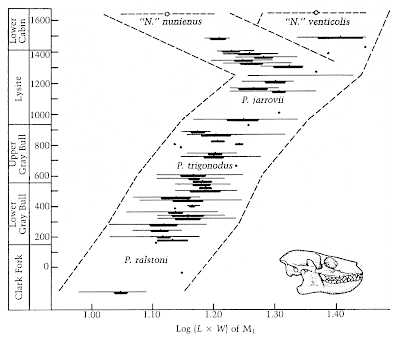
Here's Pelycodus again:

How many generations do you think are shown there?
One. One generation, many cousins. Many variations / cousins that lived at the same time and all died in the one same Flood.
Speciation can be taken as the boundary between microevolution and macroevolution, and this would be consistent with microevolution occurring within breeding populations. Generally, however, scientists don't worry so much about macro and micro, and prefer to talk about evolution and the resulting cladistic patterns.

What happens with speciation events is a division of the breeding population into two or more populations, each then free to evolve independently by microevolution within their respective breeding populations.
The ability of each population to evolve independently will continue as long as there is sufficient allelic variability for it. Back at that Creation there would have been much more than there is now so that such splits wouldn't lead to genetic reduction or depletion, even severe bottleneck splits, because all that now-dead junk DNA was functioning DNA back then. But at least since the Flood, and in more recent time, population splits may reduce genetic diversity quite a bit in a given species. The idea that microevolution just freely proceeds after such splits is the typical evolutionist assumption that doesn't recognize that these processes bring about reduced genetic diversity, which after many population divisions prevents further phenotypic changes from occurring at all. This is the basic folly of evolutionist assumption of open-ended evolution.
Creationist: No one seems interested that the best microbiology has been able to accomplish is 1+1=2. No one is interested in the boundries and limitations of mutational changes, or that just about all the changes involve loss of information. Information loss, cannot build anything new. Just faith that enough time can do the job.
Here the creationist is saying what I'm saying. Loss of information is really the same thing as reduced genetic diversity. Some alleles get left behind as new phenotypes emerge on the basis of the remaining ones. That's loss of information, although I think it's clearer to call it reduced genetic diversity.
RAZD: Perhaps that's because we've seen the evidence for 1+1+1+1+1+1+1+1+1+1=10 and know that your assertions are absolutely false.
This is just a bald assertion, where's the evidence he claims to have seen? He's not going to give any, but he'll ask the creationist to produce evidence instead.
RAZD: Of course you could try to prove me wrong by actually providing evidence of this mythic mutational barrier. See "Macro" vs "Micro" genetic "kind" mechanism? -- an 8 year old thread that asks for this mechanism, but which no creationist nor idologist has provided. Be the first
. And here's RAZD's challenge from that thread:
The whole system was supposedly set up during those original 6 days, so there must be a mechanism in place that prevents "macro"evolution ... what is the built-in biological mechanism that prevents this from happening? Where is it located? Why hasn't it been found?
Again, it's the fact that the processes of evolution can't simply keep on going because they eventually run out of alleles for genes. Evolution defeats evolution.
The creationist says: Anyone could look at old fossils and make relational assumptions. Especially if they are commonly designed.
RAZD: And those assumptions can be tested by applying the methodology of cladistics, and by having separate groups make simultaneous analysis and by comparing it with similar analysis using DNA.

Curiously this has been done, extensively. Guess what? They confirm each other. Can you tell me why the results are the same if the process is subjective
There is some sort of illusion involved in this whereby you are getting nothing more than a tautological echo of sorts. The method IS subjective. You are looking at traits and subjectively deciding how to group creatures according to their trait similarities and differences. As the creationist says, design similarity is a sufficient explanation for many similarities and your groupings can't show that it isn't simply design similarity you are grouping together. Studying DNA seems like it ought to produce an independent standard of some sort but in fact there is also a similarity of DNA design that reflects the similarity of phenotypic design and there is no way in any of this to establish actual descent from one to another.

The same is true of the supposed terrific evidence of "nested hierarchies" which gets discussed farther down the page. All this involves a subjective classification of external TRAITS, and descent is simply INFERRED, not proven.

Similar situation with RAZD's questioning the creationist about what constitutes a "large morphological change" as a definition of macro versus microevolution. The problem is that when you are dealing with morphology, just as with the nested hierarchies and the clades, it's all subjective judgment. And that includes the similarities that also are reflected in the DNA (there's bound to be a predictable correspondence between the DNA and the phenotype).
Do you want to see how large morphological changes occur and the evidence for them then you are asking for evidence of how the ToE explains changes observed in the fossil record and ends up with the diversity of morphological differences we see in the world today.

Of course, first you are going to need to define what you mean by "large morphological changes" as this is not a quantified description.

Do you think that the morphological differences between a house cat and a red fox are "large morphological changes"? Do you think they are differentiated by just a little or by lots of macroevolution?

Do you think a webbed foot is a "large morphological change" when the parents don't have webbed feet?
As long as this is all subjectively determined a creationist can say the difference between a fox and a house cat IS large enough to constitute a macro level of difference, and the evolutionist can say it isn't. But what does the DNA of the two creatures look like is the real question.

These things have to be determined at the genetic level. He asks if webbed feet from a nonwebbedfooted parent is a macro level difference or not, asking as usual for a subjective judgment of an observable trait. Seems to me it depends on whether there is the GENETIC possibility of webbedfootedness in the genome. Is there a gene for webbedness that exists in the genome or not? Is there more than one gene for the trait that could produce webbedness under certain conditions or combinations? Or allelic alternatives that could produce it? If there is then webbedness has to be one built-in variable for the particular species and is not a "large morphological change" or a macro level change. If not, then you aren't going to get webbedness in that species at all ever (except possibly as a mutation?) because it IS a macro level change that can't occur.

Wednesday, February 29, 2012

Just another Evolutionist PRATT, the usual paradigm-bound misconception of Speciation

Somebody just started a new thread at EvC titled An example of speciation in action? giving an example of reproductive isolation bringing about changes between two separate populations of a bird called a Blackcap. Differences in appearance between the two are minimal but differences in behavior are enough to keep them apart.

This is treated as some kind of wonderful event, at least a step on the way to macroevolution, which makes it just another evolutionist PRATT (Point Refuted a Thousand Times). I for one have answered it over and over both at EvC and on my blog, and I can't be the only one.

All this is merely one of the ways variation naturally occurs in species because of built-in genetic variability. It's nothing more than normal "microevolution," changes that are expected because of this built-in genetic variability, which can come about through anything that isolates a portion of a population from another so that they don't interbreed. Genetic drift within populations even does this but populations may also become physically separated from one another and go on to develop their own characteristics different from each other. This occurs because reproductive isolation brings about different gene frequencies in the new populations as compared to the original population. Really, it's to be expected that reproductive isolation would bring about changes between populations in this way. No mutations need be involved and there's no reason to suppose they are EVER involved.

It's simply a matter of different combinations or frequencies of alleles becoming characteristic in each of the separated populations. This is the natural result of the differences in gene frequencies working their way through each population over a few generations. Over time this brings about changes in the phenotypes characteristic of the new populations as a whole that differentiates them from each other more and more, sometimes to the point of approaching what the evolutionists would be inclined to call speciation. That depends on the degree of genetic variability that remains. The less genetic variability there is compared to the original population the more dramatic its changes will be, and the more likely it is that the populations will develop inability to interbreed with one another.

Is this speciation? This is an arbitrary definitional matter. It doesn't matter at what point population changes get called speciation, whether at this stage of practical differences bringing about lack of opportunity to interbreed, or behavioral disinclination to interbreed, or at the stage when isolation has brought about complete inability to interbreed because of genetic incompatibility, the effect is always that in isolation each population continues to elaborate its own separated gene pool and diverges further from the other.

Again, you don't need mutations to bring this about, merely different frequencies of alleles in each population.

And, as I've argued from the beginning of this blog, the result of these changes over time, especially with further splittings of the populations and further elaborations of the new gene frequencies brought about by the splitting, is reduced genetic variability that makes further evolution less possible, and ultimately impossible. The more evolution you have, the less evolution is possible. Evolution defeats evolution.

Oh well, they don't listen to such obvious simple contradictions of their beliefs. Maybe a creationist will come along and make the point eventually, and they'll ignore that too because they really don't care about science, only about justifying evolution.

But there's a brief statement of it just for the record.

========================
By the way, they often complain that creationists offer no evidence for many interpretations such as the above, without ever recognizing that they have no evidence for their opposing interpretations either, but have only the familiar just-so story line.

They interpret the changes brought about by reproductive isolation as steps in open-ended evolution, simply because that's what the theory requires, not because they have any evidence for it. To their mind the simple fact that such changes do occur IS the evidence -- evidence for the theory of evolution. But there is no evidence for the open-endedness of the change process itself, that's just assumed. Darwin assumed it and it continues to be assumed.

Likewise they assume mutations as the engine that keeps it all going because the theory requires such an engine. You can get different kinds of finches out of the built-in genetic complement that belongs to finches, but you can't get an iguana out of a finch without the input of new genetic material or "information."

So instead of even recognizing that there is such a thing as a built-in genetic complement that defines a species (which is really the definition OF a species or Kind at the genetic level, that elusive definition they keep haranguing us creationists to produce), they assume that ALL genetic material is constantly being created by the processes of mutation and natural selection. Again, there is no evidence for this, they have to assume it because the theory requires it.

As a creationist I interpret the changes brought about by reproductive isolation as the effect of shuffling the frequencies of alleles that belong to the built-in genetic complement for the species. There is a natural limit to the changes possible BECAUSE there is this original complement of genetic potentials that can only be shuffled and reshuffled. It CAN play out to less and less genetic variability down any particular line of variation brought about by reproductive isolation, especially a series of reproductive isolations such as in a ring species. What is called "speciation" is really the result of this reduced genetic variability. New phenotypes develop from new frequencies of genes, but reproductive isolation itself over time reduces the genetic variability. This can produce dramatic new phenotypes, but there is a point that is reached when further variation becomes impossible. You may have a striking new variation (they call it a new species) but it may have such reduced genetic variability it can't change any further at all. Yes, like the cheetah. Thus bringing the processes of evolution to an end for that line of variation.

Mutations are of absolutely no use in this scenario, they only interfere with it, and in reality that does appear to be what happens, which is evidence for the scenario right there -- thousands of genetic diseases, thousands of "neutral" mutations that have simply not produced anything identifiable (although they have to be deleterious because they change the genetic code, which was originally perfect), and a very few known "beneficial" mutations that are highly questionable. These are the facts, although the theory of evolution says the opposite and has to interpret them away, as by claiming the beneficial mutations made the entire genetic code so are therefore hard to detect. The known facts, however, are on the creationist's side.

I have also suggested a scientific test that could prove all this, which is more than the evolutionist side can offer. All they have is theory, elaborated by theory, multiplied by theory, developed by theory and validated by theory. Fantasy in other words. No evidence.