Showing posts with label Allele frequencies. Show all posts

Tuesday, March 13, 2012

Yes you DO get loss of genetic diversity with evolution Part 6

Percy's 6th:
Faith writes:
I’m simply repeating the FACT that selection and isolation, NOT MUTATION, are what bring about the new phenotype that characterizes a whole new population.
Faith, as long you continue to assert that mutation plays no role in speciation there will be no peace for you in this thread. People would not find it outrageous to argue that changing allele frequencies and permutational recombinations of alleles are a more significant factor over mutation in speciation. That would actually be a very interesting discussion. But to just declare that mutations have no role at all is once again to simply deny the real world, and assertions denying what is obviously true tend to draw many responses.
I suppose it could have gone in that direction except that people kept bringing up mutations. But there isn't really much more to say anyway. Changing allele frequences IS the formula for evolution after all, mutations only get stuck in there by debaters. If they are going to define my argument to say that changed allele frequencies are a "more" significant factor than mutatios this is going to keep requiring me to think about those nonexistent mutations anyway. How about just considering the situation without any mutations at all in the mix? They can pretend they are there but only being kept out of the discussion for now if they want.

But even by this point of the thread it's pretty clear my efforts at EvC are all over. And so endeth my last stint at EvC. Oh it limped on for a while but after this there is no point in going back. Ever. And of course they are going to go on ignoring my blog as well, although I'm sure some of them read it from time to time.

I've made the basics of the case: You don't NEED mutations to get new phenotypes, change in gene frequencies does that, and if you kept getting mutations after the breed was established you'd lose the breed. That much ought to be obvious to anyone -- except of course it isn't to evolutionists who are allergic to the implications of it.

But beyond those points, there is simply no such thing as a mutation that can form a healthy allele and they have no evidence for such a thing -- This is, again, merely an article of the faith that's necessary to the idea that phenotypic variation is open-ended, not limited to the Species. Again, all they have is theory, and they treat the theory as fact, without the evidence to justify it. But at least there is an existing stretch of DNA, the gene, for the mutation to work on, which gives them the illusion that it COULD be the source of healthy alleles, but there is nothing at all that can create a gene, the whole sequence of DNA itself that is the basic formula for a given trait.

My whole argument is pretty basic and obvious and would be recognizable IF they didn't keep throwing in the irrelevant baggage of evolutionism.

Breeders should recognize it, conservationists should recognize it. You don't get phenotypic change without a reduction of genetic diversity.

And that spells FINIS to Evolution.

Sunday, March 11, 2012

Yes you DO get loss of genetic diversity with evolution Part 5

Percy#5:
This is why there is no point in arguing any of this at EvC. Evolutionists apparently believe what Percy says here:
Every allele in existence today had its origin as a mutation to an already existing allele. Given that all alleles begin as mutations, how can you hope to prove mutations have no role in evolution? Alleles that have been around a while are really just old mutations, but we call them alleles. New mutations are alleles, too, but because they just happened we give them the special name of mutations.
Once things have been so twisted and misdefined where do you start to undo the mess?

Well, let's say this at least: You believe that mutations can create viable functioning alleles but all alleles do is provide interchangeable qualities for a given trait. The gene is for the trait of eye color, the allele makes it the specific color or contributes to the color; the gene is for the trait of ear shape, the allele determines the actual shape or contributes to it. But evolution needs a lot more than variation in traits, evolution needs whole new traits, whole new genes. It's easy enough to see that mutations change the existent sequences of genes, but what makes new genes?

and the next thing to say is: THERE IS NO EVIDENCE THAT MUTATIONS EVER DO ANYTHING BUT INTERFERE WITH A NORMAL FUNCTIONING ALLELE. And I guess I'll have to find some evidence for that somewhere, the Lord willing, and He'll have to help me because most of the stuff out there in Somewhere is corrupted by evolutionist insanity.
[Faith] If you increase the diversity you simply interfere with the development of a new phenotype.
[Percy] Do you understand that this is the same as saying that a new allele, one that isn't the same as any other allele in the newly isolated population or in the original population, hinders the emergence of a new phenotype? If so, you realize this makes no sense, right? You do understand that mutations make the newly isolated population even more different from the original population, right?
Oh brother. What a morass of confusion.

First there ARE no completely brand new unique alleles in the new population, because no such thing ever occurs, this is all a fantasy invention by evolutionists. Mutations do nothing but corrupt, mangle, deform and destroy. Whatever shows up as new in the new population has always been there but the new gene frequencies brought about by the population split have allowed this formerly less expressed or completely repressed allele --or combination of alleles -- to come to greater expression in the new population. THIS allele or combination isn't the thing doing the hindering, this what the new phenotype is based on. What HINDERS is alleles that COMPETE with this new phenotype, such as the alleles that were left behind in the old population and overshadowed it there, and are in much smaller numbers in the new population but if they came to dominate would overshadow it here too. You'd have a different trait or a reversion to the former trait picture rather than a new phenotype. Later on a NEW allele would ALSO interfere with this phenotype. If it's a breed you are trying to keep pure you don't want that to happen; if it's a "species" in the wild then it is simply now something other than that species.

Obviously I misspoke: It's not about the "development" of a phenotype but the maintenance of a phenotype. If you increase the diversity you interfere with the phenotype that is now established. If it is a domestic breed you do not want alien alleles interfering with it. This is all I'm saying.

And no, it is not MUTATIONS that "make the newly isolated population more different from the original population", it's the emergence of formerly suppressed alleles and combinations of alleles that bring about these differences, which is the result of the new gene frequencies. Hey, isn't this change in gene frequencies the very stuff of evolution according to generations of evolutionist teachers? You don't need brand new alleles, just the new frequencies.
[Faith] If mutations or gene flow or any other source of variation kept intruding on this process you would not get these clear established phenotypes.
[Percy] Why not, Faith? You said you were going to prove this. So go ahead and prove it.
Good grief this stuff is so OBVIOUS but there seem to be a dozen ways to twist the meaning of words to make them mean things I don't mean. It's SO simple -- GENE FLOW INTERFERES WITH THE PURE EXPRESSION OF THE VARIETY /BREED /SPECIES. Yikes! The way any species maintains its character or its integrity you might say is by being reproductively isolated from others, this is population genetics 1A. Gene flow interferes with that integrity. How hard can something so simple, and well known for that matter, be made anyway? If mutations DID create alleles, the same problem would keep happening, you could never GET an established identifiable breed or species, because they depend on a stable genetic substrate.

Let me quote Wikipedia on Zygosity again:
True breeding organisms are always homozygous for the traits that are to be held constant.
Are species true breeding organisms or not? (Here I'm using "species" the way evolutionists do)

What a travesty of communication this mess is. I may have botched my presentation enough to contribute to the confusion, but for sure my antagonists were frothing at the mouth to say anything at all against my argument whether they got my point or not -- and Percy obviously didn't -- and say something insulting on top of that.

Yes you DO get loss of genetic diversity with evolution Part 4

And yet another one from Percy:

Hi Faith,
...what I was responding to was that any evolution can only result in reductions in variation. As everyone's been telling you, variation can increase or decrease.
I'd NEVER say "reduction in variation" unless I had a major lapse, I ALWAYS mean "reduction in genetic variability." And evolution DOES only result in reduction in genetic variability. What do you mean by "variation?" If you mean genetic variability or diversity, no it cannot and they have NO evidence that it EVER increases. If you mean variation of the phenotype yes of course you can have more or less of that but I wouldn't talk about it without a modifier to make it clear that's what I'm referring to -- or I hope I wouldn't.

The formula is that AS PHENOTYPIC VARIATION INCREASES, GENETIC VARIABILITY DECREASES.

OK, I can see that mutation appears to be the explanation for all change in the minds of evolutionists here...
The reason I mentioned mutation is that the sum total of all alleles in a population is the amount of variation,
This conversation has already gone off the rails in a most frustrating manner. By using the term "variation" the whole meaning of what I'm saying has become muddied. Is he talking about phenotypic variation, which could be said to be the sum total of all the alleles, or is he talking about genetic variability which could also be described the same way. Depends on what you have in mind and I can't tell in this case.
and only mutation can increase the number of alleles.
Absolutely true, that's why evolution needs mutation, it depends on genetic increase, without it there is no evolution beyond the Species. But Creationism does not need mutation, all the necessary genes and alleles for each Species were built in back at the Creation, all quite sufficient for the purposes of huge variation at the level of microevolution.
Natural selection can affect allele frequency, and indeed one way to define evolution is as changing allele frequency over time, but only mutation can increase the number of alleles and thereby increase the amount of variation.
Absolutely true, as I've been saying.
The reason people are bringing up mutations isn't because they think it is the source of all evolutionary change, because obviously it isn't the only source. They're bringing it up because it is the only way to increase variation.
How on earth have I failed to be clear that I know this already? Evolution NEEDS mutations, that's why they've imagined them into existence.
Mixing and remixing the same set of alleles can create unique combinations of alleles that didn't previously exist, but it doesn't change the pool of existing alleles at all.
Well duh.
Almost no reproduction is perfect. Even people have mutations. The average number of mutations per person is usually estimated at between 10 and a hundred. Ignoring mutation might make it easier to claim that variation can never increase, but the real world has spoken.
There is no evidence whatever that normal alleles are created by mutations, this is merely an article of faith to evolutionists. Mutations are mistakes, they only interfere with alleles, change their sequence, sometimes with no observable effect but often so that they don't function as they were meant to, create diseases, and ultimately kill off many of them, which then become junk DNA.

That thread at EvC was a disaster.

Probably my own fault. I wasn't prepared for the aggressive attack, out of practice I guess.

Yes you DO get loss of genetic diversity with evolution Part 2

Percy again:
Faith writes:
[I'm] constructing an argument to show that selection and isolation single out a particular trait by eliminating all its competition and ultimately make that trait characteristic of a new population that emerges from these processes.
This argument couldn't be more wrong. The alleles for a gene are not involved in a competition where only one is left standing.
Sigh. The main problem seems to be getting it said so that we all at least know what I'm saying. I often use the most extreme example of the point I'm trying to make to indicate the DIRECTION that ALL these processes move in, I'm not trying to hang EVERYTHING on the extreme. Sigh.

It's the PATTERN I'm trying to focus on. Getting a new phenotype, a new variation, a new "species" as evolutionists think of it, REQUIRES that alleles for OTHER (yes, "competing") phenotypes / variations / species be either greatly reduced in the population or eliminated altogether -- the fewer the better for the establishment of the character of the new variation / phenotype / species.
If that were the case then extinction would be an extremely common event because a species ability to survive across changing environmental landscapes is dependent upon variability. Great variability increases the likelihood that at least some subset of a population will survive an environmental change.
Yes, genetic variability IS important for the health of a species, but maintaining genetic variability means NOT EVOLVING. The way you get NEW TRAITS, that is, EVOLUTION, is by isolating the alleles for those traits in their own population and that means ELIMINATING alleles from that population that would bring about different traits. This is how domestic breeding does it and it is also how Nature does it, whether by Natural Selection or Genetic Drift, Bottleneck or a series of population splits over generations with migration and reproductive isolation etc etc etc etc. You won't get a population specifically characterized by green and red striped fur if that population includes individuals that carry alleles for purple and yellow splotched fur.

And such variation does not always threaten extinction although it may at the extremes. However, some animals seem to thrive even with extreme genetic depletion, the elephant seals, even the cheetah does OK considering, etc.
If it were really true that more beneficial alleles eliminate those that are less beneficial or even deleterious then alleles for genetic diseases would have disappeared long ago, and yet genetic diseases like cystic fibrosis persist.
The idea that the alleles must be "beneficial" comes from the Evolution Model. On the contrary, I think accidentally or randomly isolated alleles are probably the more typical foundation for new varieties, they need have no specially "beneficial" properties. They may or may not adapt to a particular niche later. Nature loves variety.

And the alleles that are eliminated still belong to former / other populations /varieties of the same species, it's not as if they died out completely except in some rare extreme cases, it's just that they no longer belong to the population of this new phenotype. The population under discussion may have red and green striped fur while another of the same species has the alleles for purple and yellow blotched fur that would wreck THIS particular variety and vice versa. You don't want Dachshund alleles in the Great Dane breed or vice versa, but alleles for both remain in the dog Species as a whole.
You need to find solutions consistent with both your religious views *and* reality.
Sigh.

Well, I may continue with this attempt to answer objections to my argument here, but just this much dealing with it, even sticking to one antagonist to keep confusion to a minimum, makes it quite clear why I have no interest in being back at EvC. I guess the best construction to put on the problem is that it's a paradigm clash. I'm always talking from my Creationist presuppositions, and although I keep trying to spell those out as I go, the contrary Evolutionist presuppositions are so rigidly held there's little hope of penetrating the fog.

Yes you DO get loss of genetic diversity with evolution Part 1

Getting anyone to accept my claim about reduced genetic diversity, obvious though it is, is the real battle here unfortunately. So let's go back to my last thread on the subject at EvC and see if it's possible to make any headway on it:

Here's Percy's opening gambit on the subject on that thread:
Genetic diversity can go in any direction after reproductive isolation. For example, consider a relatively homogeneous population that becomes divided in two when a river changes course. There are now two populations, both with pretty much the same alleles and allele frequency. Mutations experienced in one population will no longer be shared with the other and the populations will evolve along different paths. If this continues for a sufficient period then they could lose their mutually interfertile quality and become two species.
Let's take it step by step:
Genetic diversity can go in any direction after reproductive isolation.
Of course I am claiming that genetic diversity can NOT go in "any direction" after reproductive isolation. It CAN remain more or less stable for long periods, but otherwise it can ONLY decrease; it can NOT increase. This is of course based on the Creation Model I've spelled out in earlier blog posts, that denies the mutations which are needed by the Evolution Model. Mutations are the ONLY way it could increase.

But to get off the hypothetical and bring this down to a question of evidence and fact, I'm claiming that it DOESN'T increase, and that ought to be provable with the DNA sampling test I've suggested.
For example, consider a relatively homogeneous population that becomes divided in two when a river changes course. There are now two populations, both with pretty much the same alleles and allele frequency.
Of course if you posit a split into two populations that retain the same character as the original I wouldn't expect to see much change either. This is not a scenario that leads to evolution and all I'm talking about is how evolution -- or variation or the production of a new phenotype -- leads to reduced genetic diversity.

This situation would exist if the two new populations are appreciably different in size and/or have appreciably different gene frequencies -- which is in fact more likely to occur in a smaller population. That's when you get the beginnings of the phenomenon I'm talking about. The larger may change too to some degree because its gene frequencies will have changed also, but not to the extent of the smaller one.

But evolution always has to invoke (beneficial) mutations, those imaginary changes in the DNA that fuel the changes the theory requires.
Mutations experienced in one population will no longer be shared with the other and the populations will evolve along different paths. If this continues for a sufficient period then they could lose their mutually interfertile quality and become two species.
Of course there is no evidence that this happens at all. And the Creation Model has no need of them as there are plenty of built-in genes and alleles to bring out all kinds of variations in any Species.

1. Mutation is not needed, the original genetic endowment of each Species fuels all possible variations of that Species.
2. There is no evidence for it, it's purely an article of faith.
3. Where there is evidence of its existence, its effect is either neutral or deleterious, which the Creation Model explains as due to the Fall which brought death, disease and deformity to all living things.
If both populations thrive then diversity could increase in both.
There is no way that GENETIC diversity ever increases after reproductive isolation -- not just "diversity" as PHENOTYPIC diversity is something else, and as my formula has it, phenotypic diversity increases as genetic diversity decreases. I don't know how to prove this as making charts of combinations of genes and alleles quickly gets beyond me, but keeping the Creation Model in mind ought to make it intuitively obvious. One argument I've made is that it ought to be obvious that increases in genetic diversity would prevent ever establishing a domestic breed as its character would always be threatened by the input of new alleles.

As I quote in a post below, from the Wikipedia article on Zygosity:
True breeding organisms are always homozygous for the traits that are to be held constant.
Homozygosity for an entire population is of course the extreme of genetic depletion, also known as "fixed loci" in which there is only one allele in the entire population for the given gene. It's the same situation that Nature has brought about in the cheetah and the elephant seals and the North American bison. It's the FORMULA for getting a new phenotype. It's EVIDENCE that what i'm saying is correct, that you MUST have reduced genetic diversity IF you are to get EVOLUTION.

And again it pertains not just to domestic breeding but also to varieties in the wild -- the beaks of Darwin's finches couldn't be counted on to be stable even if they had been brought about by Natural Selection, they'd always be subject to change that would interfere with their relationship to their environmental niche. In other words an increase in genetic diversity ALWAYS interferes with EVOLUTION. You get evolution or the development of new phenotypes / varieties as you lose alleles for competing traits, which means a decrease in genetic diversity. For a finch population to be characterized by a beak that can crack nuts means it has to NOT have the alleles for beaks that can penetrate small narrow spaces. It could be that an all-purpose beak would work fine and dandy, but the theory says that you get these specialized beaks by natural selection so that they can adapt to their particular ecological niche and since that does appear to be the case they must have alleles FOR their particular adaptation and NOT have the alleles for the other adaptations.

I know I argued this to death on that thread to deaf ears and here I've barely gotten through this one post from Percy. Oh well, might as well keep at it for a while at least.
But if one or both populations suffer some disaster such as flood or famine or an invasive predator or disease that greatly reduces population size, then diversity would be reduced. It all depends upon what happens to the populations.
No, it doesn't ALL depend on that although such events would certainly have an impact. The point I want to keep in mind here is CHANGE IN GENE FREQUENCIES. Many things can bring this about; what brings it about isn't the important thing but simple population splits are usually quite enough for the purpose.

Saturday, March 10, 2012

Speciation + Evolution = LOTS of Trait Diversity with LOSS of Genetic Diversity leading to end of ability to evolve

Another one from RAZD at EvC, Speciation + Evolution = More Diversity
The scene: sitting at computers all over the world ...
"Why don't creationists understand evolution -- it is so simple," the evolutionist wails:

1. Evolution - the change in hereditary traits in populations from generation to generation - is an observed and documented fact, a process that occurs constantly in the natural world around us, and

2. Speciation - the division of parent populations into reproductively isolated daughter populations - is also an observed and documented fact, a process that occurs frequently in the natural world around us.
These two simple processes are sufficient to explain the diversity of life we know, from the world around us, from history, from prehistory and archeology, from geology and physics and paleontology and the fossil record, and from chemistry and the genetic record.
Well, it sounds good on paper, I guess, as theory at least, but unfortunately it fails in reality. Yes, there is an "evolution" by which heritable traits change from generation to generation, but this has never been observed beyond what we call "micro" evolution, or evolution within the genetic limits that define each species, and in fact it can't occur beyond microevolution for the reasons I've given over and over here, which are the same reasons there is no evolution beyond speciation. And yes, speciation is also a documentable fact, but it always occurs with loss of genetic diversity, even to the extreme of fixed loci or total homozygosity for some traits in the population, which makes further evolution beyond speciation purely a pipe dream.

But RAZD just goes on asserting the theory, the pipe dream, as if it were reality, as they all do.
We can even see how evolution causes speciation with Ring Species:

1. the species forms a band made up of several varieties around some barrier to their survival ability,

2. each of the varieties has slightly different hereditary traits from their neighbors,

3. each reproduces with their neighbors in hybrid zones that show a mixing of the hereditary traits of the two neighbors, except that

4. when they meet on the other side of the barrier, the two ends do not mate.

Evolution results in different hereditary traits developing in each of the areas dominated by the different varieties, differences that do not hinder mating until they reach a certain threshold - the difference between the end varieties.

Yes, pretty much but as long as he sticks to the level of traits -- of the phenotypes, of the different observable characteristics between the populations -- he misses the reason what happens happens: The splitting of the populations changes the gene frequencies. When new traits emerge this is because alleles for competing traits have been reduced which can proceed after many population splits to the point that they are completely lost to the new population. After a series of splits the genetic diversity may be quite drastically reduced, and the main reason there is no interbreeding between the first and last populations is the genetic incompatibility that has developed by then.

Again, my prediction is that if you sampled the DNA of the first and last populations (better done in a laboratory where you can sample the first before it too undergoes change), you should find much greater genetic diversity in the first and much reduced diversity in the last, more heterozygosity in the first, more homozygosity in the last, particularly for the traits that are most characteristic of the populations.
Remove any one of the intermediate varieties, so that the band is broken, and you have two distinct species.
We now have more species than before, so life is more diverse. It is so simple:

Evolution + Speciation = Diversity
Way TOO simple, RAZD. Yes you do have more diversity of TRAITS, but you are simultaneously getting REDUCED diversity of GENETIC POSSIBILITIES. This is all just the usual evolutionist daydream based on surface facts completely ignoring what is going on genetically, which is the NECESSARY reduction of genetic diversity, which occurs with EACH splitting off of a portion of the population to form a new population. This is a trend that can keep producing new phenotypes for some time by losing more alleles, but can ultimately arrive at such genetic depletion that no further phenotypic change is possible, a condition like that of the cheetah. Not that this degree of depletion is inevitable, but reduction in that direction certainly is.
This little scenario depicts, I believe, the state of many debates between creationists - people that predominantly use faith to understand the world - and "evolutionists" - people that predominantly use science to understand the world.
What "this little scenario" actually depicts is evolutionist reliance on wishful thinking as they spell out what they THINK happens, because they haven't really faced the GENETIC PICTURE which is working against their all-too-sanguine expectation that change in traits can just go on and on without genetic cost. It really is a daydream, a fantasy. And it's quite the joke that they are constantly claiming to appeal to EVIDENCE and accusing creationists of relying only on faith.

(I skipped his caricature of the creationist response to the above because it is a distraction from what I'm trying to say here.)
Where does "large" change come from? - the change that makes giraffes so different from kangaroos? Simple:

Speciation - the division of parent populations into reproductively isolated daughter populations - is also an observed and documented fact, a process that occurs frequently in the natural world around us, and

Evolution- the change in hereditary traits in populations from generation to generation - is an observed and documented fact, a process that occurs constantly in the natural world around us.
SO simple as long as he just goes on daydreaming about the surface traits and imagining that there are no limits to change.
Speciation + Evolution = More Diversity
After speciation has occurred, the daughter populations no longer share genes through reproduction, and they are free to evolve completely different traits.
Yes, and this lack of sharing of genes means a LOSS OF GENETIC DIVERSITY. Yes, they ARE "free to evolve copletely different traits" but this is ALWAYS made possible by the loss of competing alleles for those traits, which is completely ignored by evolutionists. You can always get new traits BY LOSING competing alleles, but if the population splits that bring this about continue to occur, eventually a point will be reached where you can't get new traits any more because you'll be completely out of alleles. Speciation may not always mean genetic depletion but it certainly means genetic reduction from earlier populations particularly where the main new traits are emerging.
The likelyhood is high that one of them will become quite different, either to inhabit a new ecology that the other is not as well suited to (could have caused the original split), or to make use of the existing ecology in a different way, and this will lessen competition between the two species rather than drive one to extinction.
Lotta sheer conjecture there. It really isn't even necessary to posit environmental or situational reasons for trait changes or even the population splits themselves. Migration will bring about splits and the splits alone will bring about trait changes. The fewer individuals at the start of a new population the bigger the observable trait changes, the ecology is not likely to have much to do with it. It may be that both populations still have sufficient genetic variability even to undergo several further splits if necessary, but since he's completely ignored the whole question of what happens to the genes while focusing on the traits and fantasizing endless change he's going to miss the state of genetic depletion also when it does finally occur after more population splits.
Continued evolution of daughter populations along different ecological paths results in increased diversity - difference - between them over time. That is how the small amount of difference we seen below can become the amount of difference we see between other bird species.
Again, overrated influence from the environment but this is really a side issue, but anyway, the increased diversity is completely the result of the change in gene frequencies brought about by the population split. If the environment contributes an influence that further impacts the population numbers or reproductive isolation and therefore the gene frequencies, then it will contribute to the trait differences between the populations as well, but again, there is no need for this to happen in order for even great differences to come about as the change in gene frequencies alone will do it.
Continued evolution causes more change - in each population, from generation to generation to generation
Along with change in gene frequencies which can rapidly reduce and even eliminate some alleles as the changes continue, to the point that you run out of alleles for enough traits that further change is impossible, probably a very interesting new population with new traits but no more genetic variability.
That should be enough for starters. There is more to discuss about where change occurs, but this is long enough for now. This thread is about evolution after speciation.
A total pipe dream I'm afraid, as speciation is most likely to occur at the very outer edges of the genetic variability of the species, thus preventing further evolution.

Loss of Genetic Diversity same as Loss of Information: Both prevent macroevolution. Evolution Defeats Evolution

[NoNukes says]: A creationist might state that nature cannot create the "information" required to produce novel features and "macroevolution" . Dog breeding includes human intervention which can be viewed as being similar to an ID agent stepping in to add information allowing new features like wiener-dog legs.

I don't really grasp the context of the issue of "novel" characteristics so I'm not sure how to address that, but I can respond to the idea of "information" at least.

Apparently this is easily misunderstood, and I have to agree that the very term "information" is vague or even cryptic in a way. The idea is really pretty simple though, from a creationist point of view anyway. You have a given built-in genetic recipe from the Creation for each species, so the possibility of that species evolving into another would require the addition of whatever is lacking in the first that the second needs. That's the "information" that would have to be added to the genome for it to macroevolve. Perhaps I don't even need to invoke the original Created species for this to make sense. It should be apparent to all that each species does have its own genome, many of which are in the process of being sequenced, and they are being sequenced AS being specific to the particular species they belong to. The DNA for each species has its own characteristics peculiar to that species, genes that aren't found in some other species but only this one, a certain number of chromosomes particular to the species and so on and so forth, with of course occasional exceptions. The genes pertain to the particular trait, perhaps eye color, the alleles define the different qualities of that trait, in this case the color. Wherever there are many alleles for a trait you can get a great variety from the genome as given for that species, you don't need to add alleles. Macroevolution requires getting from these recognizable species to something completely outside the particular genetic recipe, whether you think of them as having evolved to their present identity or been created independently at the Creation. You still have to posit the addition of NEW information that is not already present in the current genome.

New genes at least. New alleles isn't enough. New alleles for extant genes could only give variation to the trait the gene instructs for.

So has anybody ever shown the formation of a new gene? Is there even a theory about how that might come about?

In any case, the whole idea of the need for more information really starts as an observation that the processes of evolution ELIMINATE INFORMATION rather than adding it, and that fact means that evolution is moving in a direction that makes evolution less rather than more possible.

But I think it's clearer to say that evolution reduces genetic diversity. It's really the same observation. Evolution eliminates alleles at the very least and at some extremes may eliminate ALL alleles for a given gene which effectively kills the gene and most probably makes it a corpse in the genetic graveyard known as Junk DNA.

This IS the natural direction of all evolutionary processes. In order to get a new phenotype, especially one that sticks and becomes characteristic of a new population or variation or breed, other alleles for the same traits that give a different character MUST GO. That's LOSS OF INFORMATION, or REDUCED GENETIC DIVERSITY.

THIS LOSS IS THE VERY MACHINE OF EVOLUTION ITSELF.

Now here comes RAZD answering NoNukes:

Curiously, the mutations that cause short legs are fairly common in many species, including humans - it's called Dwarfism.
So is RAZD saying these mutations are NEW information?

I must ask, how does he know these are mutations? He gives no evidence, he merely CALLS the allele that bring about this trait mutations. Evidence please. I'm willing to consider this a mutation myself just because dwarfism must be thought of as a disease process, which I KNOW mutations produce. But are all shorter legs caused by dwarfism or is it simply possible to get a combination of naturally occurring (built-in) genes/alleles that naturally produce shorter legs? Evidence please.
The difference is between a random mutation occurring and it being spread into the breeding population is selection.
Pure theory, which is all evolution ever has to offer. Is he talking about useful / beneficial mutations, and if so nobody has ever shown that they even occur except in very rare and problematic instances, they are merely ASSUMED to be the source of all change in the genome. But if we are talking about nondeleterious variations the most likely scenario is that a rare normal allele simply comes to expression, and then yes, it will spread in the population if it is selected in the reproductive lottery. If not, it won't. But to call it a mutation is simply to beg the usual questions.
Within the ecological challenges and opportunities imposed by artificial selection, there is a survival and reproductive benefit to having short legs for the dogs being bred that have them, and not having them would be detrimental. This is a rather demanding ecology to survive in, yes?
Could be, depends I suppose. But we still don't know if this is a mutation or simply a normal-occurring healthy allele.
Now the problem with the creationist\IDologist claim about information is that they don't define what the concept means
Well, it's difficult, but I believe I may have succeeded in defining it above. And I vote for substituting the concept of reduction or loss of genetic diversity as being easier to grasp.
or even more importantly, how it can be measured.
As I've proposed, do a DNA sampling of the first and last populations in a ring species, one you find in nature or one you create in the lab. You should find obvious reduced genetic diversity in the last population and probably a progression of reduction in intermediate populations as well. Lots of homozygosity in the last population, a lot more heterozygosity in the first. Go gather a bunch of salamanders from the California ring species, label them and sample their DNA especially the genes for the patterns on their skin.

He goes on to give an irrelevant self-fulfilling chart he claims falsifies the claim about loss of information. He's probably misreading a built-in allelic possibility as new information but it's all just an exercise in proving what he wants to prove.

No, do what I suggest above, see that there really is loss of genetic diversity (same as loss of information) when species evolve. That kills MACROevolution right there.

Evidence for Reduced Genetic Diversity as Necessary Component of Evolution

You want some evidence for the claim that evolutionary processes always involve the reduction of genetic diversity? It's pretty simple, OUGHT to be obvious, and it's all about the reduction of heterozygosity to homozygosity or even less: This is from Wikipedia on Zygosity:
A cell is said to be homozygous for a particular gene when identical alleles of the gene are present on both homologous chromosomes.[2] The cell or organism in question is called a homozygote. True breeding organisms are always homozygous for the traits that are to be held constant.
In nature the same thing applies. Once you get a new variety, a subpopulation that is reproductively isolated from its parent population or other populations of the same species, even the result of a "speciation" event, and especially after it has inbred over some generations, its traits are going to be or become fixed. For a new trait to stick, or continue to characterize the new population, competing alleles for that trait must have been eliminated from that gene pool. THIS IS THE NECESSARY REDUCTION IN GENETIC DIVERSITY THAT ALLOWS A NEW TRAIT TO COME TO CHARACTERIZE A NEW BREED OR POPULATION IN THE WILD, THIS MUST OCCUR FOR A NEW TRAIT TO DEVELOP AND STICK IN A NEW POPULATION.

If they are "true breeding", they will be homozygous for their characteristic traits. This HAS to be true whether the population is the result of natural processes such as natural selection or genetic drift, migration and so on, or domestic breeding decisions.

HOMOZYGOSITY MEANS ONLY ONE ALLELE FOR THE GENE, ALL THE OTHER ALLELES HAVING BEEN ELIMINATED FROM THAT PARTICULAR GENE POOL. THAT'S THE SEVEREST CASE OF DECREASED GENETIC DIVERSITY (except for hemizygosity and nullizygosity, mentioned in the article below) AND IT'S NECESSARY TO GETTING A "TRUE BREED." AND WHAT IS A TRUE BREED BUT A NEW PHENOTYPE OR "SPECIES," A SPECIATION EVENT IN ITSELF, THE SUPPOSED STEP ON THE WAY TO OPEN-ENDED EVOLUTION FROM ONE SPECIES TO ANOTHER ACCORDING TO EVOLUTIONISTS.

Take dogs. If you want a Dachshund you have to eliminate all the alleles that specifically produce Great Danes or Golden Retrievers or Chihuahuas etc. If any of those alleles show up in the Dachshund breeding program you'll get a less perfect Dachshund. They make the breed less than what it is supposed to be.

It works the same way in nature, maybe through Natural Selection but probably more often through random events that simply happen to separate a population into two or more subpopulations. A particularly marked salamander emerges because the other markings are genetically decreased by comparison to those for the new marking. The markings of the last species to develop in a ring species of such salamanders should be genetically homozygous. Same with the genetics underlying the last species in the ring of green warblers and so on. You should find decreased genetic variability and probably a lot of homozygosity, just because this is what evolution DOES.

It's NECESSARY to evolution, and if evolutionists weren't always imagining nonexistent mutations into the mix it ought to be obvious even to THEM. The only mutations that are involved are those that contribute diseases to the mix and interfere with the health of the most genetically reduced populations, even to extinction in some cases.

In nature the introduction of disease elements may simply eliminate a new variety, Natural Selection in operation at its most severe, but if the new variety finds a niche it can adapt to it will survive just as a good domestic breed will.

The new variety necessarily comes through a reduction in genetic diversity. That's how evolution WORKS, really, though such an obvious necessity, that must lead to LESS ability to evolve, is simply ignored by believers in evolution who go on spinning evolution out of imaginary mutations.

To repeat the point: If circumstances are such that the populations remain reproductively separate, meaning without gene flow or the sharing of alleles between them, each will develop its own particular characteristics, and as long as there remains no gene flow or reproductive contact between the populations those characteristics will remain. For them to remain means that the alleles for different characteristics have been eliminated. That's what decreased genetic diversity MEANS. This may amount to actual speciation, but at least certainly at the extremes you do get speciation, where the new characteristics are preserved because there is a complete lack of interbreeding with former populations.

Evolutionists regard bottlenecks as events that interfere with the processes of evolution, but they shouldn't. The elephant seal and the cheetah which were produced by severe bottlenecks -- reduction of their former populations to just a few individuals -- that severely reduced their genetic diversity -- really ought to be considered to be examples of speciation, nature doing what domestic breeders do. Bottlenecks are really just one way new varieties or breeds are brought about in nature or in domestic breeding. ALL the processes of evolution tend in the same direction, genetic drift, migration, natural selection, just not as rapidly. Domestic breeding in the past could be described as the artificial creation of genetic bottlenecks for the purpose of developing desired traits for new breeds. You select the desired character and take pains to breed only with others that possess that character. Since a rigid adherence to this formula also usually brings disease problems into the breed, breeders today take care to avoid the most severe bottleneck methods with the most severely decreased genetic variability by mixing with more vigorous but less desirable animals as far as the target trait is concerned, but if it weren't for the threat of disease, these severe methods would be considered the most reliable way of producing the best breeds. SPECIATION.

Yet here we have RAZD at EvC carrying on as if the evolution processes just go on and on producing new phenotypes or varieties or breeds, even past speciation which he treats as the end point of microevolution and beginning of macroevolution, but afterward the same changes continue without a hitch in his scenario.
What separates (micro) evolution from the macro view of evolution (macroevolution) is the process of speciation, as evolution occurs within the breeding population, and nested hierarchies are formed by speciation events, and macroevolution is just a macro view of what occurs over several generations via evolution and speciation.

If we look at the continued effects of evolution over many generations, the accumulation of changes from generation to generation may become sufficient for individuals to develop traits that are observably different from the ancestral parent population. This lineal change within species is sometimes called phyletic change in species. This is also sometimes called arbitrary speciation in that the place to draw the line between linearly evolved geneological populations is subjective and because the definition of species in general is tentative and sometimes arbitrary.
See, he's simply ASSUMING the open-endedness of evolution, the phenotypic changes just go on and on, a neverending ACCUMULATION of changes. He has no evidence for this, though he has charts that give it an aura of authority that are simply meaningless reflections of his false belief. Actually, they are ILLUSTRATIONS of what he believes, they provide nothing in the way of evidence for any of it. And everything he says is also all assumption without evidence. Dawkins does the same thing with his ridiculous computer models of how evolution works, simply programming in his own bias, his assumption of open-ended changes. Sometimes you'll see an evolutionist acknowledging that reduced genetic diversity can sometimes be a problem but they keep that information off in a separate mental compartment, it's something that occurs only with bottlenecks, in extreme scenarios that interfere with evolution, not with evolutionary processes themselves.

Just for the record, here is the most pertinent part of the Wikipedia article on Zygosity:
Types
The words homozygous, heterozygous, and hemizygous are used to describe the genotype of a diploid organism at a single locus on the DNA. Homozygous describes a genotype consisting of two identical alleles at a given locus, heterozygous describes a genotype consisting of two different alleles at a locus, hemizygous describes a genotype consisting of only a single copy of a particular gene in an otherwise diploid organism, and nullizygous refers to an otherwise-diploid organism in which both copies of the gene are missing.

Homozygous
A cell is said to be homozygous for a particular gene when identical alleles of the gene are present on both homologous chromosomes.[2] The cell or organism in question is called a homozygote. True breeding organisms are always homozygous for the traits that are to be held constant.

An individual that is homozygous-dominant for a particular trait carries two copies of the allele that codes for the dominant trait. This allele, often called the "dominant allele", is normally represented by a capital letter (such as "P" for the dominant allele producing purple flowers in pea plants). When an organism is homozygous-dominant for a particular trait, the genotype is represented by a doubling of the symbol for that trait, such as "PP".

An individual that is homozygous-recessive for a particular trait carries two copies of the allele that codes for the recessive trait. This allele, often called the "recessive allele", is usually represented by the lowercase form of the letter used for the corresponding dominant trait (such as, with reference to the example above, "p" for the recessive allele producing white flowers in pea plants). The genotype of an organism that is homozygous-recessive for a particular trait is represented by a doubling of the appropriate letter, such as "pp".

Thursday, March 8, 2012

Genetic Evidence of the Bottleneck at Noah's Flood Part 1

Well, hi de ho, somebody finally decided to try to have a discussion about the claim that the bottleneck of Noah's Flood should have left genetic evidence that it didn't leave. I've many times wondered exactly what evidence they think they would find, so let's hope somebody finally defines it.
In several threads, Jar has brought up the genetic bottleneck argument against the biblical flood and it appears to me to be a slam dunk of an argument. So I thought it was worth expanding on it and teasing out the details.
Sure, go for it.
Perhaps we should start with when creationists think the flood happened (my bold).

When was Noah’s Flood? 1,981 years to AD 0 plus 967 years to the founding of Solomon’s Temple plus 480 years to the end of the Exodus plus 430 years to the promise to Abraham plus 75 years to Abraham’s birth plus 350 years to Shem’s 100th birthday plus 2 years to the Flood. The Biblical data places the Flood at 2304 BC +/- 11 years.
http://www.answersingenesis.org/...v4/n1/date-of-noahs-flood

So this is about 4,300 years ago. (Maybe other dates around that time will be claimed but a bottleneck should still be apparent.)
I sometimes round it to 4500 years ago but 4300 is more accurate though a couple hundred years isn't going to change the evidence anyway.
Because all existing species have descended from so few individual so recently, their genomes should be very, very similar to each other - simply because all members of the same species would be close cousins.

Species that we know have undergone a bottleneck, such as the elephant seal and the North American bison - which were hunted to near extinction - and the cheetah, which appears to have also gone through a bottleneck 10,000 years ago, show this genetic fingerprint. In the cheetah's case their genetic variance is so small that their immune systems have so much in common that skin grafts aren't rejected between individuals.
So is this the sort of evidence you'd be looking for? Many fixed loci such as the cheetah's? Is this the "genetic fingerprint" you have in mind?
Jar's argument goes that if all animals and plants on earth (with the possible exception of some fish which may have been able to survive salinity changes) were reduced to either pairs, or sometimes a few more of each species (I don't see how 'kinds' could make a difference) we would see the bottleneck fingerprint in pretty much every plant and animal alive today.
The bottleneck should only be applied to creatures on the ark. Plants were not systematically saved on the ark but had to fend for themselves, same with sea creatures and apparently also insects and microorganisms.
But we don't. And because we don't it's not possible that virtually every species on earth was reduced to two or three individuals only a few thousand years ago.
And this should just about do it for the evolutionist side of the argument. I wonder if any creationists there will be up to answering it.
This is rather a unique situation; the proof does not rely on having witnesses around thousand of years ago, partial archaeological records, 'inferences' or any of the usual escape clauses of indirect evidence, it's repeatable, direct, clear, present and obvious.
I agree, it's a nice set-up for your purposes.
So what's wrong with it?
http://evolution.berkeley.edu/...o101/IIID3Bottlenecks.shtml
http://en.wikipedia.org/wiki/Population_bottleneck
"What's wrong with it" coming up. Let's see how the thread goes for a bit and then I'll bring on my answers here. I'll post this and then add to it.

===

JAR has now posted his response in Message 3:
IIRC I first presented that idea back in 2005 or 2006 and the beauty of it is that it begins by assuming only what the Bible stories say is true and asks, "If true, what must we see?"

If someone claims that they shot and hit the target, then we must see a hole in the target. If we look at the target and there is no hole, then the claim that the target was hit is falsified.

The test is also independent of when the flood happened; it does not matter if it was yesterday, 4300 years ago or 200,000 years ago.

Regardless of when the flood happened the genetic bottleneck would have been at the same time for every surviving species. The population would have been reduced to at best 14 critters of a kind and at worst 4 critters of a kind.
Actually it was seven and two of the animals and six human beings -- the three sons of Noah and their wives. Noah and his wife had no more children after the Flood so their genes only count in their sons.

But let's not let this go on too far before giving at least a sketchy answer to it: As JAR goes on to anticipate, the answer is in the "super genome" -- but see my previous post in which I've come around to modifying this notion to mean a more fully functional genome in which what is now junk DNA was then alive and contributing many more genes and alleles to the mix.

I also did a post on this some time back as a matter of fact, answering this same challenge from JAR. There ARE markers of the bottleneck in the genomes of all affected, in reduced genetic diversity which is shown in a reduced percentage of heterozygosity for each species.

JAR is anticipating a much more drastic genetic reduction on the order of the cheetah's and the elephant seal's to near-total HOMOzygosity, but those situations occurred very recently and occurred in gene pools that were already much genetically reduced from the time of the Flood after many generations of population splits. In recent times a severe bottleneck is much more likely to reduce many genes to fixed loci, meaning one allele shared by all the individuals of the bottlenecked population, than would have been the case back at the ark. At that time, assuming the much greater heterozygosity of the far more fully alive genome with very little dead or junk DNA, each individual on the ark would have been heterozygous for enough genes to produce all the variations we see today without the specific markers for reduced genetic variability that JAR is expecting based on TODAY's effects.

As I report in that post I linked above, today's human population has about 6.7% heterozygosity, about which I report one researcher said:
a single human couple with just "6.7% variety" could produce 10 to the 2,017 children ...before they would have to produce an identical twin..."

He goes on to say that the whole spectrum of skin color we see today would be easily produced IN ONE GENERATION with just this 6.7% heterozygosity for that trait. Combining that with the same breadth of possibilities for size, hair or fur color, bone type, muscle type, and so on and so forth, would certainly yield an enormous variety of individuals within each created kind or type.

So I figure this 6.7% heterozygosity is what remained on average to all creatures after the Flood, or perhaps it was somewhat more then and has decreased since then. It's still enough to produce enormous variety, everything we see today.
THEREFORE, at least that much heterozygosity was represented in the passengers on the ark, and since that percentage is standard today there would be no reason to expect to see the usual drastic markers for a bottleneck of the sort that produced the cheetah.

That is, this percentage of heterozygosity we have today IS the marker of the Flood bottleneck. Because of population splits since the Flood that would have reduced it even further, it was no doubt much higher then than it is now, but BEFORE the Flood it would of course have been much much higher. I don't know whether to suppose that ALL genes could have been heterozygous back at the Creation or not, and that would include all the genes that are now in the junk DNA graveyard, but it's not beyond the realm of possibility. For that 100% to have been reduced to 6.7% of the 5% of living DNA still in our genome is a perfectly reasonable expectation of the degree of loss of genetic diversity in the Flood bottleneck.

And THAT's your marker OF the bottleneck. And as I say in that post and imply above as well, so is the great percentage of junk DNA in the genome as well.

There are your markers. But you know what, I know that thread is going to go reeling on without acknowledging this idea. I'm easy to ignore out here in cyber space.

So there really isn't more to say on this subject. However, I'll continue to keep tabs on the thread, including the rest of JAR's post:

But wait, there is more...

one possible way around it has been to invoke some super genome, that the pre-flood genome was somehow different and so allowed for greater variation.

Well, there are two major problems there.

First, even if there was some super genome if the Biblical flood stories were true there would still only be at best 14 copies of it to work with and that is still a bottleneck.
True, but since the mere 6.7% heterozygosity still available in our genome today can account for enormous variety, and AT LEAST that much was represented by the few individuals of each species on the ark, a bottleneck then would have not been reduced to anything like the genetic depletion we expect today. Therefore you are looking for something that fits only your own limited imagination rather than what would really have been the genetic result of such a bottleneck. Just as the early creationist geologists and all of today's geologists persist in looking for evidence of the Flood in all the wrong places.

Second, we have genetic evidence from humans that date to before the 4300 years ago date, from as far back as 30,000 years ago and as far back as 14,000 years ago in the Americas and there is no sign of any super-genome.

I think these two lines of reasoning are pretty solid.
Well, here a creationist simply parts company with the "sciences" that take their mere conjectures about time to be fact. Sorry. The Flood occurred about 4300 years ago and the Creation about 6000 years ago and your age reckonings are nothing but delusion.

And I'm going to skip most of JAR's usual debunkeries of the Bible which usually tend to the blasphemous, and go on to:
In both myths lots of critters get killed, in the myth found in Genesis 6 it seems to be talking about land animals and birds while the myth found in Genesis 7 goes even further and wipes out all living things.

If we play mix and match and take the best scenario from each of the myths we might be able to claim that only the birds and land animals were wiped out based on the passage from the Genesis 6 story and that we have the larger saved population found in Genesis 7.

Based on that mix and match game set we have a situation where all land animals and birds found today will be descended from a population that consisted of at most fourteen critters (seven pairs of clean animals and birds) and at worst case four critters (two pair of unclean animals).
No, take the smallest numbers as I have and only for passengers on the ark, six humans, two unclean animals and seven clean (and remember that most of the clean would have been sacrificed to God by Noah after the ark landed and not have passed on their genes). Sea creatures and plants and others no doubt also perished in great numbers off the ark but we don't have the numbers to calculate in their case.

As for the passengers on the ark, the much greater percentage of heterozygosity in the pre-Flood genome even reduced to a few individuals still accounts for all the variety we see today.
Now that is what I would call a real bottleneck.

We know we can see bottlenecks in the genetic record; a great example is the one in Cheetahs but we even see them in the human genome and most other species.

BUT...

If the flood actually happened we would see a bottleneck in EVERY species of animal living on the land and EVERY bird and EVERY one of the bottlenecks show up in the SAME historical time period.

Talk about a big RED flag.
Yup you're expecting to see the same situation as in TODAY's bottlenecked populations, the extreme homozygosity even to majority fixed loci, instead of the bottleneck markers that really DO exist, the mere 6.7% heterozygosity and the 95% or more junk DNA.
That bottleneck signature would be something every geneticists in the world would see. It would be like a neon sign, Broadway at midnight on New Years Eve. It would be something even a blind geneticist could see.

So it seems to me to be a very simple test that will support or refute the Flood.

If that genetic marker is there in EVERY species living on land or bird of the air, then there is support for the flood. It does not prove the flood happened but it would be very strong support.

If on the other hand that genetic marker is NOT there, then the Flood is refuted.
Good try but the marker IS there, in fact TWO markers are there, but you miss them because your expectations are wrong.

And for the second argument see the thread Looking for the Super-Genome. -And it ain't found.
Well, now I do have a different idea of what that original genome would have looked like by which I would expect to find a pre-Flood genome with hardly any junk DNA and a majority of heterozygous genes.

The relevant question is whether it's possible to SEE the genome of ANY creature that lived before the Flood or not, and as far as I know they're all fossilized or destroyed and their DNA is not available. JAR's favorite "Oetzi" is most certainly NOT contemporaneous with Adam and Eve but lived after the Flood despite the preposterously dogmatic claims for his age. He was found in the Alps but his DNA shows him to be related to Corsicans, who most certainly did not exist before the Flood. This is all post-Flood terrain that's being described here. The Alps also did not exist before the Flood but like all the high mountains were formed by tectonic forces set in motion along with the other geologic phenomena associated with the Flood event.

In any case the markers for the Flood bottleneck ARE apparent in today's genomes if 100% or near-100% heterozygosity and no junk DNA characterize the original "super" genome.

Wednesday, March 7, 2012

The Creation Model explains the facts GENETICALLY

RAZD
Do you want to see how large morphological changes occur and the evidence for them then you are asking for evidence of how the ToE explains changes observed in the fossil record and ends up with the diversity of morphological differences we see in the world today.

Of course, first you are going to need to define what you mean by "large morphological changes" as this is not a quantified description.

Do you think that the morphological differences between a house cat and a red fox are "large morphological changes"? Do you think they are differentiated by just a little or by lots of macroevolution?

Do you think a webbed foot is a "large morphological change" when the parents don't have webbed feet?

You might want to read through Dogs will be Dogs will be ??? or MACROevolution vs MICROevolution - what is it? and see if you can formulate your question clearly.
... The only defence offered for that is, "enough time will do it". The rest is arguing about speciation, which many believe is just variation or micro-evolution. The only difference is evolutionary scientists decided it wasn't.
Well can you deny that many generations add more evolution than single generations?
Generations alone don't do it, you need population splits, and you get "more evolution" only up to the point that you run out of alleles for any given evolving trait, generally many traits by the time "speciation" is reached. This is because the processes of evolution that lead to speciation also lead to reduced genetic diversity.
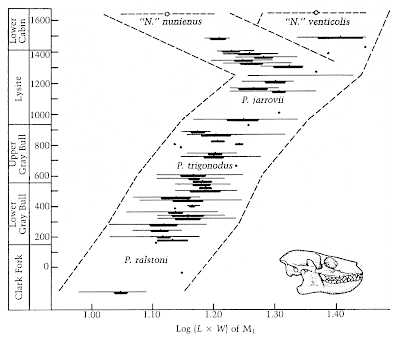
Here's Pelycodus again:

How many generations do you think are shown there?
One. One generation, many cousins. Many variations / cousins that lived at the same time and all died in the one same Flood.
Speciation can be taken as the boundary between microevolution and macroevolution, and this would be consistent with microevolution occurring within breeding populations. Generally, however, scientists don't worry so much about macro and micro, and prefer to talk about evolution and the resulting cladistic patterns.

What happens with speciation events is a division of the breeding population into two or more populations, each then free to evolve independently by microevolution within their respective breeding populations.
The ability of each population to evolve independently will continue as long as there is sufficient allelic variability for it. Back at that Creation there would have been much more than there is now so that such splits wouldn't lead to genetic reduction or depletion, even severe bottleneck splits, because all that now-dead junk DNA was functioning DNA back then. But at least since the Flood, and in more recent time, population splits may reduce genetic diversity quite a bit in a given species. The idea that microevolution just freely proceeds after such splits is the typical evolutionist assumption that doesn't recognize that these processes bring about reduced genetic diversity, which after many population divisions prevents further phenotypic changes from occurring at all. This is the basic folly of evolutionist assumption of open-ended evolution.
Creationist: No one seems interested that the best microbiology has been able to accomplish is 1+1=2. No one is interested in the boundries and limitations of mutational changes, or that just about all the changes involve loss of information. Information loss, cannot build anything new. Just faith that enough time can do the job.
Here the creationist is saying what I'm saying. Loss of information is really the same thing as reduced genetic diversity. Some alleles get left behind as new phenotypes emerge on the basis of the remaining ones. That's loss of information, although I think it's clearer to call it reduced genetic diversity.
RAZD: Perhaps that's because we've seen the evidence for 1+1+1+1+1+1+1+1+1+1=10 and know that your assertions are absolutely false.
This is just a bald assertion, where's the evidence he claims to have seen? He's not going to give any, but he'll ask the creationist to produce evidence instead.
RAZD: Of course you could try to prove me wrong by actually providing evidence of this mythic mutational barrier. See "Macro" vs "Micro" genetic "kind" mechanism? -- an 8 year old thread that asks for this mechanism, but which no creationist nor idologist has provided. Be the first
. And here's RAZD's challenge from that thread:
The whole system was supposedly set up during those original 6 days, so there must be a mechanism in place that prevents "macro"evolution ... what is the built-in biological mechanism that prevents this from happening? Where is it located? Why hasn't it been found?
Again, it's the fact that the processes of evolution can't simply keep on going because they eventually run out of alleles for genes. Evolution defeats evolution.
The creationist says: Anyone could look at old fossils and make relational assumptions. Especially if they are commonly designed.
RAZD: And those assumptions can be tested by applying the methodology of cladistics, and by having separate groups make simultaneous analysis and by comparing it with similar analysis using DNA.

Curiously this has been done, extensively. Guess what? They confirm each other. Can you tell me why the results are the same if the process is subjective
There is some sort of illusion involved in this whereby you are getting nothing more than a tautological echo of sorts. The method IS subjective. You are looking at traits and subjectively deciding how to group creatures according to their trait similarities and differences. As the creationist says, design similarity is a sufficient explanation for many similarities and your groupings can't show that it isn't simply design similarity you are grouping together. Studying DNA seems like it ought to produce an independent standard of some sort but in fact there is also a similarity of DNA design that reflects the similarity of phenotypic design and there is no way in any of this to establish actual descent from one to another.

The same is true of the supposed terrific evidence of "nested hierarchies" which gets discussed farther down the page. All this involves a subjective classification of external TRAITS, and descent is simply INFERRED, not proven.

Similar situation with RAZD's questioning the creationist about what constitutes a "large morphological change" as a definition of macro versus microevolution. The problem is that when you are dealing with morphology, just as with the nested hierarchies and the clades, it's all subjective judgment. And that includes the similarities that also are reflected in the DNA (there's bound to be a predictable correspondence between the DNA and the phenotype).
Do you want to see how large morphological changes occur and the evidence for them then you are asking for evidence of how the ToE explains changes observed in the fossil record and ends up with the diversity of morphological differences we see in the world today.

Of course, first you are going to need to define what you mean by "large morphological changes" as this is not a quantified description.

Do you think that the morphological differences between a house cat and a red fox are "large morphological changes"? Do you think they are differentiated by just a little or by lots of macroevolution?

Do you think a webbed foot is a "large morphological change" when the parents don't have webbed feet?
As long as this is all subjectively determined a creationist can say the difference between a fox and a house cat IS large enough to constitute a macro level of difference, and the evolutionist can say it isn't. But what does the DNA of the two creatures look like is the real question.

These things have to be determined at the genetic level. He asks if webbed feet from a nonwebbedfooted parent is a macro level difference or not, asking as usual for a subjective judgment of an observable trait. Seems to me it depends on whether there is the GENETIC possibility of webbedfootedness in the genome. Is there a gene for webbedness that exists in the genome or not? Is there more than one gene for the trait that could produce webbedness under certain conditions or combinations? Or allelic alternatives that could produce it? If there is then webbedness has to be one built-in variable for the particular species and is not a "large morphological change" or a macro level change. If not, then you aren't going to get webbedness in that species at all ever (except possibly as a mutation?) because it IS a macro level change that can't occur.

Saturday, March 3, 2012

The Creation Model explains the facts quite nicely

We're talking a different whole model here, one that is at least as consistent with the facts as evolutionism. At least.

In the creation model I always have in the back of my mind (some of which I certainly got from creationist sources but some is my own or at least my own way of organizing the material), species are defined at the genetic level by a particular genetic endowment that was built in at creation.

DEFINING THE ORIGINAL SPECIES, ALSO KNOWN AS THE KIND:
In the debate the evolutionists insist that creationists give a definition of a Kind or of microevolution versus macroevolution, which is of course difficult. I've given my dynamic definition of it many times and a test for it as well -- there should be measurably reduced genetic diversity after a series of population reductions as in a ring species, showing the outer limits of the Kind beyond which further evolution is impossible. But I note that Percy/Admin at EvC was apparently trying to reduce the haranguing on the subject in one thread recently by trying to give a brief definition. I think he meant to say that a change from a gray squirrel (population) to a red squirrel (population) is MICROevolution but in fact he said MACROevolution which destroyed his intent, and if so I'd have to agree with that. In general I think if you're inclined to call it by the same name as its predecessor, a "squirrel" in this case, you're talking about MICROevolution. I'm sure there are exceptions but this is most likely the rule. When you're talking about a change from a reptile to a bird or a worm to a human or an ape to a human you're talking MACROevolution.

The original genomic endowment of each species has a great deal of variability built into it that defines the limits of change available to the species, that is, there were many alleles that change the effect of particular genes, originally many more than continue today, and there were many more genes, even many for a particular trait as well, many more than today (They are all now junk DNA, but I get ahead of myself).

This is sufficient for great variability of the species as populations split off from each other down the generations.

VARIATION OR "EVOLUTION" REDUCES GENETIC DIVERSITY
Over time the variability is inevitably reduced by these splittings and isolations for any given population, but the original genetic complement was so rich that the variability remains high for many generations and it's very rare that a particular line of variation gets to the point of allelic depletion for many gene loci, such as happened with the cheetah, but it would happen occasionally with severe bottlenecks -- though originally it would have taken many bottlenecks to reduce the variability to the extent of the cheetah -- and would happen over many generations with many less drastic population splittings as well.

SOME EXAMPLES OF VARIABLES THAT WERE BUILT IN:
Among the original built-in variables for most creatures could be size differences from as big as an elephant to as small as a mouse, as big as a sabertoothed tiger but as small as a housecat, as big as a dinosaur, as small as a lizard. All within the same species. Size and shape of features and limbs would also have a fair degree of variability. Color and patterns of skin or fur or scales also. Length of fur. The excess skin of the Shar Pei is most likely also a built-in variable, one that would probably take many generations of population isolation (nature does it randomly but domestic breeding does it intentionally) to emerge according to this creationist model.

SPECIATION
So: Many variations develop from the original created Species over generations, forming new populations with their own peculiar characteristics, often to the point of "speciation" or cessation of interbreeding with former populations. Speciation in this model is simply what happens when a particular line of variation -- either by random population splitting in nature or intentional splitting by domestic breeding -- has produced a population whose genetic diversity is sufficiently reduced, or whose gene pool has become sufficiently inbred, to prevent breeding of its members with those of the population from which it originally split off. Of course breeding may cease between the two before a genetic reason for it exists, simply because of preference of members of a population for members of the same population. The effect is the same: the separate characteristics of the separated populations are preserved and so are their separate gene pools.

You NEVER get a new "species" in the sense of the original Species or Kind by any of these processes of variation, only variations on the theme of the original Species itself, but they are quite wonderfully many and diverse. So while what is called "speciation" by evolutionists clearly does happen, it's nothing more than a variation that no longer interbreeds with the rest of its Kind, so that its own pecular characteristics are preserved.

As such variations inbreed and become established in their own niches they refine their own gene pool and that further cuts them off from other members of the species.

MUTATIONS
In this model, mutations are mistakes or accidents brought about by the Fall. They have no positive function in the organism, only a negative or destructive one. They may produce no identifiable change at all, but only because the original DNA is not easily damaged. But the fact that they change anything at all in the originally perfect genetic design makes them a disease process.

Whenever I read a description of a trait as produced by a mutation I simply doubt it, recognizing it as a notion that is required by the competing model of evolution but in reality most likely simply the result of an unusual combination of the pre-existing built-in allelic possibilities that go back to the creation, brought about by many generations of population splittings and consequent reduced genetic diversity which just happened to bring this particular combination to expression.

So, I habitually reinterpret descriptions of traits that ascribe them to mutation, as in this description of the wrinkled skin of the Shar Pei dog for instance:
Scientists from the Department of Genome Sciences at the University of Washington, Seattle, announced in January 2010 that they had analysed the genetic code of 10 different pedigree dog breeds. In the Shar-pei they discovered four small differences located in the gene HAS2 which is responsible for making hyaluronic acid synthase 2. That enzyme makes hyaluronic acid, which is one of the key components of the skin. There have been rare cases in which a mutation of the same gene has caused severe wrinkling in humans as well.[3]
While this MIGHT be a mutation -- a mistake in the replication of the gene -- especially where it produces a clear deformity, it is most likely, according to the creation model, to be simply a case of a rare allele having come to expression in the breed after many generations of isolation and inbreeding.

Is it possible to tell a pre-existing normal nonmutated allele from a supposed mutation as expected by evolution? I don't think so. Mutation is simply assumed, because the theory of evolution requires it.

MACROEVOLUTION
What I'm describing is often called "microevolution" but it's the only kind of evolution that is possible, variation within the species based on the genetic endowment built in at the Creation. No other genetic input is required. For "macroevolution" to occur, however, meaning changes that transcend the Species or Kind, would require genetic input from somewhere, and this is what "mutations" are assumed by evolutionists to provide, but if they are mistakes that confer no benefit on the organism obviously this should be recognized as a dashed hope.

EVOLUTIONIST JUST-SO TALES
Also incidentally found in that same Wikipedia discussion of the Shar-Pei is the typical evolutionist tale that "explains" the survival of a particular feature, in this case the heavily wrinkled skin:
If a Shar Pei is being attacked the wrinkles keep the Shar Pei from being injured badly.[citation needed]
The sort of "explanation" that is meant to account for the persistence of the feature.

Sometimes such factors may indeed apply, but according to my creation model it's more likely that the trait simply emerged in the process of allele shufflings in population isolations over generations and wasn't a detriment so it stuck around. It may confer benefits of course, but these don't have to be the reason for its existence. The creation model produces creative variations kind-of-just-for-the-love-of-them, as it were, just for the "love" of beauty and diversity, they don't need specific reasons that enabled them to survive. So, for instance, rather than Darwin's finches having evolved their characteristic beak styles in order to fit into a niche where the particular beak was suited to the particular food, the creation model would say the finches that just happened to develop with a particular beak style gravitated to that kind of food just because the beak WAS suited to it, and over subsequent generations THEN the beak could have become established and refined for that purpose within that population.

So the idea that the wrinkled skin protects the Shar Pei from injury MAY be true enough (who knows) but it isn't necessary as an explanation for the existence of the trait. This is just the usual imaginative speculation that makes up, oh, 90% of the whole theory of evolution. It even says "citation needed." Well, maybe someone will come up with a citation to a study that seems to prove it, but evolutionists never really require such proof, the ad-hoc speculation explanation alone usually suffices.

Why aren't there any pre-human hominids (or other varieties of hominids) still running around? Oh probably because we killed them all off or ran them off the territory that sustained them and so on and so forth. They publish whole peer-reviewed papers speculating about the reasons and they'll call it science and they'll beat up creationists who continue to demur. They haven't a clue but such "likely stories" seem to be enough to keep them happy. Of course the REAL reason is that there never WERE any pre-human hominids.

How come there is a bone in the whale skeleton fossil where a hip joint would have been located? Oh that's proof that the whale evolved from a land animal. Huge huge leap but because it fits the ToE they enshrine it as ***S*c*i*e*n*t*i*f*i*c*** F*a*c*t***.

But continuing with my Creation Model:

JUNK DNA
Junk DNA is most likely the record of genetic death over the generations due to the Fall, much of it brought about by mutations that simply killed the function of gene after gene. Probably the majority of it is a record of the Great Death brought about by the Flood. If there is some function left in some of them that is all it is, a bit of crippled life that remains, that wsan't completely killed. Those creationists who want to find function in the DNA are not thinking clearly. They feel they have to prove the original perfection of the Creation and forget that the Fall has made enormous changes in the original perfection through destructive processes -- disease, death, deformity -- that had no part in the original.

NATURAL SELECTION
What about Natural Selection? In this creation model NS is one possible way variations develop, but only one of many. Simple migration will succeed at creating a new variation by isolating a new population just as well as NS will, by creating new gene frequencies, just as adapted to its situation as anything NS produces, and without the death that NS often requires. Natural Selection applies mostly to situations where there is an actual survival threat that prevents the creature from passing on its genes, such as when an aggressive predator wipes out much of the population. Some sort of defensive mechanism in a few of the prey population's members may save some of them and therefore be passed on and become characteristic of the new population. A change in the environment, say the food supply, may kill off many members of a particular population but those that have some form of adaptation to the new food situation will pass on their genes. Etc. etc. It no doubt happens, but probably is fairly rare among all the ways new populations develop from genetic variations, perhaps far more often than not simply leading to extinction rather than an adapted variation. Forced adaptation to specific situations can't be as much of a driving force for change as evolution claims. As far as new variations go, genetic drift does the same thing within a population. Bottleneck is simply a drastic version of either migration or natural selection, creating a severely reduced population with severely reduced genetic diversity in a single event. Etc. etc.

FOSSIL RECORD
What is the Fossil Record according to the Creation Model? Obviously it's overwhelmingly to be explained as the remains of the creatures that died in the Flood of Noah. Obviously.

Why is there the seeming gradation of primitive to advanced morphology in the Fossil Record? There really isn't, there is simply a sorting of creatures according to some physical principle, probably many physical principles, that occurred in the Flood. The apparent gradation is an illusion. Differences between different fossil representatives of one species to be found in different layers or different parts of the world simply demonstrate the same principle of variation I'm describing above, not evolution from one type to another. There are lots of different varieties of Trilobites in the Fossil Record for instance, each variety flocking with its own kind, which evolutionists interpret as evolution over time, presumably from less to more advanced types, but all they are really is separate populations of the many possible variations that were built into the original genome of the Trilobite species.

STRATA / GEOLOGIC COLUMN / GEO TIMETABLE
What about the existence of the strata themselves, known as the Geologic Column? Well, that is really a no-brainer. Nothing BUT a worldwide Flood could have brought about those strata. The interpretation of huge time periods attaching to separated sediments is just plain ludicrous. And don't tell me that is a wrong reading of the geo timetable. Just go look at the model of the Grand Canyon where the "time periods" are associated with the different sediments.

And so on and so forth.

The point of this post is to demonstrate that there IS a Creation Model that IS consistent with the actual facts, can account for just about everything the Evolution model attempts to account for and in my opinion way better.

There is much more that could be added here but I'll have to get back to it later or do it in another post.

==============
From Post at EvC:
No one seems interested that the best microbiology has been able to accomplish is 1+1=2.
Ok, 1 +1 =2. Then we're at 2, and 2 + 1 = 3, then we're at 3, and 3 + 1 = 4. Now we're at 4, and 4 + 1 = 5. 5 + 1 = 6. 6 + 1 = 7. 7 + 1 = 8. 8 + 1 = 9. 9 + 1 = 10.

Lots of little changes add up to a big change. What you need to do, to allow micro but deny macro, is come up with some mechanism that stops little changes from accumulating.
Easy. I told them there and I'm arguing here over and over again: THE PROCESSES THAT PRODUCE VARIATIONS / CHANGES IN THE PHENOTYPE / SPECIATION / "EVOLUTION" ULTIMATELY LEAD TO REDUCED GENETIC VARIABILITY OR DIVERSITY, WHICH EVENTUALLY PUTS AN END TO THE POSSIBILITY OF MORE CHANGES. This end point defines the outer limit of a Species or Kind. That's your "mechanism." It should be testable, both in the wild and in a laboratory.

Wednesday, February 29, 2012

Just another Evolutionist PRATT, the usual paradigm-bound misconception of Speciation

Somebody just started a new thread at EvC titled An example of speciation in action? giving an example of reproductive isolation bringing about changes between two separate populations of a bird called a Blackcap. Differences in appearance between the two are minimal but differences in behavior are enough to keep them apart.

This is treated as some kind of wonderful event, at least a step on the way to macroevolution, which makes it just another evolutionist PRATT (Point Refuted a Thousand Times). I for one have answered it over and over both at EvC and on my blog, and I can't be the only one.

All this is merely one of the ways variation naturally occurs in species because of built-in genetic variability. It's nothing more than normal "microevolution," changes that are expected because of this built-in genetic variability, which can come about through anything that isolates a portion of a population from another so that they don't interbreed. Genetic drift within populations even does this but populations may also become physically separated from one another and go on to develop their own characteristics different from each other. This occurs because reproductive isolation brings about different gene frequencies in the new populations as compared to the original population. Really, it's to be expected that reproductive isolation would bring about changes between populations in this way. No mutations need be involved and there's no reason to suppose they are EVER involved.

It's simply a matter of different combinations or frequencies of alleles becoming characteristic in each of the separated populations. This is the natural result of the differences in gene frequencies working their way through each population over a few generations. Over time this brings about changes in the phenotypes characteristic of the new populations as a whole that differentiates them from each other more and more, sometimes to the point of approaching what the evolutionists would be inclined to call speciation. That depends on the degree of genetic variability that remains. The less genetic variability there is compared to the original population the more dramatic its changes will be, and the more likely it is that the populations will develop inability to interbreed with one another.

Is this speciation? This is an arbitrary definitional matter. It doesn't matter at what point population changes get called speciation, whether at this stage of practical differences bringing about lack of opportunity to interbreed, or behavioral disinclination to interbreed, or at the stage when isolation has brought about complete inability to interbreed because of genetic incompatibility, the effect is always that in isolation each population continues to elaborate its own separated gene pool and diverges further from the other.

Again, you don't need mutations to bring this about, merely different frequencies of alleles in each population.

And, as I've argued from the beginning of this blog, the result of these changes over time, especially with further splittings of the populations and further elaborations of the new gene frequencies brought about by the splitting, is reduced genetic variability that makes further evolution less possible, and ultimately impossible. The more evolution you have, the less evolution is possible. Evolution defeats evolution.

Oh well, they don't listen to such obvious simple contradictions of their beliefs. Maybe a creationist will come along and make the point eventually, and they'll ignore that too because they really don't care about science, only about justifying evolution.

But there's a brief statement of it just for the record.

========================
By the way, they often complain that creationists offer no evidence for many interpretations such as the above, without ever recognizing that they have no evidence for their opposing interpretations either, but have only the familiar just-so story line.

They interpret the changes brought about by reproductive isolation as steps in open-ended evolution, simply because that's what the theory requires, not because they have any evidence for it. To their mind the simple fact that such changes do occur IS the evidence -- evidence for the theory of evolution. But there is no evidence for the open-endedness of the change process itself, that's just assumed. Darwin assumed it and it continues to be assumed.

Likewise they assume mutations as the engine that keeps it all going because the theory requires such an engine. You can get different kinds of finches out of the built-in genetic complement that belongs to finches, but you can't get an iguana out of a finch without the input of new genetic material or "information."

So instead of even recognizing that there is such a thing as a built-in genetic complement that defines a species (which is really the definition OF a species or Kind at the genetic level, that elusive definition they keep haranguing us creationists to produce), they assume that ALL genetic material is constantly being created by the processes of mutation and natural selection. Again, there is no evidence for this, they have to assume it because the theory requires it.

As a creationist I interpret the changes brought about by reproductive isolation as the effect of shuffling the frequencies of alleles that belong to the built-in genetic complement for the species. There is a natural limit to the changes possible BECAUSE there is this original complement of genetic potentials that can only be shuffled and reshuffled. It CAN play out to less and less genetic variability down any particular line of variation brought about by reproductive isolation, especially a series of reproductive isolations such as in a ring species. What is called "speciation" is really the result of this reduced genetic variability. New phenotypes develop from new frequencies of genes, but reproductive isolation itself over time reduces the genetic variability. This can produce dramatic new phenotypes, but there is a point that is reached when further variation becomes impossible. You may have a striking new variation (they call it a new species) but it may have such reduced genetic variability it can't change any further at all. Yes, like the cheetah. Thus bringing the processes of evolution to an end for that line of variation.

Mutations are of absolutely no use in this scenario, they only interfere with it, and in reality that does appear to be what happens, which is evidence for the scenario right there -- thousands of genetic diseases, thousands of "neutral" mutations that have simply not produced anything identifiable (although they have to be deleterious because they change the genetic code, which was originally perfect), and a very few known "beneficial" mutations that are highly questionable. These are the facts, although the theory of evolution says the opposite and has to interpret them away, as by claiming the beneficial mutations made the entire genetic code so are therefore hard to detect. The known facts, however, are on the creationist's side.

I have also suggested a scientific test that could prove all this, which is more than the evolutionist side can offer. All they have is theory, elaborated by theory, multiplied by theory, developed by theory and validated by theory. Fantasy in other words. No evidence.