Showing posts with label Speciation. Show all posts

Saturday, March 10, 2012

Speciation + Evolution = LOTS of Trait Diversity with LOSS of Genetic Diversity leading to end of ability to evolve

Another one from RAZD at EvC, Speciation + Evolution = More Diversity
The scene: sitting at computers all over the world ...
"Why don't creationists understand evolution -- it is so simple," the evolutionist wails:

1. Evolution - the change in hereditary traits in populations from generation to generation - is an observed and documented fact, a process that occurs constantly in the natural world around us, and

2. Speciation - the division of parent populations into reproductively isolated daughter populations - is also an observed and documented fact, a process that occurs frequently in the natural world around us.
These two simple processes are sufficient to explain the diversity of life we know, from the world around us, from history, from prehistory and archeology, from geology and physics and paleontology and the fossil record, and from chemistry and the genetic record.
Well, it sounds good on paper, I guess, as theory at least, but unfortunately it fails in reality. Yes, there is an "evolution" by which heritable traits change from generation to generation, but this has never been observed beyond what we call "micro" evolution, or evolution within the genetic limits that define each species, and in fact it can't occur beyond microevolution for the reasons I've given over and over here, which are the same reasons there is no evolution beyond speciation. And yes, speciation is also a documentable fact, but it always occurs with loss of genetic diversity, even to the extreme of fixed loci or total homozygosity for some traits in the population, which makes further evolution beyond speciation purely a pipe dream.

But RAZD just goes on asserting the theory, the pipe dream, as if it were reality, as they all do.
We can even see how evolution causes speciation with Ring Species:

1. the species forms a band made up of several varieties around some barrier to their survival ability,

2. each of the varieties has slightly different hereditary traits from their neighbors,

3. each reproduces with their neighbors in hybrid zones that show a mixing of the hereditary traits of the two neighbors, except that

4. when they meet on the other side of the barrier, the two ends do not mate.

Evolution results in different hereditary traits developing in each of the areas dominated by the different varieties, differences that do not hinder mating until they reach a certain threshold - the difference between the end varieties.

Yes, pretty much but as long as he sticks to the level of traits -- of the phenotypes, of the different observable characteristics between the populations -- he misses the reason what happens happens: The splitting of the populations changes the gene frequencies. When new traits emerge this is because alleles for competing traits have been reduced which can proceed after many population splits to the point that they are completely lost to the new population. After a series of splits the genetic diversity may be quite drastically reduced, and the main reason there is no interbreeding between the first and last populations is the genetic incompatibility that has developed by then.

Again, my prediction is that if you sampled the DNA of the first and last populations (better done in a laboratory where you can sample the first before it too undergoes change), you should find much greater genetic diversity in the first and much reduced diversity in the last, more heterozygosity in the first, more homozygosity in the last, particularly for the traits that are most characteristic of the populations.
Remove any one of the intermediate varieties, so that the band is broken, and you have two distinct species.
We now have more species than before, so life is more diverse. It is so simple:

Evolution + Speciation = Diversity
Way TOO simple, RAZD. Yes you do have more diversity of TRAITS, but you are simultaneously getting REDUCED diversity of GENETIC POSSIBILITIES. This is all just the usual evolutionist daydream based on surface facts completely ignoring what is going on genetically, which is the NECESSARY reduction of genetic diversity, which occurs with EACH splitting off of a portion of the population to form a new population. This is a trend that can keep producing new phenotypes for some time by losing more alleles, but can ultimately arrive at such genetic depletion that no further phenotypic change is possible, a condition like that of the cheetah. Not that this degree of depletion is inevitable, but reduction in that direction certainly is.
This little scenario depicts, I believe, the state of many debates between creationists - people that predominantly use faith to understand the world - and "evolutionists" - people that predominantly use science to understand the world.
What "this little scenario" actually depicts is evolutionist reliance on wishful thinking as they spell out what they THINK happens, because they haven't really faced the GENETIC PICTURE which is working against their all-too-sanguine expectation that change in traits can just go on and on without genetic cost. It really is a daydream, a fantasy. And it's quite the joke that they are constantly claiming to appeal to EVIDENCE and accusing creationists of relying only on faith.

(I skipped his caricature of the creationist response to the above because it is a distraction from what I'm trying to say here.)
Where does "large" change come from? - the change that makes giraffes so different from kangaroos? Simple:

Speciation - the division of parent populations into reproductively isolated daughter populations - is also an observed and documented fact, a process that occurs frequently in the natural world around us, and

Evolution- the change in hereditary traits in populations from generation to generation - is an observed and documented fact, a process that occurs constantly in the natural world around us.
SO simple as long as he just goes on daydreaming about the surface traits and imagining that there are no limits to change.
Speciation + Evolution = More Diversity
After speciation has occurred, the daughter populations no longer share genes through reproduction, and they are free to evolve completely different traits.
Yes, and this lack of sharing of genes means a LOSS OF GENETIC DIVERSITY. Yes, they ARE "free to evolve copletely different traits" but this is ALWAYS made possible by the loss of competing alleles for those traits, which is completely ignored by evolutionists. You can always get new traits BY LOSING competing alleles, but if the population splits that bring this about continue to occur, eventually a point will be reached where you can't get new traits any more because you'll be completely out of alleles. Speciation may not always mean genetic depletion but it certainly means genetic reduction from earlier populations particularly where the main new traits are emerging.
The likelyhood is high that one of them will become quite different, either to inhabit a new ecology that the other is not as well suited to (could have caused the original split), or to make use of the existing ecology in a different way, and this will lessen competition between the two species rather than drive one to extinction.
Lotta sheer conjecture there. It really isn't even necessary to posit environmental or situational reasons for trait changes or even the population splits themselves. Migration will bring about splits and the splits alone will bring about trait changes. The fewer individuals at the start of a new population the bigger the observable trait changes, the ecology is not likely to have much to do with it. It may be that both populations still have sufficient genetic variability even to undergo several further splits if necessary, but since he's completely ignored the whole question of what happens to the genes while focusing on the traits and fantasizing endless change he's going to miss the state of genetic depletion also when it does finally occur after more population splits.
Continued evolution of daughter populations along different ecological paths results in increased diversity - difference - between them over time. That is how the small amount of difference we seen below can become the amount of difference we see between other bird species.
Again, overrated influence from the environment but this is really a side issue, but anyway, the increased diversity is completely the result of the change in gene frequencies brought about by the population split. If the environment contributes an influence that further impacts the population numbers or reproductive isolation and therefore the gene frequencies, then it will contribute to the trait differences between the populations as well, but again, there is no need for this to happen in order for even great differences to come about as the change in gene frequencies alone will do it.
Continued evolution causes more change - in each population, from generation to generation to generation
Along with change in gene frequencies which can rapidly reduce and even eliminate some alleles as the changes continue, to the point that you run out of alleles for enough traits that further change is impossible, probably a very interesting new population with new traits but no more genetic variability.
That should be enough for starters. There is more to discuss about where change occurs, but this is long enough for now. This thread is about evolution after speciation.
A total pipe dream I'm afraid, as speciation is most likely to occur at the very outer edges of the genetic variability of the species, thus preventing further evolution.

Evidence for Reduced Genetic Diversity as Necessary Component of Evolution

You want some evidence for the claim that evolutionary processes always involve the reduction of genetic diversity? It's pretty simple, OUGHT to be obvious, and it's all about the reduction of heterozygosity to homozygosity or even less: This is from Wikipedia on Zygosity:
A cell is said to be homozygous for a particular gene when identical alleles of the gene are present on both homologous chromosomes.[2] The cell or organism in question is called a homozygote. True breeding organisms are always homozygous for the traits that are to be held constant.
In nature the same thing applies. Once you get a new variety, a subpopulation that is reproductively isolated from its parent population or other populations of the same species, even the result of a "speciation" event, and especially after it has inbred over some generations, its traits are going to be or become fixed. For a new trait to stick, or continue to characterize the new population, competing alleles for that trait must have been eliminated from that gene pool. THIS IS THE NECESSARY REDUCTION IN GENETIC DIVERSITY THAT ALLOWS A NEW TRAIT TO COME TO CHARACTERIZE A NEW BREED OR POPULATION IN THE WILD, THIS MUST OCCUR FOR A NEW TRAIT TO DEVELOP AND STICK IN A NEW POPULATION.

If they are "true breeding", they will be homozygous for their characteristic traits. This HAS to be true whether the population is the result of natural processes such as natural selection or genetic drift, migration and so on, or domestic breeding decisions.

HOMOZYGOSITY MEANS ONLY ONE ALLELE FOR THE GENE, ALL THE OTHER ALLELES HAVING BEEN ELIMINATED FROM THAT PARTICULAR GENE POOL. THAT'S THE SEVEREST CASE OF DECREASED GENETIC DIVERSITY (except for hemizygosity and nullizygosity, mentioned in the article below) AND IT'S NECESSARY TO GETTING A "TRUE BREED." AND WHAT IS A TRUE BREED BUT A NEW PHENOTYPE OR "SPECIES," A SPECIATION EVENT IN ITSELF, THE SUPPOSED STEP ON THE WAY TO OPEN-ENDED EVOLUTION FROM ONE SPECIES TO ANOTHER ACCORDING TO EVOLUTIONISTS.

Take dogs. If you want a Dachshund you have to eliminate all the alleles that specifically produce Great Danes or Golden Retrievers or Chihuahuas etc. If any of those alleles show up in the Dachshund breeding program you'll get a less perfect Dachshund. They make the breed less than what it is supposed to be.

It works the same way in nature, maybe through Natural Selection but probably more often through random events that simply happen to separate a population into two or more subpopulations. A particularly marked salamander emerges because the other markings are genetically decreased by comparison to those for the new marking. The markings of the last species to develop in a ring species of such salamanders should be genetically homozygous. Same with the genetics underlying the last species in the ring of green warblers and so on. You should find decreased genetic variability and probably a lot of homozygosity, just because this is what evolution DOES.

It's NECESSARY to evolution, and if evolutionists weren't always imagining nonexistent mutations into the mix it ought to be obvious even to THEM. The only mutations that are involved are those that contribute diseases to the mix and interfere with the health of the most genetically reduced populations, even to extinction in some cases.

In nature the introduction of disease elements may simply eliminate a new variety, Natural Selection in operation at its most severe, but if the new variety finds a niche it can adapt to it will survive just as a good domestic breed will.

The new variety necessarily comes through a reduction in genetic diversity. That's how evolution WORKS, really, though such an obvious necessity, that must lead to LESS ability to evolve, is simply ignored by believers in evolution who go on spinning evolution out of imaginary mutations.

To repeat the point: If circumstances are such that the populations remain reproductively separate, meaning without gene flow or the sharing of alleles between them, each will develop its own particular characteristics, and as long as there remains no gene flow or reproductive contact between the populations those characteristics will remain. For them to remain means that the alleles for different characteristics have been eliminated. That's what decreased genetic diversity MEANS. This may amount to actual speciation, but at least certainly at the extremes you do get speciation, where the new characteristics are preserved because there is a complete lack of interbreeding with former populations.

Evolutionists regard bottlenecks as events that interfere with the processes of evolution, but they shouldn't. The elephant seal and the cheetah which were produced by severe bottlenecks -- reduction of their former populations to just a few individuals -- that severely reduced their genetic diversity -- really ought to be considered to be examples of speciation, nature doing what domestic breeders do. Bottlenecks are really just one way new varieties or breeds are brought about in nature or in domestic breeding. ALL the processes of evolution tend in the same direction, genetic drift, migration, natural selection, just not as rapidly. Domestic breeding in the past could be described as the artificial creation of genetic bottlenecks for the purpose of developing desired traits for new breeds. You select the desired character and take pains to breed only with others that possess that character. Since a rigid adherence to this formula also usually brings disease problems into the breed, breeders today take care to avoid the most severe bottleneck methods with the most severely decreased genetic variability by mixing with more vigorous but less desirable animals as far as the target trait is concerned, but if it weren't for the threat of disease, these severe methods would be considered the most reliable way of producing the best breeds. SPECIATION.

Yet here we have RAZD at EvC carrying on as if the evolution processes just go on and on producing new phenotypes or varieties or breeds, even past speciation which he treats as the end point of microevolution and beginning of macroevolution, but afterward the same changes continue without a hitch in his scenario.
What separates (micro) evolution from the macro view of evolution (macroevolution) is the process of speciation, as evolution occurs within the breeding population, and nested hierarchies are formed by speciation events, and macroevolution is just a macro view of what occurs over several generations via evolution and speciation.

If we look at the continued effects of evolution over many generations, the accumulation of changes from generation to generation may become sufficient for individuals to develop traits that are observably different from the ancestral parent population. This lineal change within species is sometimes called phyletic change in species. This is also sometimes called arbitrary speciation in that the place to draw the line between linearly evolved geneological populations is subjective and because the definition of species in general is tentative and sometimes arbitrary.
See, he's simply ASSUMING the open-endedness of evolution, the phenotypic changes just go on and on, a neverending ACCUMULATION of changes. He has no evidence for this, though he has charts that give it an aura of authority that are simply meaningless reflections of his false belief. Actually, they are ILLUSTRATIONS of what he believes, they provide nothing in the way of evidence for any of it. And everything he says is also all assumption without evidence. Dawkins does the same thing with his ridiculous computer models of how evolution works, simply programming in his own bias, his assumption of open-ended changes. Sometimes you'll see an evolutionist acknowledging that reduced genetic diversity can sometimes be a problem but they keep that information off in a separate mental compartment, it's something that occurs only with bottlenecks, in extreme scenarios that interfere with evolution, not with evolutionary processes themselves.

Just for the record, here is the most pertinent part of the Wikipedia article on Zygosity:
Types
The words homozygous, heterozygous, and hemizygous are used to describe the genotype of a diploid organism at a single locus on the DNA. Homozygous describes a genotype consisting of two identical alleles at a given locus, heterozygous describes a genotype consisting of two different alleles at a locus, hemizygous describes a genotype consisting of only a single copy of a particular gene in an otherwise diploid organism, and nullizygous refers to an otherwise-diploid organism in which both copies of the gene are missing.

Homozygous
A cell is said to be homozygous for a particular gene when identical alleles of the gene are present on both homologous chromosomes.[2] The cell or organism in question is called a homozygote. True breeding organisms are always homozygous for the traits that are to be held constant.

An individual that is homozygous-dominant for a particular trait carries two copies of the allele that codes for the dominant trait. This allele, often called the "dominant allele", is normally represented by a capital letter (such as "P" for the dominant allele producing purple flowers in pea plants). When an organism is homozygous-dominant for a particular trait, the genotype is represented by a doubling of the symbol for that trait, such as "PP".

An individual that is homozygous-recessive for a particular trait carries two copies of the allele that codes for the recessive trait. This allele, often called the "recessive allele", is usually represented by the lowercase form of the letter used for the corresponding dominant trait (such as, with reference to the example above, "p" for the recessive allele producing white flowers in pea plants). The genotype of an organism that is homozygous-recessive for a particular trait is represented by a doubling of the appropriate letter, such as "pp".

Wednesday, March 7, 2012

The Creation Model explains the facts GENETICALLY

RAZD
Do you want to see how large morphological changes occur and the evidence for them then you are asking for evidence of how the ToE explains changes observed in the fossil record and ends up with the diversity of morphological differences we see in the world today.

Of course, first you are going to need to define what you mean by "large morphological changes" as this is not a quantified description.

Do you think that the morphological differences between a house cat and a red fox are "large morphological changes"? Do you think they are differentiated by just a little or by lots of macroevolution?

Do you think a webbed foot is a "large morphological change" when the parents don't have webbed feet?

You might want to read through Dogs will be Dogs will be ??? or MACROevolution vs MICROevolution - what is it? and see if you can formulate your question clearly.
... The only defence offered for that is, "enough time will do it". The rest is arguing about speciation, which many believe is just variation or micro-evolution. The only difference is evolutionary scientists decided it wasn't.
Well can you deny that many generations add more evolution than single generations?
Generations alone don't do it, you need population splits, and you get "more evolution" only up to the point that you run out of alleles for any given evolving trait, generally many traits by the time "speciation" is reached. This is because the processes of evolution that lead to speciation also lead to reduced genetic diversity.
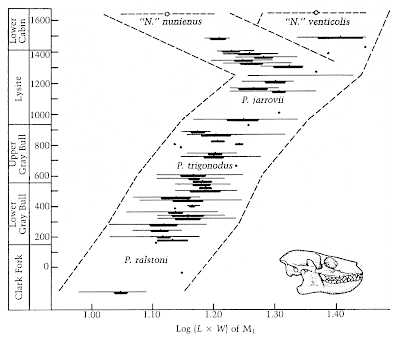
Here's Pelycodus again:

How many generations do you think are shown there?
One. One generation, many cousins. Many variations / cousins that lived at the same time and all died in the one same Flood.
Speciation can be taken as the boundary between microevolution and macroevolution, and this would be consistent with microevolution occurring within breeding populations. Generally, however, scientists don't worry so much about macro and micro, and prefer to talk about evolution and the resulting cladistic patterns.

What happens with speciation events is a division of the breeding population into two or more populations, each then free to evolve independently by microevolution within their respective breeding populations.
The ability of each population to evolve independently will continue as long as there is sufficient allelic variability for it. Back at that Creation there would have been much more than there is now so that such splits wouldn't lead to genetic reduction or depletion, even severe bottleneck splits, because all that now-dead junk DNA was functioning DNA back then. But at least since the Flood, and in more recent time, population splits may reduce genetic diversity quite a bit in a given species. The idea that microevolution just freely proceeds after such splits is the typical evolutionist assumption that doesn't recognize that these processes bring about reduced genetic diversity, which after many population divisions prevents further phenotypic changes from occurring at all. This is the basic folly of evolutionist assumption of open-ended evolution.
Creationist: No one seems interested that the best microbiology has been able to accomplish is 1+1=2. No one is interested in the boundries and limitations of mutational changes, or that just about all the changes involve loss of information. Information loss, cannot build anything new. Just faith that enough time can do the job.
Here the creationist is saying what I'm saying. Loss of information is really the same thing as reduced genetic diversity. Some alleles get left behind as new phenotypes emerge on the basis of the remaining ones. That's loss of information, although I think it's clearer to call it reduced genetic diversity.
RAZD: Perhaps that's because we've seen the evidence for 1+1+1+1+1+1+1+1+1+1=10 and know that your assertions are absolutely false.
This is just a bald assertion, where's the evidence he claims to have seen? He's not going to give any, but he'll ask the creationist to produce evidence instead.
RAZD: Of course you could try to prove me wrong by actually providing evidence of this mythic mutational barrier. See "Macro" vs "Micro" genetic "kind" mechanism? -- an 8 year old thread that asks for this mechanism, but which no creationist nor idologist has provided. Be the first
. And here's RAZD's challenge from that thread:
The whole system was supposedly set up during those original 6 days, so there must be a mechanism in place that prevents "macro"evolution ... what is the built-in biological mechanism that prevents this from happening? Where is it located? Why hasn't it been found?
Again, it's the fact that the processes of evolution can't simply keep on going because they eventually run out of alleles for genes. Evolution defeats evolution.
The creationist says: Anyone could look at old fossils and make relational assumptions. Especially if they are commonly designed.
RAZD: And those assumptions can be tested by applying the methodology of cladistics, and by having separate groups make simultaneous analysis and by comparing it with similar analysis using DNA.

Curiously this has been done, extensively. Guess what? They confirm each other. Can you tell me why the results are the same if the process is subjective
There is some sort of illusion involved in this whereby you are getting nothing more than a tautological echo of sorts. The method IS subjective. You are looking at traits and subjectively deciding how to group creatures according to their trait similarities and differences. As the creationist says, design similarity is a sufficient explanation for many similarities and your groupings can't show that it isn't simply design similarity you are grouping together. Studying DNA seems like it ought to produce an independent standard of some sort but in fact there is also a similarity of DNA design that reflects the similarity of phenotypic design and there is no way in any of this to establish actual descent from one to another.

The same is true of the supposed terrific evidence of "nested hierarchies" which gets discussed farther down the page. All this involves a subjective classification of external TRAITS, and descent is simply INFERRED, not proven.

Similar situation with RAZD's questioning the creationist about what constitutes a "large morphological change" as a definition of macro versus microevolution. The problem is that when you are dealing with morphology, just as with the nested hierarchies and the clades, it's all subjective judgment. And that includes the similarities that also are reflected in the DNA (there's bound to be a predictable correspondence between the DNA and the phenotype).
Do you want to see how large morphological changes occur and the evidence for them then you are asking for evidence of how the ToE explains changes observed in the fossil record and ends up with the diversity of morphological differences we see in the world today.

Of course, first you are going to need to define what you mean by "large morphological changes" as this is not a quantified description.

Do you think that the morphological differences between a house cat and a red fox are "large morphological changes"? Do you think they are differentiated by just a little or by lots of macroevolution?

Do you think a webbed foot is a "large morphological change" when the parents don't have webbed feet?
As long as this is all subjectively determined a creationist can say the difference between a fox and a house cat IS large enough to constitute a macro level of difference, and the evolutionist can say it isn't. But what does the DNA of the two creatures look like is the real question.

These things have to be determined at the genetic level. He asks if webbed feet from a nonwebbedfooted parent is a macro level difference or not, asking as usual for a subjective judgment of an observable trait. Seems to me it depends on whether there is the GENETIC possibility of webbedfootedness in the genome. Is there a gene for webbedness that exists in the genome or not? Is there more than one gene for the trait that could produce webbedness under certain conditions or combinations? Or allelic alternatives that could produce it? If there is then webbedness has to be one built-in variable for the particular species and is not a "large morphological change" or a macro level change. If not, then you aren't going to get webbedness in that species at all ever (except possibly as a mutation?) because it IS a macro level change that can't occur.

Wednesday, February 29, 2012

Just another Evolutionist PRATT, the usual paradigm-bound misconception of Speciation

Somebody just started a new thread at EvC titled An example of speciation in action? giving an example of reproductive isolation bringing about changes between two separate populations of a bird called a Blackcap. Differences in appearance between the two are minimal but differences in behavior are enough to keep them apart.

This is treated as some kind of wonderful event, at least a step on the way to macroevolution, which makes it just another evolutionist PRATT (Point Refuted a Thousand Times). I for one have answered it over and over both at EvC and on my blog, and I can't be the only one.

All this is merely one of the ways variation naturally occurs in species because of built-in genetic variability. It's nothing more than normal "microevolution," changes that are expected because of this built-in genetic variability, which can come about through anything that isolates a portion of a population from another so that they don't interbreed. Genetic drift within populations even does this but populations may also become physically separated from one another and go on to develop their own characteristics different from each other. This occurs because reproductive isolation brings about different gene frequencies in the new populations as compared to the original population. Really, it's to be expected that reproductive isolation would bring about changes between populations in this way. No mutations need be involved and there's no reason to suppose they are EVER involved.

It's simply a matter of different combinations or frequencies of alleles becoming characteristic in each of the separated populations. This is the natural result of the differences in gene frequencies working their way through each population over a few generations. Over time this brings about changes in the phenotypes characteristic of the new populations as a whole that differentiates them from each other more and more, sometimes to the point of approaching what the evolutionists would be inclined to call speciation. That depends on the degree of genetic variability that remains. The less genetic variability there is compared to the original population the more dramatic its changes will be, and the more likely it is that the populations will develop inability to interbreed with one another.

Is this speciation? This is an arbitrary definitional matter. It doesn't matter at what point population changes get called speciation, whether at this stage of practical differences bringing about lack of opportunity to interbreed, or behavioral disinclination to interbreed, or at the stage when isolation has brought about complete inability to interbreed because of genetic incompatibility, the effect is always that in isolation each population continues to elaborate its own separated gene pool and diverges further from the other.

Again, you don't need mutations to bring this about, merely different frequencies of alleles in each population.

And, as I've argued from the beginning of this blog, the result of these changes over time, especially with further splittings of the populations and further elaborations of the new gene frequencies brought about by the splitting, is reduced genetic variability that makes further evolution less possible, and ultimately impossible. The more evolution you have, the less evolution is possible. Evolution defeats evolution.

Oh well, they don't listen to such obvious simple contradictions of their beliefs. Maybe a creationist will come along and make the point eventually, and they'll ignore that too because they really don't care about science, only about justifying evolution.

But there's a brief statement of it just for the record.

========================
By the way, they often complain that creationists offer no evidence for many interpretations such as the above, without ever recognizing that they have no evidence for their opposing interpretations either, but have only the familiar just-so story line.

They interpret the changes brought about by reproductive isolation as steps in open-ended evolution, simply because that's what the theory requires, not because they have any evidence for it. To their mind the simple fact that such changes do occur IS the evidence -- evidence for the theory of evolution. But there is no evidence for the open-endedness of the change process itself, that's just assumed. Darwin assumed it and it continues to be assumed.

Likewise they assume mutations as the engine that keeps it all going because the theory requires such an engine. You can get different kinds of finches out of the built-in genetic complement that belongs to finches, but you can't get an iguana out of a finch without the input of new genetic material or "information."

So instead of even recognizing that there is such a thing as a built-in genetic complement that defines a species (which is really the definition OF a species or Kind at the genetic level, that elusive definition they keep haranguing us creationists to produce), they assume that ALL genetic material is constantly being created by the processes of mutation and natural selection. Again, there is no evidence for this, they have to assume it because the theory requires it.

As a creationist I interpret the changes brought about by reproductive isolation as the effect of shuffling the frequencies of alleles that belong to the built-in genetic complement for the species. There is a natural limit to the changes possible BECAUSE there is this original complement of genetic potentials that can only be shuffled and reshuffled. It CAN play out to less and less genetic variability down any particular line of variation brought about by reproductive isolation, especially a series of reproductive isolations such as in a ring species. What is called "speciation" is really the result of this reduced genetic variability. New phenotypes develop from new frequencies of genes, but reproductive isolation itself over time reduces the genetic variability. This can produce dramatic new phenotypes, but there is a point that is reached when further variation becomes impossible. You may have a striking new variation (they call it a new species) but it may have such reduced genetic variability it can't change any further at all. Yes, like the cheetah. Thus bringing the processes of evolution to an end for that line of variation.

Mutations are of absolutely no use in this scenario, they only interfere with it, and in reality that does appear to be what happens, which is evidence for the scenario right there -- thousands of genetic diseases, thousands of "neutral" mutations that have simply not produced anything identifiable (although they have to be deleterious because they change the genetic code, which was originally perfect), and a very few known "beneficial" mutations that are highly questionable. These are the facts, although the theory of evolution says the opposite and has to interpret them away, as by claiming the beneficial mutations made the entire genetic code so are therefore hard to detect. The known facts, however, are on the creationist's side.

I have also suggested a scientific test that could prove all this, which is more than the evolutionist side can offer. All they have is theory, elaborated by theory, multiplied by theory, developed by theory and validated by theory. Fantasy in other words. No evidence.

Sunday, September 18, 2011

A Creationist Appreciation of Darwin Part 2

Darwin spends much time on the question of just what exactly constitutes a species as opposed to a variety. In Chapter 2, Variation Under Nature, he writes:
Many years ago, when comparing, and seeing others compare, the birds from the separate islands of the Galapagos Archipelago, both one with another, and with those from the American mainland, I was much struck how entirely vague and arbitrary is the distinction between species and varieties. On the islets of the little Madeira group there are many insects which are characterized as varieties in Mr Wollaston's admirable work, but which it cannot be doubted would be ranked as distinct species by many entomologists. Even Ireland has a few animals, now generally regarded as varieties, but which have been ranked as species by some zoologists.
Richard Leakey, who wrote the introduction and edited the abridgment of the edition of the Origin I've been reading lately, says:
[Darwin's] opponents believed that each species had been separately created by God, but that varieties had arisen within these species by natural variation.
This would be a reasonable distinction from the creationist point of view today as well, if there were any way to know which was which with any certainty, but even now when we have the science of genetics it isn't always possible to know. In Darwin's day it was entirely a matter of the degree of difference in appearance from other groups as subjectively judged. When a new distinct group was known to have descended from another it was called a variety, but in most cases this was not known for wild species, so naturalists determined which was which according to the degree of difference they thought they could identify from observation.

It's tempting to quote Darwin at great length where he describes the species-variety confusions of his day because it's really quite fascinating to see how they thought about these things in those days, but Darwin's main intention in spelling it all out was to lay the groundwork for his theory of how a species can evolve into another species, as Leakey says:
Hence Darwin's overriding objective is to minimze the distinction between species and varieties
Where to draw the line between species and varieties is still the problem for creationists, though no longer for evolutionists, who have found an objective way of defining a species -- not necessarily true of course, but objective at least. As Leakey puts it: (62)
Modern biologists would define a species as a group of individuals all of which can potentially interbreed one with another. This is a working definition which holds good in the majority of cases. There are anomalies however, some of which Darwin deals with ...
So evolutionists have a definition of species that sounds fairly definite and objective although of course they maintain that a species can eventually change to the point of producing another species. But at least since a species in Darwin's time was subjectively determined by judgment from the appearance of the creature, meaning there was no way to establish it as fact, so now there seems to be a criterion that works and at least puts a stop to the subjective uncertainties.

But now creationists have been deprived of the very term species. It has now been defined to support the theory of evolution, assuming endless ability to change from one species to another, where it used to imply the immutability attached to special creation. Consequently, creationists have had to scramble to find a different term to refer to the Biblical created kinds, sometimes resorting to "type" or "group," and sometimes using that very Biblical term, kind. The problem is that all the relevant terms are more or less interchangeable. Species simply means "kind" or "class" or "type."

But the earlier creationists had already stretched the concept of the Biblical created kinds to such an extent that it had lost all meaning anyway. Creationist naturalists had no problem splitting many of what today would be considered to be immutable separate Species -- such as Cats or Dogs or even possibly Birds -- into several species rather than varieties, considering them to be special creations in their own right, judging subjectively by the appearance of their differences. Creationists in those days could very easily have accepted Darwin's many "species" of finches for instance, regarding them as separate creations. (And this way of artificially multiplying species, which evolutionists continue to do today, is the reason for the challenge by evolutionists that there would have been far too many species ever to have fit on the ark. But if most of what are now called species are really just varieties of an original Kind, room on the ark for the species of that ancient time is not a problem).

But these days the evolutionist redefinition of species now precludes this kind of classification for creationists. And that's a good thing. This is one of the effects of Darwin's work for which I think we should thank him. It seems to me easy to sympathize with Darwin's objection to the arbitrariness of the subjective distinctions of his day. There was clearly a need for a more objective system to distinguish a species from a variety, and not only biology in general but also creationism could only stagnate under the imprecise subjectivity of classification he criticized.

Of course creationists must object to the evolutionist definition, but thanks to that definition we are now forced back to the Biblical perspective. The unbiblical idea of separate creations after the original creation described in Genesis had to be abandoned, the readiness to assume that striking differences between groups make them species as opposed to varieties had to go, the glib explaining-away of odd phenomena as simply having been created for some purpose had to give way to an empirical way of thinking about those things.

Saturday, September 17, 2011

A Creationist Appreciation of Darwin Part 1

Despite creationist objections to Darwin and to the theory of evolution that developed from his work, it really ought to be recognized and acknowledged that some of Darwin's observations have been of value to creationism, as well as to biology in general. I just realized this after some rereading of his Origin of Species and being reminded of the impression I had when I first read it back before I was a Christian. I enjoyed the book enormously then. I always enjoyed reading someone who could lead me through a well-presented argument and Darwin does that in his careful measured way. He's a genuine thinker. His observations are well described and well used in the service of his theory; his conclusions are logical and easy to follow.

This time around I have an entirely different perspective, of course. I notice things I wouldn't have noticed forty years ago; I have objections I didn't have then. But in spite of all that I find myself again impressed with his methodical presentation of evidence and clear arguments.

This time around I was also struck by some ideas for which I think he should even be thanked by creationists. The creationism of Darwin's day was a pretty subjective affair that needed the sharp kicks Darwin administered in his Origin. Special Creation as it was called then was such a feeble excuse for a scientific position it didn't take much to topple it, and even his first edition changed many minds, as he indicates in the Preface to a later edition:
Until recently the great majority of naturalists believed that species were immutable productions, and had been separately created.
"Until recently" means "until the publication of the first edition of the Origin of Species."

I'm sure it seems that a creationist should grieve at the success of Darwin's argument for evolution, but the creationism he reveals in his book is not the creationism it should have been. For one thing, the idea of special creation of immutable species was used to explain anything and everything. Whatever was observed was attributed to the organism's having been created for that purpose. At the beginning of Chapter 9, Hybridism, for instance, Darwin says:
"The view commonly entertained by naturalists is that species, when intercrossed, have been specially endowed with sterility in order to prevent their confusion."
That is, sterility is observed in some hybrids and the explanation from special creation is that they were made that way for a purpose. It's the sort of answer that would stop all thought in its tracks rather than stimulate further investigation into the reason for the sterility.

In Chapter 13, Geographical Distribution, he says something that suggests that the belief in special creation included the unbiblical idea of continuing or periodic creation over time, which is far from the once-for-all-time creation as described in Genesis.

Here he's commenting on an island devoid of mammals and remarks:
"It cannot be said that there has not been time for the creation of mammals; many volcanic islands are sufficiently ancient...."
Of course there would be no question of the time needed if the prevailing creationist view was that all living things had been created at once as reported in Genesis 1 and not created for particular locations at later particular times.

And he goes on to demonstrate the uselessness, even the absurdity of the creationist understanding:
"Although terrestrial mammals do not occur on oceanic islands, aerial mammals occur on almost every island..." "Why has the supposed creative force produced bats and no other mammals on remote islands?"
He answers that the most probable explanation is they weren't created just for the islands, it's simply that bats could have flown the distance whereas terrestrial animals had no way to get there.

At the end of Chapter 5, Laws of Variation, he is objecting to an idea about the genus that includes horses that was prevalent in his time, that
"...each [equine] species was independently created with a tendency to vary ... so as often to become striped like the other species of the genus," and "created with a strong tendency, when crossed with species inhabiting distant quarters of the world, to produce hybrids resembling in their stripes, not their own parents, but other species of the genus.

To admit this view is, as it seems to me, to reject a real for an unreal, or at least an unkonwn, cause. It makes the works of God a mere mockery and deception; I would almost as soon believe with the old and ignorant cosmogonists that fossil shells had never lived, but had been created in stone so as to mock the shells living on the sea-shore.
I have to say that I agree. Even back then it would have been far more reasonable to consider that the separate "species" in the genus were in fact varieties of the same species, and that the striping showed up as a reversion to a characteristic of the species closest to the original. It comes off as a cop-out, or intellectual laziness, to invoke God's purpose to explain such a phenomenon.

It looks like Darwin has done quite a good job of thoroughly trouncing some of the creationist ideas of his day, and it seems to me they needed to be trounced. The creationist ideas were subjective and silly, but more important, they weren't Biblical. They had already been much compromised by what naturalists of the day thought science had proved, which is always the big danger for creationism. Creationists had been rationalizing the Biblical revelation away to accommodate the current interpretation of the evidence, and this still goes on among some who consider themselves creationists. Seems to me Darwin illuminated a problem and to a great extent even solved it, so that biology could move in a more constructive direction and creationists could regroup from a Biblical perspective, which they must do if they are to hope for any success in answering evolution.

Friday, November 12, 2010

Evolution has been killed dead a zillion times but they keep following its ghost around pretending it's alive

Oh BROTHER. This would be funny if it weren't so pathetic. Now they are accusing ICANT and other creationists on the thread "Can I disprove Macro-evolution" of being off topic. Hoo boy, what will they think of next? But then it turns out it's not that they're off topic, it's that they haven't disproved Macroevolution, which is what the title of the thread supposedly demands of them, which of course the evos wouldn't recognize if it bit them, and they have teeth marks all over them but don't seem to notice. Case of genetic entropy perhaps -- nerve degeneration radiating out from the gluteus maximus?
The problem is that Dawn Bertot and JRTjr and ICANT are happily leading you and others down those oh so attractive rabbit holes.

The topic is NOT whether Macro-Evolution happened, it is an assertion that they can disprove Macro-evolution.

It is their assertion that it did not happen, and until they provide a model that better explains what is seen than the current model, they have failed.

Stop letting them change the subject and lead you guys astray.

It is up to them to provide convincing evidence that Macro-Evolution did not happen.
Nothing would qualify as convincing evidence for them, obviously. They are just wilfully blind to the good evidence that HAS been provided. There's nothing wrong with ICANT's evidence.

And the latest in this string of nonsense posts on that thread:
i know i would poste the latin name of that new mouse and the house mouse but he would still say they are still mice
Of course he would because that IS the evidence against Macroevolution and he has fulfilled the requirement of the title of the thread with a resounding Yes he CAN disprove Macroevolution and he did. Because you can't just redefine reality and call it science, folks, if mice are still mice no matter what new Latinized characteristics a particular strain of them may have you have not achieved Macroevolution. AND again, they will have reduced genetic diversity TOO, which is THE real-world actual-fact killer of evolution.

========
I guess this is a place to tack on a reaction to a later post by ICANT: This is a post where he and I disagree:
I also understand that there will be sub-species that will arise due to malfunctions in errors in DNA information resulting in mutations.
Sub-species arise from the simple shuffling of the genetic possibilities that God built into the DNA, a very abundant array of possible variations, far MORE abundant in past generations and extravagantly abundant in the pre-Flood world, losing diversity over time thanks to the Fall and the Flood.

The reason offspring are different from parents is not mutations, it's the shuffling of the alleles for the various characteristics in the parents' DNA and this is how new varieties get formed too, as limited populations become isolated from the greater population and their smaller gene pool is the source of their own characteristics.

I'm sure science is right that we do all have mutations, even our own unique mutations, but I can't think that is a good thing since there are thousands of genetic diseases in the human genome, no doubt caused by mutations, and I'm also convinced that "junk DNA" is -- mostly -- the result of mutations, basically a killing off of formerly functioning genes.

Evolutionsts ASSUME that all the DNA was the result of mutations but that's just an article of faith; there is no evidence that that is so. Mutations are errors in the DNA and must be a consequence of the Fall. Of course evolutionists aren't going to do the necessary tests to really pin it down and I don't know how many creationists are looking in this direction either.

Mutations are not necessary, and I personally doubt that they ever contribute anything positive to the development of varieties or sub-species.

Thursday, November 11, 2010

Word Magic, Definitional Abracadabra is how evolutionism wins the Micro/Macro-evolution Debate

This is HILARIOUS. Oh Crashie, you've outdone yourself. Post of the Month material here.

Creationist ICANT (whose posts I have to admit to not being able to follow much of the time, and I think he and I disagree on some major points as well, but I've lost track) has been hitting the theme of microevolution as the limit of evolution pretty well lately in my opinion, emphasizing how inability to interbreed is an arbitrary definition of Species, with some good examples from his own experience with animals. He's been holding up tenaciously (he doesn't lose his temper the way I do, forgive me Lord), against the evos for some time at EvC.

So here's crashfrog showing how evolutionists think , and it ain't pretty:
[ICANT} You can call it anything you want to call it. But if you start with two mice and a billion years later you got trillions of mice and billions of them can not breed with each other because of changes or habits you still got trillions of mice, whether they can breed with each other or not.
[crash] Right. And again - macroevolution is not the prediction that mice will ever stop being mice; it's that the group called "mice" will come to refer to more and more different species.

"Ape" referred, once, to only a single species. Now it refers to dozens, including hominids like us. "Hominid" once referred to a single species; now, it refers to dozens, including Homo hablis, Homo neandertalis, and Homo sapiens.

Do you understand, yet? Mice will still be mice, apes will still be apes, tetrapods will still be tetrapods, birds will still be birds - yet, macroevolution will still be occurring, species will still be changing, and new species will still be emerging from old ones. Mice will never turn into birds - but evolution doesn't say that they ever did.

Do you understand that?
So what he's doing here is trying to pull the rug out from under all attempts to make the point ICANT has been making by simply redefining his point out of the contest. Definitional abracadabra. WORD MAGIC. I dunno, what's the very best analogy? Shell and pea game maybe?

Oh yes macroevolution IS exactly what he says it is not: ...macroevolution is not the prediction that mice will ever stop being mice. It most certainly IS, Crash, and that should be the definition of macroevolution.

What crash is saying amounts to total denial that the Theory of Evolution says all living things came from OTHER living things with OTHER NAMES. We don't dispute that microeveolution occurs, many varieties of the same species, some of which cannot interbreed with one another, which is ICANT's point. But MACROevolution begins where the NAMES CHANGE. Come ON crash, this is word games you are playing here. Or really it's Evolutionism that's playing the word games. You are FORCING your view of things on us this way rather than making a rational case for it.

We know the difference between a mouse and a marmot, between a lizard and a bird, crash, AND SO DO YOU! The words clearly designate an objective reality that all recognize, so don't tell us about 5000 species of mice or lizards when the question at hand is whether the processes of variation could ever produce something that we would no longer CALL by the name of its originating species, something we'd no longer call a mouse or a lizard. THAT's WHAT THE QUESTION IS, CRASH, AND YOU KNOW IT.

We even concede the term "species" to you all, and why not? since all those words are synonyms -- Kind, Species, Class, Variety, etc. Clarity depends on having a fixed meaning for their specific uses but unfortunately Evolutionism has co-opted the terms to their own meanings, which they designate as Correct of course, leaving Creationists to make awkward convoluted efforts to distinguish one meaning from another, which evos can then pounce on with their trimphalist denunciations. We try to use the terms to convey the reality we have in mind and it's hard under the best of circumstances to be clear in that effort, but you and your evo friends seem to want to go out of your way to be as unclear as possible. There is no honest effort at debate here. Or, to be fairer than is warranted, at the very least you are so completely bamboozled by your own paradigm you can't think any other way and won't give the benefit of the doubt to so many who are trying to make the opposite case, just because it doesn't fit into your terminological and conceptual system. Of course it doesn't, it is a DIFFERENT MODEL COMPLETELY from evolution's. PARADIGM conflict, Crash.

Yes, WORD MAGIC. That's most of what Evolutionism is and Crashie has demonstrated it here. The Geology wing labels the strata in ways guaranteed to mystify anyone just starting out trying to understand some of these things, and more knowledgeable people as well who memorize it all as if it meant something. The labels serve only to obscure the reality the inquirer is looking for. What we have is slabs of rock but since they've been given fancy names to designate them as Time Periods it's very hard even to remember that they are just slabs of rock. This bit of word magic prevails despite the fact that over the decades since these labels came into fashion their boundaries have been pushed around quite a bit, mostly back and back -- as if nobody has a clue what they're talking about, which they don't.

Then the Biology wing pulls this kind of trick described by crashfrog. And the Paleontology wing does it by making sure the latest fossil discovery is carefully defined by supposed age and supposed evolutionary lineage so you can't get a clear picture of exactly what it is they found, thus begging the very question creationists are trying to address, co-opting the facts for the ToE, making it as hard as possible to think outside their carefully constructed theoretical box.

Yeah, shell and pea game, you can't lose if you keep shifting the definitions -- surreptitiously moving the pea from one shell to another. If you get all the definitions completely blurred together in the service of Evolution eventually we won't be able to think at all and we'll all just nod and smile and lockstep along with whatever you say.

===============

Postscript: The thread continues:
[ICANT] At no time did the piney-woods-rooter cease to be the same creature that I started with.

Well, it's not the same creature you started with. The creature you started with, presumably, died long ago, and the piney-woods rooters you have now are his descendants.

And, again - if "piney-woods rooter", as a term, can now encompass two species where before it encompassed one, why can't that be happening in nature? Why can't that have happened in the past?

Why can't "mammal", for instance, at one time have encompassed only a single kind of creature, and then over time come to have encompassed a large number of related creatures?
At least you need to begin to become aware of something you are just blithely skipping over here, Crashfrog, which is that there is a real problem with thinking you can prove evolution by definitional changes.

Consider this: Children are all different from their parents and from each other in describable ways. Are they separate species from their parents?

This is what you are implying when you say that the descendants of wild hogs selected by ICANT are a different species because they weigh much more than their ancestors, which he described here in Message 136 :
I am a farm raised person who has taken wild hogs we called piney-woods rooters that could survive on little food and water who weighed less than a hundred pounds. Through selective, breeding produced animals that weighed over 700 pounds that could survive on small amounts of food and water.
Where are you going to draw the line? Or are you going to refuse to draw one at all, and make every individual human or ape or horse into a separate species? Perhaps you want to eliminate the entire concept of Species altogether so that we'll have no names for anything any more and can go back to living in caves.

I know, you draw the line at inability to interbreed any more. But again, sorry, I've already shown that that one is just as arbitrary and meaningless. "Species" always meant creatures with different names. That's what it meant in Darwin's day and up until recently, at least until all this definitional hooha started taking over.

Let's stick to that definition. We'll have macroevolution when ALL SANE PEOPLE AGREE to call ICANT's new hog something other than a hog or a pig, not until. Meanwhile the changes within a species that lead to differentiating a new population from an old population, including inability to interbreed, are still only microevolution. Otherwise the debate is meaningless, words mean nothing, and we might as well all check into the loony bin.

============
Yet later:
And now Dr. Adequate chimes in.
[ICANT] I don't see how the big stallion and the little mare in my avatar can breed and produce an offspring.

They are both classified as horses.

So where is the difference other than size?
[Dr. A] The difference other than the very obvious difference? Well, if they can't breed, the other difference is species.
WRONG! You've just shown your adherence to the definitional destruction of truth, the Word Magic corruption of Reality, to mystification, to obfuscation. It's only macroevolution because you say it is, not because it is.

====================
Friday note:
Can't believe I left out the usual word on what the real reality actually IS. It's the fact that all new "species" that are highly specialized -- of mice, of hogs, of horses -- OUGHT to have the ability to further "evolve" into new varieties and "species" IF EVOLUTION IS TRUE, but the FACT is that in order to get such variations or "species" their genetic potentials must be REDUCED as those for their peculiar characteristics are refined and elaborated. It's what MUST happen when you (or Nature) isolate a small number from the greater population in order to develop a new variety, and you MUST reduce the numbers to get such new species so there's no way to avoid the genetic reduction. It does not happen any other way. I've made this point over and over and over. You can't get from any new highly "evolved" or specialized species to further species, whether this is brought about by domestic breeding or by the various forms of selection and isolation that operate in the wild, and that is the end of Evolution right there.

Ta-DA!!!
====================

Yeah, you CAN wait around until Judgment Day if you MUST to find this out if you don't want to acknowledge it now.

Tuesday, November 17, 2009

Famous model for different types of speciation:


I'll be back to discuss it.

While I'm gone, ponder it. Don't just accept the evolutionist idea of it.


Wikipedia Reference