Showing posts with label Hutton. Show all posts

Friday, May 13, 2011

Angular Unconformities: An Alternative Interpretation Part 2: Charles Lyell Proves My Point

Now I want to go into more detail in the attempt to demonstrate that angular unconformities are created after the whole stack of layers is laid down, which contradicts the current interpretation of angular unconformities as gradually developing and requiring a very long time to form.

Since the Grand Canyon - Grand Staircase area has the advantage of showing pretty much the entire Geologic Column from "Precambrian" to "Quaternary" or "Recent" rock, it makes the best display of undisturbed horizontality of ALL the strata up through the entire stack. The whole area was clearly completely undisturbed until the canyons and cliffs were cut into the strata and the area was raised and tilted and mounded, all probably brought about by the volcanic activity in the area. Even this activity didn't disturb the strata for thousands of miles, it merely slightly tilted and cut into them.

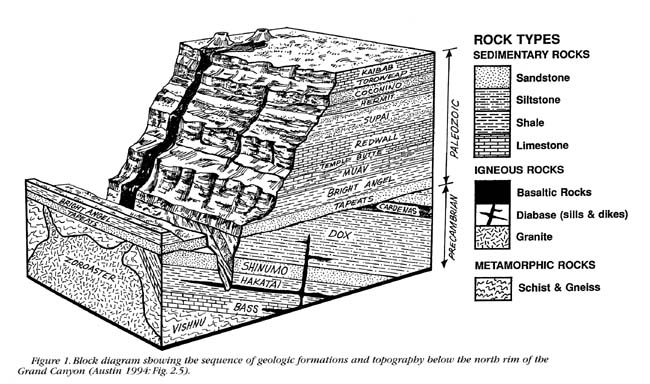
The Great Unconformity at the base of the Grand Canyon I've already explained as most likely caused by the same volcanic force AFTER all the strata were in place. It's an educated conjecture in that case (just as the build-tilt-erode-build interpretation is conjecture), but there is another angular unconformity in the region that I think clearly shows that it had to have been created in that order. Here are some diagrams:


Click to see enlarged. This is an official government drawing showing the whole area from the Grand Canyon through the Grand Staircase.

Below is the north end of the Staircase from this same diagram showing the angular unconformity to the north of the Hurricane Fault. This unconformity was apparently created by the slipping of the fault line. The land dropped about 4000 feet and tilted the strata both against the nearly-vertical fault line and against the layer above marked “V” which remains horizontal.

Perhaps this section fell simultaneously with the raising of the main body of the strata. Probably the volcanic eruption indicated in the magma dike which exits in a lava flow at the very top of the Staircase was the cause of the whole displacement.

Since we see the same stack of strata on both sides of the Hurricane Fault, in the same order, but one side is tilted except for the horizontal Clarion layer “V” and the other is continuous, all parallel, this ought to suggest that the unconformity was created in one event. This should bring into question Hutton’s interpretation of angular unconformities as requiring a great deal of time for tilting and erosion before the laying down of new horizontal strata. In this case the horizontal layer was almost certainly already there as it is continuous with the one to the right above, and the whole structure appears to have been formed in one event.

I've been trying for some time to come up with a good model for how I think this happens -- that is, how lower strata could be folded or tilted beneath higher strata without disturbing the higher strata -- and although I can describe it I can't think of practical examples that demonstrate it.

The example comes to mind of the trick of pulling a tablecloth out from under a full table setting of dishes and cups and so on without disturbing them and that does demonstrate that force can be applied to an object beneath other objects without disturbing them. The conditions required for this to work would be heavier solid upper objects and more flexible lower objects, which is exactly what I have in mind, but of course this example doesn't exactly DO what an angular unconformity does. There must be many other examples but I keep drawing a blank.

I've also imagined an experiment with modeling-clay strata but that's really beyond my means to set up and it would be much too hard to recreate anything like the circumstances of the actual strata on such a small scale. But then I found a description of exactly that sort of experiment having already been done, in Chapter 5 of Elements of Geology by Charles Lyell, friend of Darwin and popularizer of Hutton's theory of a very old earth and the principle of uniformitarianism. He was trying to explain how folded strata form, such as in this sketch on the same page:


Folding by Lateral Movement.—An experiment was made by Sir James Hall, with a view of illustrating the manner in which such strata, assuming them to have been originally horizontal, may have been forced into their present position. A set of layers of clay were placed under a weight, and their opposite ends pressed towards each other with such force as to cause them to approach more nearly together. On the removal of the weight, the layers of clay were found to be curved and folded, so as to bear a miniature resemblance to the strata in the cliffs. Chap 5, p. 76
I've been looking for a way to illustrate the upright tilting of strata but this experiment demonstrated how they are folded or buckled. It's very important for my purposes that he placed the clay layers under a weight before applying lateral pressure. Lyell doesn't explain this but it seems intuitively necessary to do this. What I've been claiming is that the weight of strata above is a necessary resistance to the tilting of the strata beneath in the creation of angular unconformities; that is, the strata above would have to have already been in place before the tilting occurred, as opposed to the accepted theory which puts the tilting first, then erosion, then the laying down of strata above. The heavy and horizontal weight overhead would force the tilting or folding strata to form a horizontal upper surface, probably the result of violent erosion from friction between them and the upper layer as the force was applied.

On the present theory it's hard to see how tilted strata without a weight overhead could be anything but very irregular and jagged. And this is also where I question the idea that erosion at this point would level such a formation. I also question the idea of a hiatus or time gap during which the strata are no longer forming. What could cause that cessation? And if the strata did keep on forming after such a tilting of strata the new sediments would be forced to settle in the crevises between the jagged or folded uprights, they wouldn't just neatly arrange themselves in a new horizontal layer lying flat across the top of them.

Lyell even explains the absence of upper horizontal strata in some such formations this way:


the ... upper portion, being supposed to have been carried away by denudation, or that action of water which will be explained in the next chapter.
He next discusses an experiment which comes even closer to what I've been envisioning:
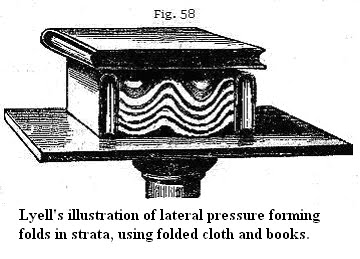


We may still more easily illustrate the effects which a lateral thrust might produce on flexible strata, by placing several pieces of differently coloured cloths upon a table, and when they are spread out horizontally, cover them with a book. Then apply other books to each end, and force them towards each other. The folding of the cloths (see Fig. 58) will imitate those of the bent strata; the incumbent book being slightly lifted up, and no longer touching the two volumes on which it rested before, because it is supported by the tops of the anticlinal ridges formed by the curved cloths. In like manner there can be no doubt that the squeezed strata, although laterally condensed and more closely packed, are yet elongated and made to rise upward, in a direction perpendicular to the pressure.
I would never have thought of using CLOTH, but it makes the point beautifully. Again a weight is placed above and the "strata" are shown to buckle just as real strata do under the weight with pressure applied from the side.

Lyell has accepted Hutton's view of an old earth and his principle of uniformitarianism, so throughout this book he assumes extremely slow processes for all the formations, but what's interesting is that he pictures a weight over the folding and tilting strata as essential to the explanation, and that contradicts Hutton's idea that the strata were FIRST tilted and THEN the upper strata were laid down over them. In fact that was essential to Hutton's idea of an old earth and now Lyell has shown that it's not necessary at all, apparently without grasping the implication that an old earth is not needed to explain these formations.

As you read on in this chapter of his book you find him showing how upright strata were probably originally folded, giving some good examples, including one of Siccar Point as part of a larger formation that includes such folded strata. He then describes the unconformity at Siccar Point in Hutton's terms:


...it is evident that a period had elapsed between the production of the two sets of strata, and that, during this interval, the older series had been tilted and disturbed. Afterwards the upper series was thrown down in horizontal strata upon it.
The model of the cloth strata between the books shows that this is most likely not the real order of events, that the weight of already-existing upper horizontal strata would have been necessary to the formation of the tilted strata.

I've also been imagining a tilting following a breaking of lower strata, but Lyell brings up the very likely possibility that the lower strata were originally folded and the bent or folded section was lost. He discusses only the case of their being lost through water denudation, but in the examples I have in mind they'd have been sheared off in the process of being forced under a resistant horizontal weight of strata above them. After the shearing what is left is simply tilted strata without evidence of the prior folding. I still think it possible that in some cases there was first a breaking and then a tilting and shearing off without folding. In fact I think that's most likely what happened in the angular unconformity illustrated above at the far north of the Grand Staircase. Maybe Lyell even considers that somewhere. His book is quite a tome but I expect to keep reading it.

So, the explanation for the unconformity at Siccar point is that there was originally a great depth of horizontal strata there just as there was everywhere else around the world after the Flood of Noah. Then tectonic or volcanic forces tilted or folded a block of the LOWER strata, which were sheared off at the top under the weight of higher strata that remained horizontal though they may have been raised by the force. Then it was probably the rush of receding Flood waters that scoured off the layers above those that remain. And the same thing occurred in the formation of the Great Unconformity at the base of the Grand Canyon except that a huge depth of strata remained in place above it, as only the very highest strata, those above the Kaibab layer that continue in the Grand Staircase to the north, were scoured off by the receding Flood waters.

I really think we could put QED to this here. Lyell himself in the very act of supporting Hutton's idea of extremely slow geological formation ignores Hutton's own inciting example in favor of an example that demonstrates that lower strata can be deformed under strata that remain horizontal, which does not require millions of years, but could easily have occurred in the time frame of the Flood of Noah and subsequent tectonic and volcanic pressures afterward.
==========================================================


***Blog Post Powered by Prayer***

This one was definitely powered by prayer more than others I've done as I was struggling to find the best models for what I've been envisioning and the Lord answered prayer for those models by leading me to Lyell's book, the most striking example being the cloth strata, but I credit the Lord for all the other ideas as well. I couldn't think a useful thought without his guidance. Of course, all errors are my own.

Sunday, May 8, 2011

Angular Unconformities: an Alternative Interpretation Part 1: Siccar Point

Geologist James Hutton's [1726 - 1797] drawing of Siccar Point (actually James Hall's, who was with Hutton), and a recent photograph:

Siccar Point, Scotland, is where James Hutton decided that the Earth had to be very old and set the ball rolling for that to become the standard assumption of geology, overturning all previous assumptions of a young earth. His conclusion was that the more-or-less horizontal rocks on top of the vertical rocks had to have been laid down long after the vertical ones were in place, as it would take a huge amount of time for the lower to have been laid down, then tilted upright, then eroded before the upper were deposited on them. This kind of formation is known as an angular unconformity and it is considered to be lethal for Young Earth Creationism.

According to Wikipedia:
Siccar Point is a rocky promontory in the county of Berwickshire on the east coast of Scotland. It is famous in the history of geology for Hutton's Unconformity found in 1788, which James Hutton regarded as conclusive proof of his uniformitarian theory of geological development.
And according to a University of Wisconsin article:
One day in 1788, he and some friends rented a boat and sailed along the coast, discovering the rocks here at Siccar Point. The younger sandstones are resting atop vertical beds of older rock. The older rocks must have been deposited horizontally, tilted, eroded, then buried by the younger rocks.
As I recall from a biography of Hutton he was familiar with the formation already but he and his friends went out looking for it to verify the theory he was concocting in his head about it.

As the theory has it, "the older rocks must have been deposited horizontally, tilted, eroded, then buried by the younger rocks."
The vertical rocks are now known to be about 425 million years old and were deposited during the Silurian Period. They were tilted during a mountain-building event caused by the collision of North America and Europe. In North America the collision created the northern Appalachians. In Europe it is called the Caledonian Orogeny (Caledonia is the old Latin name for Scotland.)The mountains were eroded flat and the younger rocks were deposited during the Devonian Period about 345 million years ago, about 80 million years later.
I accept the explanation that it was tectonic movement that caused the tilting of the lower layers, the same movement that built the Appalachians, but I believe it was the jerky breaking apart and pulling away of North America from Europe that did it, as well as the volcanic eruptions that brought about the split, not a collision. There is plenty of evidence of ancient volcanoes in Britain and western Europe as well as along the east coast of North America.

And the theory is reiterated: "The mountains were eroded flat" and new horizontal strata were laid over them some 80 million years later.
...The contact at Siccar Point is called an angular unconformity, a place where an interval of geologic time is not preserved, and where the lower rocks have been tilted so they form a sharp angle with the overlying rocks. Hutton's Unconformity at Siccar Point is one of the most spectacular examples in the world as well as being of great importance in the history of geology.
Here's a diagram of The Grand Canyon showing the angular unconformity at its base.

Here's a page showing a few of the famous angular unconformities. The theory is affirmed in the description of the Entrada formation:
This unconformity (a buried erosional feature) formed when folded rocks of the lower formation (Entrada) had been eroded to a relatively flat surface before the sandy basal conglomerate of the Morrison formation were deposited on and buried this erosion surface.
"A buried erosional feature."

Here are some animations of the current theory about how angular unconformities are formed:

Exploring Earth Visualization.

There are two series of animations on this page that include the formation of a nonconformity as well as an angular unconformity.

And here's another animation of the angular unconformity

The sequence is identical in all cases. You see the buildup of horizontal strata, then the tilting of the strata, then the erosion of the surface to a relatively flat plane on which new horizontal strata are built.

This online book Telling Geologic Time, is nicely done and gives some clear illustrations of the current theory. The following diagram comes from this book and includes the same steps as in the above-noted animations of how angular unconformities develop.


This diagram shows the theoretical erosion part of the process, the erosion of the buckled strata more or less flat. Again, the process as current geology visualizes it it involves the laying down of flat horizontal strata, followed by a buckling of the strata, followed by an erosion of the surface that more or less levels it, followed by the laying down of more flat horizontal strata.

MAIN OBJECTION TO THIS THEORY: COGNITIVE DISSONANCE HERE: SINCE WHEN DOES EROSION EVER RESULT IN A FLAT PLANE SURFACE? Even a "relatively" flat plane surface? Since when would erosion reduce a mountain or a buckled block of strata to a plain?

The diagrams based on the theory all show a leveling of the elevated parts of the buckled strata. The idea seems to be that even mountains are ultimately eroded utterly flat, like a plain, so buckled or tilted strata with all their protuberances are expected to have been eroded down to flatness.

In what universe?

ON THE CONTRARY, erosion follows gravity, making paths down hills from summits, carving stream beds and gullies, transporting rocks and other debris and depositing them hither and thither, even in this way transforming plains into pocked and pitted and lumpy bumpy terrain, the OPPOSITE of what is claimed by these diagrams. Erosion also has an easier job of it with soft rocks and not so easy with hard ones -- and strata contain both soft and hard rocks. No way normal erosion is going to neatly scour away a stratified mountain to a flat plain.

Funny how they assume that erosion would level the buckled strata and yet at the same time they believe an ordinary river carved the Grand Canyon. This is really quite funny.

The only time erosive processes would ever produce a plain would be in such a massive event as the Flood of Noah, when huge areas of the higher strata would break up under tectonic or volcanic disturbance and be scoured off the surface of a particularly hard lower layer by the receding Flood waters. This is what appears to have been the case with the formation of the Kaibab Plateau that extends from the rim of the Grand Canyon to the base of the Grand Staircase, and other parts of the Southwest where some remnants of the upper strata remain in the form of buttes and odd "monuments" and hoodoos and the like, while the surrounding terrain is flat.

But normal-sized rivers, even little streams, just cut gullies and deposit rocks and other debris that disturb flatness. Just happened to find this photo of erosion of the cliffs of Dover on Wikipedia: I think it makes the point.

One absurd idea that comes from this absurd theory is that the Appalachian Mountains are "older" than the Rockies or the Himalayas, even that the Appalachians were "once higher than today's Himalaya mountain range."

No, they are different kinds of mountains. Both formed by tectonic forces no doubt, but the Appalachians are rather gently buckled compared to the Rockies, which appear to have been abruptly thrust up toward the sky in one massive movement that often preserved the strata's straight parallels if not their horizontality. The Himalayas also show such a cataclysmic origin, though I can't even find strata in pictures of them. The Appalachians never had jagged peaks that supposedly eroded away. Their strata are often gently buckled into anticlines and synclines. No amount of erosion would turn the Rockies or the Himalayas into Appalachian type mountains, and no amount of erosion could reduce the Appalachians to a flat plain either.

But that's of course a side trip.

BUT ALSO, WHY DOES STRATA-BUILDING STOP AND EROSION BEGIN?
Another question that occurs to me is why they so consistently assume that after the buckling of the strata there MUST be a period of erosion? Why? Why doesn't the laying down of sediments continue as usual? What magic wand was waved to stop that process? If the erosive period continues for as long as 80 million years, as apparently it's supposed to have done in the case of Siccar Point, before new strata are formed over the old, why aren't strata being formed during that 80 million years as well? What is it that would suddenly trigger erosive processes to the extent of being able to wipe out mountains in place of the usual processes of strata building? If strata just simply continued to be formed after the buckling of the previous strata then the new sediments would fill in the spaces in the buckled strata first. I'm not even sure there is such a formation anywhere to be found on the planet.

As there shouldn't be according to Flood theory, which shows that all the strata were put down at one time and buckling and other distortions occurred afterward.

Just another way the current theory makes no sense.

[Realized later that they assume the strata were laid down under water, tilted under pressure, then the land was lifted above the water and that's when the erosion began and the deposition of strata stopped. This raises its own questions but I realize it's at least necessary to acknowledge this much.]

SO HOW DID THE ANGULAR UNCONFORMITIES FORM?

1) All the strata had been built by the Flood.

2) A tectonic force from the side or a volcanic force from beneath (in the case of the Grand Canyon) tilted or buckled a block of the lower strata WITHOUT DISTURBING THE STRATA ABOVE THEM. Slippage between layers of different kinds of rock would facilitate such a movement, softer rock buckling under harder rock for instance. In the case of the Grand Canyon the volcanic force raised the whole area so that the higher strata follow the shape of the mounded elevation into which the canyon was cut, but even higher strata that were once there were cracked and broken by the force and washed away in the flood waters, leaving the Kaibab Plateau as the uppermost layer, a hard layer of limestone. Underneath, the volcano displaced the lowest strata which were met by the counterpressure of the heavy upper layers and simply tilted beneath them, creating erosion by the friction between them and the layer they are sliding under.

Same thing certainly happened at Siccar Point and other angular unconformities. One thing to notice about Siccar Point is that although a difference of 80 million years is assumed between the lower vertical and the upper horizontal layers, they look identically weathered and eroded. Speaking of what erosion is supposedly capable of, according to current theory, you'd think the entire block of vertical strata would have been reduced to the supposed flat plain well within the 80 million years allotted to it before the upper strata were deposited. At the very least they should look a lot more spindly and splintery than the upper strata in such a time frame.

TO BE CONTINUED.

Wednesday, November 17, 2010

Science rejects THE source of truth and prides itself on its trek down the primrose path.

At EvC today,
Percy writes:
Dembski writes:
As a biblical inerrantist, I believe that what the Bible teaches is true and bow to the text, including its teaching about the Flood and its universality.
An inerrantist of any type, whether Newtonian, Darwinian, Einsteinian or Biblical, cannot be considered a scientist.
This is of course a foundational principle at EvC, though to one who knows the Bible as the Word of God, very odd, as if Science had consciously chosen to be misled. Consciously or not, of course, they ARE misled.

The thread to this point has questioned whether Dembski is really true to the Bible, but I don't have an opinion about that and it doesn't make a difference on this particular point. Dembski claims to believe that the Bible is inerrant and Biblical inerrancy is the point in question.

Percy doesn't seem even to recognize that his statement is based on nothing but a raw assumption, the assumption that the Bible is on the same level as the writings of Newton, Darwin and Einstein, a mere human work. But of course to a believer the Bible is truly the word of God, and as the word of God it can instruct us in EVERYTHING as whatever God says is foundational to ALL truth, including science. It's not a scientific text but it says just enough to make science a liar if it ignores it.

If you start with the Bible you can't go wrong, scientifically or any other way, as long as you recognize that your take on what the Bible implies on scientific questions may not be right. But if you make your own fallible intellect your foundation you will forever be finding what seem to you to be contradictions with the Bible. The problem with scientific thought over the last oh 150 years or so, particularly about origins -- origin of the cosmos, origin of the planet, origin of life -- is that it has progressively rejected God's word because fallible intellect is unable to reconcile its own impressions with the Bible's often veiled hints.

Early scientists had some strange ideas about what sort of evidence the Biblical Flood would have left, for instance (and science is stuck still with those strange ideas), so when science pointed out a fact or two that did not square with their strange ideas they jettisoned not just the strange ideas but the Bible itself, as if those strange ideas came from the Bible, which they didn't.

Same with Galileo. The Roman Church was enamored with the teachings of Aristotle through Aquinas, mixing pagan belief with God's word (just as they do with their worship of the "saints" and the "Queen of Heaven" and relics and indulgences and all that pagan superstition along with their lavish pagan paraphernalia and unholy wealth), and Aristotle's pagan religion put the earth at the center of the cosmos. So it was Aristotle, not the Bible, that Galileo's findings contradicted, but people still have the mistaken impression, since the Roman church taught that mistaken impression, that it was the Bible he contradicted. Now they have accepted Galileo and rejected the Bible, although there is no contradiction, and they have accepted evolution and rejected the Bible, although it should be the other way around.

The early geologist Hutton took a look at a formation on the coast of Scotland and declared off the top of his own fallible head that it proved that the earth was ancient, far more ancient than the age determinable from the Bible, and scientists ever after have accepted that declaration from his fallible head and added their own fallible conjectures to it, declaring it all fact as they went, as well as their conjectures about some supposedly objective scientific procedures they believe confirm it.

God will laugh in the end.

Saturday, March 13, 2010

Diary more than anything else

I'm not much of a blogger if the objective is to make contacts with others of similar interests, and I've thought that eventually I would go out and connect with other blogs on my favorite topics; but I've come to think of my blogs as more like a diary or journal, a place to organize my thoughts. I enjoy it when someone does come by and comment, even if the comment is loudly negative, as many are of course on the subjects I pursue.

Lately I've been blogging less and reading more. Still in my favorite subjects. Bought some books I really can't afford and am having a very enjoyable time of catching up on the history of science. I wish I could afford more. In fact I wish I could live inside the most complete libary on earth. The internet is wonderful that way, but it's not complete and I do get frustrated at times.

I've been reading mostly in the history of geology lately. I started out reading in genetics but found myself in geology before long. Both of course are related to the issues surrounding evolution. Read a biography of James Hutton, "the father of modern geology," very entertaining as well as informative. Accumulating a big wish list at Amazon on geology books, such as Hutton's friend John Playfair's Illustrations of Huttonian Theory. I wish I had access to a whole slew of pictures of the geological formations on which Hutton developed his theory of the earth -- I may find that in a more modern book on geology, of which I have one in my wish list too. Again, the internet is a great source for these things, I just wish there was more available. I also wish it were less expensive to print out the sources that ARE available. If wishes were horses .... Academic books are often prohibitively expensive. Sometimes you can find a decent deal on used books through Amazon but if the book is a classic the used copies will be too expensive too.

I can't go out and look at these formations for myself so pictures are absolutely necessary. There are photos and diagrams of Hutton's Siccar Point available on the internet: Here's a good one and the comment about how Hutton simply looked at it and "realized" the earth was old is priceless. This site speaks of "environments of deposition." I find this very amusing but of course geologists take it seriously.

I have plenty of thoughts about Hutton's theory, but I'm not going to post them here right now.