Showing posts with label Strata. Show all posts

Saturday, October 8, 2016

Yes, the only reality is the stacks of rocks.

Apropos the previous post, the "stacks of rocks" mentioned came from the title of a thread I started at EvC:  The Geological Timescale is Fiction, Whose Only Reality is Stacks of Rocks.

The direction I took with that argument was to try to show the implications of the fact that the actual and only evidence we have on which the Geological Timescale is constructed, is the rock strata, usually called the Geologic Column, that the whole idea of time periods is based on that stack of rocks and on nothing else, but that in reality there is no physical way for the scenes imputed to the time periods to have become reduced to the actual layers of rock that represent them.

The scenes or landscapes I'm referring to are those fictional illustrations you may have seen here or there, depictions of whatever environment is supposed by standard Geology to have characterized a particular time period, a particular kind of landscape with particular plants and animals, as determined by the fossils found in the rock layer of formation of layers that represents that time period. 

Here's a typical example, this one of the Permian Period:


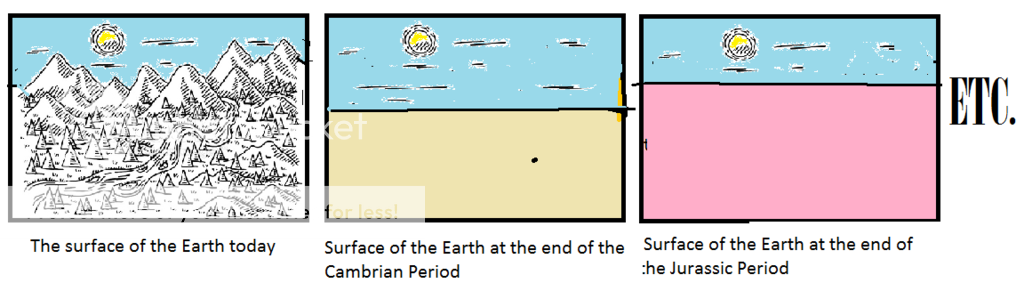
So I put together a cartoon to show the basic idea that there were never scenes or landscapes represented by the rocks, but only the rocks themselves, which would be huge flat featureless expanses of sediment. 


Even if there had been a landscape for a particular time period, since it all has to reduce down to the flat rock that is its only evidence, by the end of any "time period" there would be nothing left of the landscape but the flat sediment that will eventually become the rock.

Since the strata do not occur everywhere on earth, presumably there would also be areas of chaotic deposition as well, if the cause was the Flood, but there is no evidence of a normal landscape apart from the strata, although it must be assumed in the standard interpretive scheme, assumed but nothing more, because all the evidence of the time periods is contained in the layered rocks.  It is the strata that contain the fossils, it is the strata that are dated, all schematic representations of the Geological Timescale identify it in terms of the stratified rocks.

But again, the rocks are the ONLY evidence.  And what that means in terms of the historical situation is that if there was once upon a time a landscape in which creatures lived, in a particular slice of time, called Cambrian, or Devonian, or Permian, or Jurassic etc., at the very end of that period there had to be nothing but this expanse of sediment and no remains whatever of the supposed landscape,   And that must be the case because all there is now is an expanse of flat rock.  Before it was rock it had to be an expanse of flat sediment, no doubt wet sediment, and if we are to imagine a landscape that got reduced down to that flat wet sediment we have to imagine that everything that had lived in that landscape left no trace whatever, assuming anything specific lived in that hypothetical window of time.  

But we will be reminded that the surface of some of those rocks is marked by animal tracks, animal burrows and other signs of life, and raindrop impressions and ripple impressions, which are interpreted by the standard theory to be evidence that there did exist a landscape that represents the time period. 

Which led me to another part of the argument:  the observation that those tracks and burrows and raindrops and ripples were clearly formed on a huge flat featureless surface and not in any kind of normal landscape with plants and hills and valleys and so on.  This is apparent, after all, from the simple fact that they are embedded in the surface of a huge flat rock, or burrow into a huge flat rock.  All of such tracks that are found in the strata, all the burrows, all the raindrop impressions, all the ripples:  they all occur on these flat featureless expanses of sediment that are now rock in which they are preserved.  So these very phenomena that are taken for evidence of a time period with its own kinds of plants and animals, are really evidence against the idea.  At the moment they were impressed into the sediment there was no such landscape, only the vast expanse of sediment itself that became the vast flat featureless rock.  So either somehow the assumed landscape was transformed into the rock, or there never was a landscape at all, just the vast expanse of sediment.  Which is of course consistent with the Flood explanation and not the time period explanation.   The time periods are pure interpretation, pure theory, based entirely on qualities of the rock itself plus its fossil contents.  If it's limestone it must have been formed a shallow sea for instance, if it's sandstone with a certain angle of crossbedding it had to have been sanddunes on that very site, that somehow got compressed into rock with flat top and flat bottom.  And so it goes..

The arguments on that thread revolved around efforts to show me how the expected landscape that represents a time period could have been reduced to an expanse of rock, in fact a whole stack of such rocks that was once a whole stack of such landscapes. 

To be continued.

Evidence in the strata against the Geologic Timescale and for the Flood

Having quit posting at EvC again, I've so far resisted all temptations to return, really having no desire whatever to put myself through the inevitable frustrations and utter futility of it.  That's a topic in itself since I used to encounter temptations I couldn't resist and now I can resist them, finally being able to see ahead enough to realize that no matter how good I think my argument is, or a given post, nobody else is going to find anything good in it.  I used to be taken by surprise all the time by the incredibly ingenious ways they all have of managing to mangle a simple reasonable statement.  Well, somehow I did come to be able to anticipate that anything I say will be so mangled and once I could do that all desire to try again just evaporated. 

But nothing's perfect and this morning I found myself tempted to answer something.  I do know better now, I know I can't just get away with simply answering it, I'll be drawn into a round of escalating misrepresentsations that I feel obliged to deal with, having already given in to the initial temptation.  So the only solution seems to be to answer it here:

It's a very simple misrepresentation concerning the use of evidence that I should be able to answer very briefly:
About Earth's history Faith likes to call geological strata "stacks of rocks" as if they contain no evidence of time and process, ... "Evidence? What evidence?
Not exactly.  I find evidence in the rocks and have described it many times, even evidence of "time and process":  it is evidence of rapid deposition, seen in the tight straight lines between layers, lack of the sort of erosion that would be expected from millions of years of exposure, either marine or aerial; also seen in the different sediments that frequently characterize separate layers;  just to name a few.  It is also evidence of process:  rapid deposition by water:  that's the only process that could account for those tight straight lines and the clear demarcation between layers and different sediments.  I also find evidence in the many cross sections constructed of various stacks of rocks, that give away such things as that whole blocks of layers are all bent together in a particular direction which demonstrates that they were all malleable, still soft, which contradicts any idea that they were laid down and lithified into rock millions of years apart.  This is shown in places where the rocks curve as a unit, also in places where faults have displaced sections of strata.  Also the utter lack of the sort of erosion consistent with exposure as mentioned above.

There's plenty more and I may come back to add to the above.

So it's simply not so that I ignore evidence.  I'm sure that every thread I've started on the subject of the strata is aimed to demonstrate the interpretation of a particular bit of evidence in favor of rapid deposition and against the idea of millions of years of time per formation. 

Saturday, October 15, 2011

More on the Flood, inadequate comparisons with local floods

There have been half a dozen posts at EvC recently, mostly on the Flood, that I've wanted to respond to but haven't been able to get to them, don't know if I will yet. But here's a new one:
Portillo says: Billions of dead things, which we call fossils, laid down by water all over the world.
And Panda answers: Although true: that is far too a general statement to be useful.

The following sentence is also true:

If 1000's of small floods occurred over millions of years, what would you expect to find? Billions of dead things, which we call fossils, laid down by water all over the world. And what do we find? Billions of dead things, which we call fossils, laid down by water all over the world.
Sorry, but this sentence is NOT true. Perhaps Portillo should have been more detailed in his remark but that probably wouldn't faze the sophists at EvC either. But anyway, No, from small floods even in the millions we could NOT get the billions of dead things that we find as fossils in the worldwide strata and we certainly do not get the depth and extent and amazingly consistent appearance of the strata themselves, an appearance that suggests to anyone really thinking that they all had to have been created in ONE event, not a series of events, and not a hodgepodge of little floods over time. This is just evo sophistry run amok.
There needs to be something to separate your claim from the more mundane floods that we see regularly, all over the world.

So, although correct, you statement needs to be more specific to rule out the everyday events.
As I've stated above.

And Dr. A adds his own two cents in the next post:
[Portillo]If a flood occurred, what would you expect to find? Billions of dead things, which we call fossils, laid down by water all over the world.
[Dr. A]Why? Is mass fossilization the usual sequel in the locale of a localized non-magical flood? Please provide evidence that this is the case.

If not, then I would have no such expectation.
Interesting. He's implying a disagreement with Panda's implication that local floods COULD have produced all those fossils. He's right, they could not. Mass fossilization is NOT the usual sequel to local floods, there is no comparison, which just highlights Panda's sophistry.

But he's also committing the error of thinking the Flood of Noah can be compared to local floods. About the only effect that they can be used to demonstrate is the destructiveness of even small floods, which ought to get across that there had to be huge effects from the worldwide Flood. And there are: The entire world has a wrecked and tumble-down appearance, but also the strata and the fossils around the world testify to it to anyone with eyes to see. NOTHING could have created all that BUT the Flood of Noah.

Earlier in the same thread Dr A responds to someone's claim that the Channeled Scablands of Washington show what would happen in the Flood:
[Coyote]One example of this is the evidence left by the Channeled Scablands of eastern Washington.
[Dr. A] I think I've expressed my doubts about the Channeled Scablands before, but this is a new thread, so I'll do it again.

The snag is that they were caused by the breaking of a natural dam so that a lot of pent-up water swept laterally across the landscape. Rather than by a lot of rain. Sure, it's a catastrophic flood, but is it a good model for the Flood
And in another post down a bit:
[Coyote] The massive amounts of rain would quickly seek lower levels, and we know from recent disasters how devastating that can be.
[Dr. A] Devastating, yes. Producing channeled scablands, no.
And if I'm following this correctly -- it's not as clear as it might be-- he's right, the Flood would not have created the Channeled Scablands. The Flood wouldn't carve land like that, simply destroy it, at least in the initial stages from the heavy rains -- but the Flood and ONLY the Flood could have deposited the strata -- in a later stage. As current Geology convincingly says about the Scablands, they were created by the breaking of a dam that released a massive amount of water from a standing lake. THAT kind of water flow COULD carve such channels.

However, in a sense it IS still all the Flood's doing, as a Floodist regards that enormous lake, known as Lake Missoula, to be water left after the Flood had drained away, along with other giant lakes such as Lahontan and Bonneville in the same general area. It's also seemed to me that a trigger for the breaking of the dam and the release of the water from not just Missoula but all the lakes could likely have been the tectonic forces that came into play some time after the Flood. They built the Rockies, pushed up the land, could have dumped the lakes as well. Something like that is surely what carved the Grand Canyon and Grand Staircase area. The canyon appears to have been formed first by deep volcanic eruption which raised the land in that area and cracked the upper strata which had been laid down to a depth of two miles or more originally. That admitted the residual standing Flood waters as an enormous cataract pouring in from all sides of the crack. Certainly something like that had to have been the case. The Colorado river even swollen to the max could not have done such a thing in billions of years.

LATER ADDITION:
Then Coyote, who repeats his mantra about the age of the strata and the fossils because he can't think any other way. He regards it all as fact to such an extent that his mind can't even produce a contrary thought.

Anyway, here's his comment:
If a flood occurred, what would you expect to find? Billions of dead things, which we call fossils, laid down by water all over the world. And what do we find? Billions of dead things, which we call fossils, laid down by water all over the world.
One problem with this scenario is that these fossils are spread over a billion or so years; they are far from being the same age.
Sorry, we believe your methods of dating are all wrong, don't believe a word of it. They ARE all the same age, you just have to learn to see with new eyes.
Another problem is that we can see evolution in the fossils. These layers of different ages show a progression of critters from older to younger. This progression had to take a lot of time to develop.
They SEEM to but you are of course ignoring anything that contradicts that perfect scenario and you are INTERPRETING the differences between varieties of the same type to be evolution of that type when all they are is VARIETIES that form from the BUILT-IN gene code for that species. Trilobites for instance obviously had a broad range of variation possible built into their genome. And there is really nothing about them to justify your categorizing those higher in the strata as younger or "more evolved" than those lower, that's just an artifact of your theory / figment of your imagination. I'm sure you can rationalize it but without any real justification, only by noting certain factors while ignoring others. And if you are talking about different species in the sense of Kinds (they're called something different from the other species) being older or younger with respect to each other, again that is PURELY an artifact of your theory, something you can possibly rationalize by making certain comparisons and ignoring others, but in reality they are simply SEPARATE SPECIES with their own species-specific gene code.
Also, floods don't produce fossils.
That is true, the ordinary everyday floods that go on in our time do NOT produce fossils. But the Flood of Noah did, because it moved such prodigious amounts of sediments and living things and deposited them in such thick layers all over the earth it created the ideal conditions for fossilization.
Shellfish fossils are produced in oceans, and sometimes lakes or marshes.
HOW DO YOU KNOW THAT? Meaning what is your evidence. But of course one would expect seashells to come from the ocean so that part's obvious. But the FLOOD WAS AN OCEAN FER PETE'S SAKE. You know, ALL THE WATER ON THE PLANET KINDA SORTA MINGLED TOGETHER IN THAT EVENT. As for "sometimes" lakes or marshes, HOW DO YOU KNOW THAT? Kindly give us the evidence that any lake or marsh since the Flood has produced a fossil. I don't say it's impossible, only that any of the billions of fossils in the strata were NOT produced by a lake or a marsh.
The most a flood could do is move a fossil.
This was not just "A FLOOD," this was THE Flood to end all floods. It did not MOVE fossils, it MADE fossils.
Ignoring the two problems above, what are the odds that the fossils could be ripped up from their original locations and sorted out by time and type in their new locations by chaotic flood waters?
The fossils weren't, but the question applies somewhat to the living things themselves that were buried by the Flood. The TIME element of course does not apply, that's just your usual presupposition that you can't seem to suspend even for a moment's consideration of another point of view, but the sorting by type is mostly a SEEMING sorting by type as I say above. However, the Flood wasn't as chaotic as you seem to think. Ocean water has layers and currents and streams in it and these carry things. We can only suppose that the living things were sorted by some physical factors as well as their original habitat and their having been found all together in one place at the time of the Flood.

===========
And now Nuggin following Coyote:
If a flood occurred, what would you expect to find? Billions of dead things, which we call fossils, laid down by water all over the world. And what do we find? Billions of dead things, which we call fossils, laid down by water all over the world.
When floods occur, they kill everything that can not get away. They sweep all the dead things downhill to form giant piles of dead things.
As is the case with most here, you are picturing an ordinary flood limited in space and time compared to THE Flood which covered the entire planet and lasted a year. It rained 40 days and 40 nights during which time mudslides would have occurred and living things would have sought higher ground, most likely flocking together in their own groups. When they are swept up in a mudslide they are all together with perhaps the odd misfit as well. They do not form just a bunch of giant piles because there is too much water. Some may stay buried but as the water rises it's going to continue to erode away the land including all the mud with the dead creatures in it and carry them in the water along with the sediments. We know water sorts sediments, and apparently there was enough of it in the Flood that it also sorted everything else and carried it along in its layers and currents and streams until whatever law of physics came into play at whatever was the right phase of the Flood and dropped them on the now-denuded land mass in interestingly separated layers of sediments with their peculiar creaturely contents.
Those dead things are not sorted.
Not in an ordinary little local flood. Think bigger, Nuggywuggy.
If you flood Upstate New York, you are going to get dead people, dogs, cats, horses, cows, deer, coyotes, raccoons, mice, rats, snakes etc. All the things in the environment.

When we look at fossil beds we do not see a vast collection of "everything". We see certain groups of things clustered together and then other groups of things clustered together in different strata.

If "The Flood" were to occur, we'd expect to find elephants AND mammoths AND mastadons AND rabbits AND T-Rex AND zebras all in one big piles
We never find that. Ever.

So, unless "The Flood" included magic sorting water, your claim just doesn't.... carry water.
. Yeah well you've got the usual commonsense notion based on no knowledge whatever or even a reasonable imagination of what a worldwide Flood would do that lasted an entire year, just the usual itty bitty flood you've seen with your own eyes on television. And it has its plausibility as an exercise of fallible human imagination but that's all it has.

Actually your objection to the way things are sorted is just as much an objection to the evolutionist explanation. OK you've got the strata sorted VERTICALLY into time periods so you can get away with explaining the sorting of the fossils in terms of time, but there's nothing in evo theory that accounts for the HORIZONTAL sorting that is also seen in the strata. There is some mixture, sure, but there are also whole beds of one family of creatures from trilobites to dinosaurs, sometimes so ridiculously packed together the idea that they died in anything other than an enormous catastrophe is just ludicrous. Why should that be? Do animals all go to the same place to die? Not in our world. They die willy nilly just as you picture those creatures from New York dying in your tiny little flood.

No, SOMETHING sorted all of it. Seems to me the Flood is the only reasonable explanation. Something to do with the characteristics of a huge body of water, not magic.

Sunday, August 14, 2011

Polystrate Tree Fossils

So I've been taking some side trips into other than my usual / favorite issues, and ran across the "polystrate trees." These are trees that have been fossilized in an upright position penetrating through MANY layers of sedimentary rock, or in terms of geological time, through millions upon millions of years, which of course is impossible. Yet this common creationist argument is treated by evolutionists as merely one of countless PRATTs, or "points refuted a thousand times." Of course they haven't refuted most of them, they are simply claiming they have. In the case of polystrate trees, as usual they act as if they've definitively answered the creationist argument but they've really merely sidestepped it.

As I discovered when I did a little reading on it:

At Wikipedia I found this completely evasive remark:
Geologists see no need to invoke a global flood to explain upright fossils. This position of geologists is supported by numerous examples, which have been found at numerous locations, of upright trees completely buried within either late Holocene or historic sediments. These buried upright trees demonstrate that conventional geologic processes are capable of burying and preserving trees in an upright position such that in time, they will become fossilized
Creationists certainly do argue for the Flood against the geologic time table of millions of years per flat horizontal slab of sedimentary rock, but referring to the Flood as if that were the only creationist argument about the significance of polystrate tree fossils completely evades the point.
The problem with polystrate trees is that given the enormous time spans assumed by current geology no tree could remain intact while the sediments were depositing, so as to appear whole after the millions of years it supposedly takes for them to deposit. But they do appear whole. Go look at the photos at the links. Their wholeness through what are supposed to be millions of years proves that the assumption of millions of years for sedimentation to occur is false.

[Later: It needs to be said in here that they claim that RAPID DEPOSITION occurred in the case of the polystrate trees. But rapid deposition of more than one layer normally identified as a time period of millions of years simply eliminates those millions of years altogether -- but it certainly fits the Flood, which somehow they manage not to notice. More on this farther down the post].

And yes, the far better explanation IS the worldwide Flood which would have rapidly buried them in a sequence of sediments in very short order, which is the necessary condition for fossilization of a whole upright tree buried in many layers of sediment.

Polystrate tree fossils DISPROVE THE TIME SCALE OF CONVENTIONAL GEOLOGY. This is "just another PRATT" only in the dreams of evolutionists.

I then went to the article on the subject at Talk Origins, probably the most famous website on the creation-evolution debate on the web, and found them being evasive in a more convoluted way (anything to mystify the reader I guess).

I next found a creationist discussing the Talk Origins article, which you can find at his site. Here he's elaborating the point I just made above:
...This argument craftily avoids the issues while claiming to explain them. The issues in question are:
1) How did the tree survive during multiple catastrophes without rotting or being knocked down?

2) How can anyone reasonably believe that a tree could stand for the length of time it takes to build up the additional layers?

3) How can a tree representing a short life span (on evolution’s geological time scale) stand erect through geological layers representing millions and often hundreds of millions of years?
This is not a problem for evolution? Regardless of how you slice it, the tree had to stand erect without rotting, falling or being knocked down for millions of years. The layers of strata have fossils representing different time periods according to the evolution model. It DOES pose a huge problem for evolution. If the tree was buried rapidly as Dawson hints toward and as creationists have said all along, evolution is out the window. If all layers were deposited together, then there is no such thing as millions of years. That would mean that all fossils were laid at the same time.

...If the trees were not covered rapidly, then there is no explanation as to how a tree could have embedded itself into layers of strata that accumulated over millions of years. The article does not attempt to answer any of these questions. Yet it claims (as all evolutionists do) to have the answers.
This writer also makes the intelligent point, which I unfortunately don't let myself believe sufficiently, that you cannot win the argument with an evolutionist. He won't listen to your argument for starters, he will simply bury you in his claims for "evidence" for evolution which he accuses the creationist of failing to appreciate and refusing to learn about, and aggressively drowns out all contrary ideas with as much abusive insulting language as he can muster.

==============

Here's DWise on this subject a couple years ago at EvC:
But even more telling was what that article said about rates of depositation. While Steve Austin was being paid by the ICR to get a post-graduate degree in geology (so that they could finally claim to have a degreed geologist on staff) he would write creationist articles for them using a pseudonym, "Stuart Nevins". As Stuart Nevins, he wrote an article in which he claimed that geologists believed that strata formed at a completely gradual and constant rate, even though even undergraduate geology students know full well that that is a complete and utter lie -- and Austin was writing that while he was a graduate student. He had to know better and yet he still repeated that lie!

Well, had Austin actually read that article (I learned to not make such an assumption about creationists with the ICR's NASA document moon-dust debacle), he would have learned what he should have learned years ago in his undergraduate classes: geologists can distinguish between layers formed by rapid depositation and layers formed by slow depositation. It's described in Broadhurst's article. Those "polystrate" tree stumps were buried in layers formed by rapid depositation.
Typical snide suspicious accusatory anti-creationist post from someone who hasn't the grace to give the benefit of the doubt on any point whatever, is willing to utterly trash anyone he disagrees with.

TELL US, MR. WISEACRE, HOW geologists distinguish between layers formed by rapid deposition and those formed by slow deposition. The question is HOW. Give us the "science" involved. You can't get away with a flat assertion and call it science. What exactly is it that tells them the difference? And give us all the independent tests that verify it too.

HOWEVER, since you admit that they were buried in rapidly deposited layers, THEN tell us how we are to distinguish the rock strata built up in such a fashion from those built up more slowly. Must be pretty subtle differences, Mr. Wise, of gossamer fine subtlety I suspect, mystifyingly fine just to stand back and look at a stack of strata and wonder which might have been which. Oh the ones with the polystrate trees in them, THOSE were rapidly deposited. Right.

HOWEVER AGAIN, we're talking about MANY LAYERS OF STRATA THAT ARE NORMALLY IDENTIFIED BY GEOLOGISTS AS ENORMOUSLY LONG TIME PERIODS. The "Carboniferous," the "Holocene" are specifically mentioned in connection with polystrate trees. Are these millions-of-years-long ages or not? Did the lower "age" deposit rapidly and then WAIT a few million years for the next "age" to start depositing, while the tree just sat there twiddling its thumbs instead of rotting away?

If you have three or four "time periods" all rapidly deposited around a tree trunk, guess what you have? You no longer have "time periods" at all, YOU HAVE THE WORLDWIDE FLOOD.

RAPID DEPOSITION IMPLIES THE WORLDWIDE FLOOD, and there is NO way they can talk their way out of the evidence of the polystrate trees against an Old Earth except of course by the usual evolutionist "scientific" methods of ridicule, accusation, snide put-downs, self-delusion and lies.

Monday, August 8, 2011

Dealing with some arguments against the Flood

D Wise who posts at EvC forums has his own site on the debate, or really, on what's wrong with creation science. He's amassed quite a collection of arguments against creationist arguments, many against the Flood. This is an improvement over the endless refrain at EvC that the Flood has been discredited many times over although most of the time all they offer is that refrain and leave it to the reader to figure out what evidence they have in mind. So it's helpful to see all the arguments mustered in one place, as D Wise does on this page.

It's a formidable collection and I'm sure I won't be able to address more than a few of them, but I'd like to do whatever I can, and I'll take them in the order he's presented them:

First, I just want to note that he's extremely offended at the statement of belief made by the late Henry Morris of the Institute for Creation Research:
Notice that they [some Christian geologists] suffered severe crises of FAITH, not of GEOLOGY! This should not come unexpected, considering Dr. Henry Morris' teachings about geological evidence, teachings which the ICR lives by:
"No geological difficulties, real or imagined, can be allowed to take precedence over the clear statements and necessary inferences of Scripture." (_Biblical Cosmology_, page 33)

"The data of geology, in our view, should be interpreted in light of Scripture, rather than distorting Scripture to accommodate current geological philosophy." (_Science, Scripture, and the Young Earth_, page 6)
In short, if it don't fit our theology, then either make it fit or ignore it. To that, his son and heir apparent, John Morris, has added (and many at the ICR seem to concur and actively teach): if it refutes the smallest part of our theology, then it disproves our entire theology. No wonder those students suffered so at seeing their faith crumble before them; this is one of the more distasteful and destructive consequences of the "Dark Side of the Farce."
Of course we can't expect an unbeliever to grasp the importance of the credal statement by Henry Morris, but all Christians should certainly embrace it -- it is the Light while the Dark Side is the offense taken against it. The Bible is God's word, not to be subjected to dissent or argument, that's the nonnegotiable foundation. And yes, we either have to find a way to reconcile science with it or simply leave science alone until enough is known to make the reconciliation. There is no other alternative, whether Wise and other unbelievers find this "distasteful and destructive" or not. Our faith and the world will always be at enmity.

Of course this assumes RIGHTLY reconciling science with scripture, although Wise accuses creationists of all manner of dishonesty, and I'm not going to get into that because I haven't followed all the creationist claims. The one time I specifically asked an evolutionist for an example of such dishonesty he described what was really only a confused wrong idea about what evolution teaches, not dishonesty at all. In fact I haven't yet seen an example of what I would have to agree is dishonesty. Not that it doesn't exist, I wouldn't know.

So I generally avoid those issues, but I'll weigh in on the basics. One of the basics is that God's word trumps ALL. Period.

That said, on to the science issues (I've added the headlines):

TIME NEEDED TO FORM GRANITE AND METAMORPHIC ROCK

Also speaking at the 1986 ICC was Harvard paleontology graduate student Kurt Wise (no relation, I'm sure), who surveyed what is known about the speed of formation of the three major kinds of rock. While he found that many kinds of sedimentary rock can form rapidly, igneous rock is another matter. While a small chunk of granite can conceivably form in a short time, many massive bodies are known, such as huge granite batholiths, some of them 10 kilometers in diameter, in the White Mountains of New Hampshire. Under the most favorable conditions, such formations would take about 100,000 years to cool, instead of the 6000 to 8000 years required by Flood Geology. Metamorphic rock is worse since it must first be formed as sedimentary rock, be heated, and then cool off.

During the question period, geophysicist John Baumgardner pointed out that Wise's figures had been very conservative and that much more time would be needed for rocks to form. He also offered sheer forces as a source of heat and pressure for metamorphic rock, but Wise countered that many metamorphic rocks show no signs of sheer.
[It's "shear" but anyway]. As I've been refining my view of the formation of the Grand Canyon I came to the question of how the granite and schist at the base formed. I've explained the Great Unconformity at the base as brought about by the volcanic eruption that is evidenced by the magma (granite) intrusions in all the illustrations as well as by the uplift of the area of the canyon itself, and logically the granite and metamorphic rocks were also formed by the same eruption.

There's heat and pressure generated by the volcano plus the weight of the strata overhead for that part of the transformation -- the metamorphic rock or in that case the schist -- and if all this occurred while the Flood waters were still on the earth, which I'm arguing was the case, there would have been plenty of water everywhere to exert a cooling effect on the rising magma. The strata would be saturated and oozing water for some time to come, a cooling effect on the order of a gigantic Wet Blanket some two to three miles deep in the Grand Canyon area.

I don't know about New Hampshire but granite batholiths form deep in the earth under the same blanket of strata everywhere -- there are many illustrations on the web that demonstrate this. They spread out horizontally to great distances, apparently kept from pushing upward by some barrier above, such as a few miles' depth of wet sediments. The magma does also push up through the strata in separate fingers that cool to dikes over time, burning through all the layers to the surface where lava overflows and making horizontal "sills" of magma between layers on the way up. (The computer I'm using doesn't have enough power to allow me to post some diagrams but eventually I'll try to put some up).

The batholiths would be relatively thin vertically and in contact with the wet rock above for their entire horizontal extension. The rock immediately above would heat up from contact with the magma, even while exerting a cooling effect in return, but there's plenty of water above that point of contact to keep trickling down through the layers to continue the cooling effect for a great while to come. Eventually the magma would be cooled to granite batholith, which it seems to me would occur appreciably faster under these conditions than the usual calculations take into account -- they assume dry rock -- though no doubt not nearly as fast as lava cools on the surface.

More to come from D Wise's list of arguments.

=====================
Yes, I know geologists are used to encountering water underground. Would they recognize the effect of a few miles' worth of damp sediments on rising magma that occurred over 4000 years ago? And how would they recognize it?

Email correspondent gave me some calculations about how the weight of the strata wouldn't be sufficient to form metamorphic rock within the time span I'm allotting, or to cool the magma I think he also said but I'll have to reread it to be sure. Somebody is going to have to translate the math into descriptive English if they want me to accept any of it. For all I know it doesn't represent the situation I have in mind at all.

Thursday, June 23, 2011

The Flood is Evident Everywhere Pt. 3

On that same thread, Taq replies to creationist Chuck77:
[Chuck77]I have no proof of the worlwide flood when it comes to "regular" Science.
[Taq] Wouldn't there be scientific evidence if the entire Earth were covered by water just 4,500 years ago? I would think that such evidence would be obvious and abundant. Don't you?
Of course there would be and there is, an abundance of it, a copious abundance even, an in-your-face indisputable abundance of it. Hidden only by the assumptions of establishment geology which misinterpret it, as I've said SO many times here, and lately in the previous two posts and now this one.

It is sad that so many creationists have so many different ideas about the Flood and so few focus on the most salient facts that demonstrate it. This situation is quite similar to earlier Flood geology which was all too easily overthrown by the Old Earth theorists simply because there was no developed coherent Flood theory. By now there should be. I believe I've been hammering away at the most important pieces of evidence, and that's what we should be doing. We may not be able to answer all the various claims and challenges but we ought to be able to simply point to the obvious evidence of the Flood in the strata themselves and their fossils, pointing out the necessity of explaining them by such an event and the absurdity of the current explanation. Then the other issues should gradually fall into place as well.
Is it possible that all of the waters from the flood are in the oceans today? The mountains were "hills" before the flood and didn't "sprout " up till afterwards because of plate tectonics?Or catastophic plate tech? The earth's surface was maybe a little more level back then. Also the water poured into the deep valleys in the oceans afterwards when tectonic movement took place.
I would like to approach these questions from a different angle than the posters above. What type of geologic formation would demonstrate that this didn't happen? IOW, how does one falsify the idea of a recent worldwide flood (in your eyes)?
Said the spider to the fly.

My list of absurdities in Part 1 of this series should sufficiently falsify the current Old Earth theory, let's stick to that.

The sequence of posts on that thread started back with this one, which is a frustrating rehearsal of the false expectations that are allowed to dominate this discussion. Chuck77 has shown himself to be completely out of his depth and a very tempting morsel for the spider's wiles when he supposes that the Flood should have been evidenced in ONE layer of the earth's surface. His question is badly misconceived and the answers are only going to take advantage of his ignorance:
So, I guess if I were to rephrase my question it would simply be, where is the flood layer? Maybe? . So, is it at all possible since most of the world is covered by water, a lot of the evidence of the flood could be barried under the ocean floors, if in fact we aren't finding any evidence on land? Or "enough" on land? Im sure almost everywhere in the world has been under water at some point in time and that there are areas that would say so but can it be certain it wasn't all at once at some point in time
When dealing with the "flood" we aren't looking at geological layers, but soil layers. The dating of the flood is ca. 4350 years ago, not in distant geological time. This is the conclusion of biblical scholars.
So the assumptions of the geologic time table are brought out to answer our hapless creationist, the assumption that the worldwide strata reflect time periods such that the Flood should be located at whatever depth they would identify as 4500 years ago, which of course completely begs the question. The establishment insists on such things as looking at "soil" layers and ignoring the miles deep strata themselves, which are all neatly tied up in their theory to such an extent that they can't think outside that framework. But the Flood laid down ALL the strata with ALL their fossils, the timetable is wrong, the whole time-focused system is false.
An early lesson in archaeology states, "if you want 10,000 year-old sites, look in 10,000 year-old dirt." For the flood we have to look in 4,350 year-old dirt.
Yeah right. The current theory defines how old the dirt is and this definition blinds everyone to the simple sheer fact that the entire geologic column had to have been created by the Flood. But he's shifted the focus from geologic time to archaeologic time. The latter spans ONLY the time SINCE the Flood, being built ON the strata that were laid down by the Flood. In some parts of the world -- not all -- human settlements have been layered over and built one atop another in that short time period, a completely different kind of layering from that laid down in the Flood.
Fortunately that is easy to find. You probably have some in your back yard.

The easiest place to find and analyze 4,350 year-old dirt is in archaeological sites where there are a lot of different time markers.
Total misdirection based on a false assumption based on a blind acceptance of the current theory.
I have tested probably over a hundred sites that cross-cut that time period, and have found neither evidence of massive erosion nor depositions from a flood at the appointed time.
Of course not, because his assumption is wrong. The Flood completely rearranged the crust of the earth into that huge depth of strata that is found in bits and pieces and occasionally very deep deposits all over the earth.
My colleagues around the world have tested tens of thousands of sites with the same results.
Looking for the Flood in all the wrong places, alas!
But we do find evidence of localized floods. The channeled scablands of eastern Washington state are a good example. These are about three times older than the 4,350 year date ascribed to the "flood" but they are clearly seen by archaeologists and geologists. See this website for some good details:

http://www.uwsp.edu/...ticipants/dutch/vtrips/scablands0.htm
Let me know what you think.

Which I already addressed in Part 1.

Poor Chuck77.

Wednesday, June 22, 2011

The Flood is Evident Everywhere Pt. 2

Some more from that same EvC thread:
[Dr. A] Genesis 7:19 makes it clear that there were "high mountains" pre-flood; and Genesis 8:7 and 8:13 describe the water as drying up from the fac of the Earth, not flowing away.
First consider the massive evidence indicated in my previous post which is foundational to any answer to these questions.

Either the expression "high mountains" refers to the highest of the pre-Flood hills or to the mountains that were built afterward that the new generations no doubt assumed had always been there. "High mountains" was written a thousand years after the Flood, and most likely no one had witnessed their building, nor been affected by the tectonic forces involved except perhaps as by an earthquake at a great distance. Most of the mountain building went on in parts of the world where Noah's descendants migrated much later.

"Drying up from the earth" describes how it appeared to those at land level, it doesn't purport to describe the mechanisms that took the water away. Some of it no doubt DID flow away, but the upshot was that the land got dry.
As for catastrophic tectonic events, might they not have been a little too catastrophic? I don't see what you're describing happening without tsunamis, which would have been inconvenient for Noah.
Not if he was up on a mountainside in the middle of a land mass rather than near the water.
Myself I don't think creationists need to try to hard to explain the how of the Flood, since your hypothesis involves a god with miraculous powers who can take care of these details. But the question of whether it happened at all is much more awkward.
There is no hint of anything miraculous occurring in the Flood scenario except that God apparently herded all the animals in Noah's direction.
[Percy] As I'm fond of saying, things that actually happen leave evidence behind. If around 4500 years ago water covered the Earth, and if the mountains rose and the valleys deepened, then there must be evidence of these events. Every geological event of Earth's history is accepted by geologists because of evidence, and they'll include the flood as one of those events as soon as evidence of the flood is discovered.
The evidence is everywhere but they interpret it away.

Evidence of the Flood is the worldwide strata chock full of fossils (see previous post), about as evident a mass of evidence as you'll find for any event. Evidence of mountain building is the strata of the mountains themselves and the marine fossils found at mountaintops, at the very least.
[Jonf]...the big problem with condensing events such as plate tectonics into a short time period is that there are certain characteristics of the events that cannot be scaled. E.g., radioactive decay releases heat and radiation, and X amount of radioactive decay releases Y amount of heat and radiation no matter the time period, so accelerated nuclear decay would leave subtle traces such as a molten Earth and all life destroyed twice over.

Similarly, mountain building by plate tectonics is inefficient (thermodynamically speaking) and releases heat, and creates earthquakes and tsunamis. It's difficult if not impossible to quantify the effects of catastrophic plate tectonics but it's pretty certain no life could survive it. And that's not even considering the extreme silliness of the scenarios that have been proposed for catastrophic plate tectonics.

IOW, the fact that we are here is strong evidence that plate tectonics and nuclear decay and other process have taken place over time scales many orders of magnitude greater than YEC time scales.
Whatever occurred did so in a period when there were few human beings on the earth, all of them concentrated in a small piece of geography by comparison with the whole planet. You don't know what happened, you are merely speculating of course, and if you are going to speculate you need first to take into account the MASSIVE evidence of the existence of the strata and their fossil contents, which can only be reasonably accounted for by a worldwide Flood (see previous post) and adjust your speculations accordingly. Obviously, whatever happened did NOT destroy Noah and his descendants.
[Jar says] I have yet to find a YEC that can explain how the lowest exposed material at the Grand Canyon got formed.
I've answered this many times both here and at EvC. The granites and schists were formed by underground volcanic activity toward the end of the strata-building of the Flood, compressed by the weight of the then-two-mile depth of strata above; the Great Unconformity was formed by the force of that same volcanic activity displacing the originally horizontal strata beneath the upper strata -- the upper strata remained more or less horizontal although raised by the force.
The dates for the local post-ice age floods fit within an overall framework, which includes fauna and flora, geology, sedimentation rates, and so on. The whole package fits together nicely, as worked out by scientists over 100+ years.
There are all kinds of absurdities involved in this supposedly neatly fitted scenario, as I note in my previous post. It's all concocted to fit the theory but if you think about the reality it's utterly absurd to suppose slow sedimentation rates, to turn fossils that were clearly catastrophically dumped into their current beds into time-period flora and fauna and so on.
If there were any real dating problems you can bet that various scientists and advanced students would be all over them, trying to figure out where the problems were.
Sounds good but apparently they are mesmerized by the theoretical edifice that has already been built. Their only option would be to turn YEC and if they do that they'll lose all credibility with the establishment.
A good way to become well-known quickly in a field is to find the answer to a long-standing puzzle. But at this point, the dating of the post-ice age floods is pretty well understood, as that site I referred you to shows.
It's pretty well accepted as understood, despite the holes in it as indicated in my previous post.
You note that you find no proof for the worldwide flood in "regular" science and that you get your support from creationist sources. That should be a clue.

Keep checking out the real science sites, and perhaps you will learn a few things. The information is out there, in plain sight.
The dogma is out there in plain sight of course, and the weight of establishment adherence to it can sway a half-educated person in its favor. It is accepted as evidence but it's very shaky evidence in reality. (See previous post and all my others on this subject).

Tuesday, June 21, 2011

The Flood is evident everywhere, odd they can't see it

Another example of this odd blindness from EvC:
[Coyote]But we do find evidence of localized floods. The channeled scablands of eastern Washington state are a good example.
[Dr. A] Arguably they're not a good example of what creationists should be looking for, since they were caused by a natural dam breaking and a sheet of water sweeping laterally across the landscape.

The question is, what results would Noah's flood have had if it had happened? I think not very much (in geological terms, biogeography is a whole other question).
Such blindness to the obvious is clear evidence that nothing anyone says is going to open their eyes short of an intervention by God.

The entire "geologic column," all the strata, all their fossil contents, is proof of the Flood. The current interpretation is sheer absurdity from many different points of view -- the absurdity of the idea that time periods could be characterized by discrete sediments; the absurdity of the idea that such an abundance of tossed and tumbled bunches of fossilized life forms, often found in beds of one kind alone, could have occurred piece by piece over millions of years, and in such slowly developing circumstances fossilization would be nearly impossible; the absurdity of explaining the worldwide distribution of marine fossils in such extravagant abundance as the result of many former localized changes in sea level; the absurdity of many risings and fallings of land and/or sea level at all; the absurdity of thinking in terms of billions of years for strata in some places a mile deep or more, that are clearly undisturbed by normal weathering and erosion all the way up to the top layers (absurdly considered to be "recent time" as opposed to ancient time), when and only when such disturbances finally occurred -- tectonic distortions, foldings and tiltings, breaking and canyon formation, volcanic distortions, liftings and tiltings, etc. etc.

But a worldwide Food and the tectonic / volcanic disturbances that followed it account quite well for all of it.

How odd they are so completely blind to it, something so obvious.

That's the evidence for the worldwide Flood. The "local floods" such as the one mentioned above that made the Washington scablands are clearly former huge lakes that broke through natural dams -- Lahontan, Missoula, Bonneville -- lakes most likely left after most of the Flood had drained away, dams that most likely broke under the tectonic and volcanic disturbances that followed the Flood, possibly even years afterward.

Yes, I know I'm repeating myself. But then that's all they do over at EvC too. Our positions are pretty well established by now. Either they get their eyes opened or the "debate" just continues along the same old lines indefinitely.

I do hope I have time eventually to get back to Lyell. That got shelved by what is known as "real life" outside the internet.

=========================

Oh, and a side note on another EvC absurdity: Buzsaw got banned from the science forums for the mere infraction of correcting somebody's misunderstanding of his point of view. Simply describing his point of view, which is clearly all that is called for under such circumstances, is insufficient according to EvC administration, which is quite blandly insensitive to context.

Here's Buz explaining his position to Zen Monkey, who had gotten it wrong:
Zen, my position has never been that the rain or flood skewed the dating. It has always been that the implications of the make-up of the pre-flood planet and atmosphere would be the reason for skewing the conclusions reached via research methodology of conventional science.
A perfectly simple direct statement of his position which ZM had misunderstood, and a standard creationist position too.

And here's Admin completely missing the point:
Hi Buz,

It wasn't so long ago that you were restricted from posting in the science forums because of your inability or unwillingness to argue from evidence. You were permitted back in to the science forums after committing to keep your arguments focused on evidence, but you're not doing this. Efforts to reach an understanding with you about what was desired in terms of evidence have not been successful.

...You leave me no choice but to reinstate your restriction from the science forums. Please do not participate in threads in the science forums from this time forward.
Of course Buz is only too familiar with this sort of treatment, as is any creationist who hangs out there very long. I decided there was no point in continuing to subject myself to it, but Buz seems to manage to keep on keeping on despite it all.

Saturday, May 7, 2011

The K-T Boundary Fairy Tale

Starting at Post #37 this thread at EvC brings up some familiar debate issues concerning the evolutionist interpretation of the death of the dinosaurs.

The poster of message 37 is a creationist who says:
Its been a great gain for YEC creationism to have the impact thing arive to explain the great fauna/flora change in the world suddenly.
this creationist sees the k-t line as the flood line.
so what did for us is to demonstrate a instant die off and a dramatic and different recovery in a point in history.
We simply say this was the biblical flood.
A great die off and different recovery in fauna/flora.
The impact is simply misunderstood as to when it happened.
The layer designated by geologists as the K-T line or the line between the Cretaceous and the Tertiary time periods this creationist calls the "flood line." This is a popular choice for creationists who locate Noah's Flood not in all the strata but in some particular one.

If a creationist accepts any specific layer of the worldwide strata as the demarcation of the Flood he accepts the evolutionist belief that the strata represent time periods, that the geological column represents the history of the planet. But this is the very position a creationist should be opposing. The geological column is a museum of life forms that lived before the Flood. The strata could not have been formed except in such a cataclysmic event as a worldwide flood.

Evolutionists look at a particular layer of sedimentary rock which contains many dinosaur fossils and call it the Cretaceous period, and a block of layers above it which contains no dinosaur fossils at all, as the Tertiary. Floodists simply see disparate sediments with disparate fossil contents deposited by water in one cataclysmic event.

Here's a typical discussion of the K-T "event" at Wikipedia.
The Cretaceous–Tertiary extinction event, which occurred approximately 65.5 million years ago (Ma) at the end of the Maastrichtian, was a large-scale mass extinction of animal and plant species in a geologically short period of time. Widely known as the K–T extinction event, it is associated with a geological signature known as the K–T boundary, usually a thin band of sedimentation found in various parts of the world.
See how they describe something as a fact, a known reality, which is nothing but their own imaginative conjecture? This conjecture is based on a thin layer of iridium-rich clay between the sedimentary rock that usually contains dinosaur fossils and the rock above. They don't even bother to say something like "Scientists have conjectured that the iridium layer might indicate a mass extinction ..." The only clue they have to the possibility of an extinction event in the first place is the fact that dinosaurs don't occur above this line. In other words the whole thing is dictated by their theory that the strata represent time periods.
Non-avian dinosaur fossils are found only below the K–T boundary, indicating that non-avian dinosaurs became extinct during the boundary event.[3]
Yup, it's only the non-presence of dinosaur fossils above this line that leads to the extinction theory -- which, again, is described as a fact.

But the next sentence is also very interesting:
A very small number of dinosaur fossils have been found above the K–T boundary, but they have been explained as reworked, that is, fossils that have been eroded from their original locations then preserved in later sedimentary layers.[4][5][6]
See how easy it is for evolutionists to reinterpret something that doesn't fit their theory. If they found a rabbit fossil in pre-cambrian rock they'd come up with something similar.
Mosasaurs, plesiosaurs, pterosaurs and many species of plants and invertebrates also became extinct.
Meaning they too aren't found in the layer above.
Mammalian clades passed through the boundary with few extinctions, and evolutionary radiation from those Maastrichtian clades occurred well past the boundary. Rates of extinction and radiation varied across different clades of organisms.
All of which is describing only the presence or absence or rarity or abundance of fossils found in either location.

Here's another discussion of theK-T "event" as if it were a known fact:
One of the foremost problems that any successful theory of dinosaur extinction must explain is the fact that not just dinosaurs were affected. In fact, dinosaurs represent but a small portion of the species that became extinct at or near the end of the Cretaceous Period. The extinction event that brought the Cretaceous Period to a close (called the K/T extinction, where K stands for Cretaceous, and T for the Tertiary Era -- the Age of Mammals) was truly a "mass extinction," in that a wide variety of taxonomic groups from many different habitats were wiped out essentially at the same time.
It always helps to take any description of evolutionist fantasy and strip it of all the fantasy accretions down to the bare facts. In this case, ALL THIS MEANS IN TERMS OF ACTUAL KNOWN FACTS is that fossil creatures represented in this particular sedimentary rock that is called the Cretaceous Period do not appear in any rock above it. Their not appearing in any particular layer of sediments means NOTHING. Creatures were simply buried by the Flood in certain sediments and fossilized as the sediments hardened. In the case of dinosaurs, as with all land animals, a pair of them would have been on the ark. They may have survived for a while after the Flood and may have been the source of the various dragon stories across the world, but have since become extinct.
Life in the Ocean
Many of the groups of organisms that were hit hardest by the K/T extinction lived in the ocean. Ammonites and belemnites, shelled cephalopod mollusks related to the octopus and squid, were abundant in the seas of the Cretaceous Period, but had disappeared entirely by its end.
Again, all this means in terms of known fact is that there is an abundance of fossils of these creatures in the sedimentary rock misidentified as the time period "Cretaceous" that don't show up either in the rock above it or in the world today.
Another squid relative, the nautiloids, were also severely affected; only two species, the Chambered Nautilus and the King Nautilus, have survived to the present.
Do they show up in the strata above the Cretaceous or not? This ought to be the subject here, not merely whether they exist now.
Plesiosaurs, long necked, fish-eating marine reptiles, and mosasaurs, ferocious giant sea-going lizards, also vanished from the seas at this time... although their smaller land-dwelling reptilian cousins survived mostly unscathed.
FACT: fossils found in "Cretaceous" rock not found in strata above or living now either, except for the "smaller land-dwelling reptilian cousins."

Some creatures are found in fossilized form in specific layers and not at all in higher layers, but if they live today there's of course no reason to think of them as having gone extinct. But that's an interesting puzzle in itself -- if they exist only in some layers and not higher layers but do exist today, their not existing in layers they must have lived through -- according to the theory that those layers represent huge periods of time -- needs an explanation. But apparently this question only arises in creationists' minds as it calls the whole time period system into doubt; evolutionist geologists seem to be content to recognize fossils in only a specific layer even though none of them may appear in higher layers. Odd but true. Just one of the many ways science is blind to important questions that should falsify their theory.

Of course if the fossils were simply washed into their current beds by the great Flood all this is clearly nothing but fantasy, but worse than that it's fantasy forced on the public as fact, as the whole theory of evolution is


Here is a nicely simplified but typical example of an illustration of the Geological time scale showing the creatures whose fossils are found at each level of the strata, mislabelled of course as time periods.

So what does the layer of iridium suggest? Probably that the asteroid or comet which is supposed to be its source hit during the Flood and spread its iridium over the flood waters, which carried it along with some clay sediments to its current place between the dinosaur-fossil-carrying rocks and the higher mammal-fossil-carrying rocks. Perhaps it occurred in a late stage of the Flood since it is evidenced in the higher layers of the strata. OR, perhaps iridium from the Earth itself, although a rarity, was stirred up by the Flood and carried there. The Flood would have stirred up just about everything on the planet after all.

There is no need for any more proof of the way evolutionism reifies its theory, that is, treats its conjectures and fantasies as actual fact, but it's hard to resist another example:
Dinosaurs are a diverse group of animals that were the dominant terrestrial vertebrates for over 160 million years,
"Dominant" because there are so many of them in that one layer of rock that has been fantasized into a 160-million year time period. Sigh
from the late Triassic period (about 230 million years ago) until the end of the Cretaceous (about 65 million years ago).
Translation: Dinosaur fossils are found in great abundance in rocks given these names and misidentified as time periods.
The extinction of most dinosaur species occurred during the Cretaceous–Tertiary extinction event.
Translation / Fact: Dinosaur fossils don't occur in rock above the iridium layer (except as noted above sometimes they do and that fact is rationalized away but oh well).
The fossil record indicates that birds evolved within theropod dinosaurs during the Jurassic period.
Translation: Bird fossils are found in this rock with the dinosaurs.
Some of them survived the Cretaceous–Tertiary extinction event, including the ancestors of all modern birds.
Fact: Do they show up in higher rock or not -- it is not said, but since birds exist now perhaps it is simply assumed they also lived during that fictional time period even if perhaps there are no fossils to show it.
Consequently, in modern classification systems, birds are considered a type of dinosaur—the only group of which that has survived to the present day.[1][2]
Sigh.

Allow me to reiterate the absurdity of ascribing a time period to a particular depth of sediment in any case, particularly the neatly horizontal layers of sediments in the worldwide strata. May I point out that while the surface of the earth NOW is quite irregular -- rippled and buckled and carved out and folded and raised up and lumpy and hilly etc etc etc -- the strata are FLAT except where they have been distorted after they were all in place -- originally they were ALL flat. For great distances. All over the world. Where they are buckled and distorted this clearly occurred to many layers at once, obviously after they were all in place and at least somewhat hardened.

Here's a perfectly pedestrian example of the bumpy earth we live on today that also shows the straight horizontal strata that are so laughably supposed to have been laid down in enormously long time periods -- without a bit of bumpiness to show for all that time they hung out on the surface of the planet, just nice clean flat horizontality.

Somewhere in this picture is the K-T boundary by the way. I'm not sure which line is supposed to be that boundary though.

What does this mean? It means at least that logically, according to the geologic timetable, all the earlier periods of time until the recent were undisturbed by normal processes of erosion, earthquakes, tectonic uplift, tectonic buckling, etc. etc. etc. All this occurred to the strata only AFTER THEY WERE ALL IN PLACE. I've put up many pictures on this blog that demonstrate this fact.

Therefore the standard evolutionist / geo timetable theory gives a picture of a remarkably placid planet unlike anything we know in historical time. (Yes I know they are rightly assumed to have been laid down in water, but were they under water ALL that time and only emerged to the surface at the point the canyon was cut?)

So, following the standard theory that explains those neat flat layers as time periods of millions of years each, nothing at all happened in the Grand Canyon - Grand Staircase area in the way of normal surface disturbance for all those millions of years, until after all the strata / time periods were neatly built up. THEN came the volcano beneath that uplifted the land, THEN came the cracking and breaking off of the layers that caused the canyons and the cliffs, THEN came the cataract of water that carved the canyon, and the canyons and cliffs of the Grand Staircase to the north as well. NO canyon was cut until all the strata were in place, no river ran through them until then. For millions upon millions of years.

This simple logical observation OUGHT to wake some up out of the Evolutionist Daydream. It really ought.

Overview of Grand Canyon / Grand Staircase Area explaining the extensive Kaibab plateau between them

The Kaibab Plateau is the uppermost layer of the Grand Canyon that follows the rounded slope from the canyon downward to the north, the great plateau exposed between A and B, becoming a deep layer under the Grand Staircase. As I've described in other posts, the entire column of layers that now exists only in the Grand Staircase area once covered the Grand Canyon area as well. The rounded uplift into which the Grand Canyon was cut was likely caused by volcanic force beneath it (illustrated on many diagrams by magma intrusions) in the last stages of the Flood but before all the Flood waters had drained away. All the strata had been built and then the volcanic eruption pushed up the land and caused cracks in the upper layers. It caused the crack that became the canyon and allowed a cataclysmic draining of the flood waters that carved it out to such a prodigious width and depth, scouring off all the layers above the Kaibab in the process. The same force also created the cracks in the Grand Staircase area that became canyons and cliffs as the draining waters in that area scoured off the various terraces and slopes that became the "stairs."

I started this post wanting to get an idea of what the layer was above the Kaibab to better understand why the Kaibab was so neatly scoured and left bare for such a great distance. The layer above was the Moenkapi layer, known as the Chocolate Cliffs in the Grand Staircase, which is made up of siltstones and sandstones, and siltstones at least are softer than the limestone of the Kaibab, which seems to explain it.

Another couple of good diagrams of the area. The first one shows all the layers from the bottom of the Grand Canyon to the top of the Grand Staircase, spanning the entire "Geologic Time Table," the second shows the Grand Staircase only. You have to click twice to enlarge the first one enough to appreciate it:


The above diagrams are from this geology blog.

These show the Chocolate Cliffs as the next layer up from the Kaibab -- made up of siltstones and sandstones according to the Utah Geological Survey website:

Kaibab Plateau: the southern and lowermost tread forms the north rim of the Grand Canyon in Arizona and extends northward into Utah. Kaibab Formation limestones.

Chocolate Cliffs: the first major riser is made of chocolate brown-colored siltstones and sandstones of the Moenkopi Formation. Forms a slope below the more resistant cap of light gray conglomerates and sandstones of the Shinarump Member of the Chinle Formation.

...The alternating configuration of cliffs, terraces, and slopes is due to the varied erosion rates of different rock types. Harder rocks, such as sandstone and limestone, erode slowly and make up the cliffs and terraces. Softer rocks, such as shale and siltstone, erode faster and make up the slopes.
So the limestone Kaibab is harder and the softer siltstone-sandstone Moenkopi / Chocolate Cliffs formation just above it got scoured off completely wherever the Kaibab is exposed, which is all over the area from the Grand Canyon up to the Grand Staircase.

Wednesday, October 13, 2010

Chuck Missler on the Flood, and a reiteration of the Grand Canyon argument

I kind of like ol' Chuck Missler. He's a character, an eccentric in a way, but he's also a very thorough expositor of the Bible, and even if he often goes off on tangents that lead where I don't particularly want to follow I do appreciate his overall approach and I've learned a lot from him in these last few weeks.

I was sorry to find a whole website devoted to criticizing him for a long list of supposed errors and misbehaviors. I can't judge some of the criticisms, having to do with accusations of plagiarism and getting some facts wrong, but the bulk of the criticisms seems to be aimed at his "fringey" ideas, such as the interpretation of Genesis 6, the return of the Nephilim, UFOs and that sort of thing. They call him "crazy Chuck." I don't know why Christians find such possibilities so beyond the pale. They seem to hold a secularist mentality on such questions, that automatically denies that anything outside our usual experience could ever happen on this planet, that "all things continue as always" and so on.

Well, that's not a problem I have with him. Where he loses me at times is where he goes off on his own science-nerdy speculations, Quantum physics, hyperspace, and dozens of other preoccupations. But I have to assume there may be some who get a lot out of that even if I don't.

Anyway, I've posted links to his talks on I think three of my blogs now, since he discusses not only End Times passages of scripture, the question of the Rapture for instance, but also current political events, and the authenticity of Bible versions.

It's maybe a bit of a stretch to now also put up a link on my Evolution blog, because he doesn't set himself up as a creationist except in the most informal sense, and doesn't go into the creation-evolution controversy in any systematic way. But he does make comments on those issues where it's relevant within his Bible studies, and here I'm going to link to his study of the Flood of Noah. This is from his series on Genesis, and this is Session 12 in the series, on Genesis 7 and 8. Again, it's not specifically about the creationist arguments for the Flood but he does touch on some of them, and also in the next study in this series, on Genesis 9 and 10. So here's Chuck Missler on the Flood .

I just have one comment I'd like to add, which is that he mentions the Grand Canyon in passing, as an example of the effect of the Flood, pointing out that there's no way that little river could have cut that huge gorge, which is quite true of course. But it's interesting to me that that's about as far as many go on the Grand Canyon, whereas it seems to me that the most amazing thing about it is not so much the canyon itself but that incredible depth of layers of different kinds of rock that the canyon exposes to view, that can be seen in every vista of the canyon walls from any vantage point. This is UNDISTURBED layering, quite neatly horizontal as far as the eye can see within the canyon, which implies that it continues for hundreds of miles in all directions beyond the canyon, merely having been exposed by the cutting of the canyon. This is the case all over the Southwest USA as a matter of fact, where all kinds of strange multi-layered formations are exposed by the washing away of layered material that obviously originally surrounded them.

The cutting of the Grand Canyon obviously occurred AFTER all of the layers had been laid down. This raises what seems to me to be the OBVIOUS question, how did they manage to remain undisturbed if they supposedly took millions of years to build up, while the huge disturbance of the cutting of the canyon itself occurred only after they were all in place? Why no canyon cutting for bazillions of years, and then after the uppermost layer is in place this humongous canyon is cut through the entire stack? Same goes for all those formations in the Southwest. The layers were already in place and THEN the weird hoodoos were sculpted out of them, and THEN the buttes and towers were left after the surrounding layers were washed away and so on. The Flood laid down that almost unimaginable depth of layers -- two miles deep in some places -- over hundreds of square miles, and then it had to have been the receding Flood water that washed away so much and exposed the layers that continue standing.

Geologists and amateur geologists in the evolution-creation debate attack me rather nastily for trying to make this point, saying that the layers visible in the Grand Canyon are NOT undisturbed but exhibit erosion and so on. This is ridiculous. They get in way too close to the rocks; they need to back up and survey them from a distance, AND their argument is entirely from presuppositions they refuse to examine. The degree of disturbance they find is not consistent with slow long-term layering over millions of years but IS consistent with rapid layering in a great depth of water, the supposed "erosion" they find between layers being no more than runoff squeezed out in the narrow spaces between the layers. You can't SEE these spaces, you realize, what you SEE is just the line where two layers meet, in the Grand Canyon usually different kinds of rock layered one over the other. The idea that such "spaces" deserve the name "erosion" at all in the very presence of a canyon that's a mile deep and hundreds of miles long just makes me wonder about those geologists.

The very idea that all those different kinds of rock could have been laid down in their own specific ancient time frames is crazy in itself to begin with. It's like the scientists won't stand back from the evidence but simply ASSUME the layers represent time periods and then dig around in them finding what they think is evidence for conditions in some ancient time period they have assumed the rock represents, though it's all really just the flotsam and jetsam that got carried there in the Flood.

Oh well.

Oh well.

Saturday, March 20, 2010

EvC's silly straw man argument against the Flood that other planets also have canyons

Boy they really don't get it at all over at EvC. Here's a new thread challenging creationists who attribute the Grand Canyon to Noah's Flood to explain the canyons on other planets.

Do they really not get it? Has it really just gone over their heads? Have we been so unclear in our presentation of the argument? There are thirteen posts on that thread at this time and NOT ONE has seen what's wrong with the question.

Creationists don't argue that the Flood merely cut the canyon, creationists argue that the Flood BUILT THE STRATA into which the canyon was cut! The Grand Canyon simply happens to be a marvelous place for actually SEEING the strata that make up the surface of the entire earth since the Flood because it exposed them to such a great depth.

We DO also argue, of course, that the Grand Canyon was not cut by the Colorado River over bazillions of years, but was carved out by the draining of massive lakes that were left over from the Flood, but primarily the focus is on the strata themselves as evidence for the Flood.

It so happens that I've recently often thought about how the planets are good evidence for the Flood of Noah because they don't have strata! That is, the strata are NOT the normal result of billions of years of existence as a planet; they could only have been created by special circumstances, which on planet Earth means the Flood of Noah.

So the lack of strata on other planets is very good evidence against the claims of geology that the strata represent normal buildup over bazillions of years. Oh I know, they DO claim it takes water, only not the Flood. Rather they postulate a series of many risings and fallings of the land, periods of immersion in water between periods of drying out. They don't bother trying to explain how periodic immersion in lakes and seas would have created layers of different sediments either, they just claim it did. A mountain eroded and its sediments fell into the water and so we got a thick slab of, oh, sandstone, and then after a few million years somehow a new mountain formed built of, oh, clay, and now we get a layer of slowly-falling clay into the water etc. They also don't bother to explain their ridiculous idea that there were many risings and fallings of the land to facilitate this building up of the layers. All over the earth? Oh, you can get a rising from an underground volcano, sure, but then what's going to cause the land to fall again so it can pick up another layer of a brand new sediment? And you can get a falling of the land, but you don't get risings and fallings. The sheer nuttiness of such ideas, apparently started back with James Hutton in the 18th century, ought to have led self-respecting geologists to make some changes in the theory by now.

http://www.holoscience.com/views/view_mars.htm

http://news.xinhuanet.com/english/2008-07/15/xin_202070515101467153594.jpg

http://i.space.com/images/030617_mars_grandcanyon_04.jpg

http://www.nasa.gov/images/content/144527main_pia02892-516.jpg

http://books.google.com/books?id=aKJxbM8FOS8C&pg=PA64&lpg=PA64&dq=canyon+on+mars+strata&source=bl&ots=ibiSfKabzj&sig=JbexqtpWFaDMqjhdOYlgLC9NwOE&hl=en&ei=71ymS6D9No7asgOBy83fAw&sa=X&oi=book_result&ct=result&resnum=6&ved=0CBgQ6AEwBQ#v=onepage&q=canyon%20on%20mars%20strata&f=false

They claim in this above publication to see strata but the picture shows nothing at all like our strata. Then they say it's basalt flows. Not really strata.