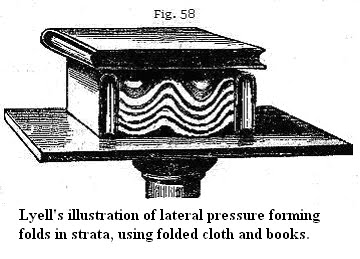
In the Principles Lyell goes into the history of theories in this area which is quite fascinating, such as the very strange ideas about the nature of fossils which some had entertained down the centuries, and of course arguments for and against the Flood. His entire Chapter 3 is devoted to this history.
Wishing I didn't have to work so I could put more time into this. Wishing I could afford more books. Wishing I weren't so old and physically disabled for anything as strenuous as poking around in fossiliferous strata. Never had the slightest interest in geology until I began reading up on the creation-evolution disputes, and now I can appreciate why people would choose to go into this field, completely apart from the two theories at issue I mean: what the earth is made of has become interesting to me. I used to see it as nothing but "dirt," dirt of different qualities of course, such that some of it would grow a luxuriant garden while some was death to all living things, the alkali flats of the desert areas for instance, but all just varieties of dirt, rocks, dirt, rocks and more dirt. Not dirty dirt, just dirt.
Of course my overarching interest remains the evidence for the Flood. Now I see the earth as a fascinating collection of chemical and physical ingredients in various combinations and situations that have been scattered and rearranged by the Flood, from some primordial condition of perfection I can barely even guess at. Everywhere I look I see the Flood, just as everywhere they look, establishment geologists see evidence against the Flood. Including Lyell. Although it took Hutton to convince him.
Obviously they have a different sort of Flood in mind than I have.
In any case, it seems to me that arguments for the Flood would benefit from more knowledge of the history of these ideas I'm finding in Lyell.
-------------------
As I continue to read, sometimes going back and forth between Lyell's Elements and his Principles, I also have to express some gratitude for these writings. They are thorough detailed simple readable descriptions of actual phenomena, something that is hardly ever found, in my experience, in the usual scientific reports having to do with geology or biology wherever they assert various evolutionary interpretations. What you get is interpretation presented as fact (a fossil creature defined by its supposed age for instance) instead of simple description of the phenomena themselves. SO happy to find in Lyell just such a simple description of where fossils are found and what kinds they are, and how their presentation LEADS to the interpretation currently in favor, as in this description from Lyell's Elements, Chapter 1:
If a stratified arrangement, and the rounded form of pebbles, are alone sufficient to lead us to the conclusion that certain rocks originated under water, this opinion is farther confirmed by the distinct and independent evidence of fossils, so abundantly included in the earth’s crust. By a fossil is meant any body, or the traces of the existence of any body, whether animal or vegetable, which has been buried in the earth by natural causes. Now the remains of animals, especially of aquatic species, are found almost everywhere imbedded in stratified rocks, and sometimes, in the case of limestone, they are in such abundance as to constitute the entire mass of the rock itself. Shells and corals are the most frequent, and with them are often associated the bones and teeth of fishes, fragments of wood, impressions of leaves, and other organic substances. Fossil shells, of forms such as now abound in the sea, are met with far inland, both near the surface, and at great depths below it. They occur at all heights above the level of the ocean, having been observed at elevations of more than 8000 feet in the Pyrenees, 10,000 in the Alps, 13,000 in the Andes, and above 18,000 feet in the Himalaya.*Of course the OBVIOUS interpretation that OUGHT to spring to the mind of anyone in Lyell's day since it was still being defended in respectable geological circles, is THE FLOOD. Good grief, it's SO obvious and yet even Lyell is now blinded by the mere speculative imaginations of Hutton and others.
These shells belong mostly to marine testacea, but in some places exclusively to forms characteristic of lakes and rivers. Hence it is concluded that some ancient strata were deposited at the bottom of the sea, and others in lakes and estuaries.