Wednesday, March 7, 2012

The Creation Model explains the facts GENETICALLY

RAZD
Do you want to see how large morphological changes occur and the evidence for them then you are asking for evidence of how the ToE explains changes observed in the fossil record and ends up with the diversity of morphological differences we see in the world today.

Of course, first you are going to need to define what you mean by "large morphological changes" as this is not a quantified description.

Do you think that the morphological differences between a house cat and a red fox are "large morphological changes"? Do you think they are differentiated by just a little or by lots of macroevolution?

Do you think a webbed foot is a "large morphological change" when the parents don't have webbed feet?

You might want to read through Dogs will be Dogs will be ??? or MACROevolution vs MICROevolution - what is it? and see if you can formulate your question clearly.
... The only defence offered for that is, "enough time will do it". The rest is arguing about speciation, which many believe is just variation or micro-evolution. The only difference is evolutionary scientists decided it wasn't.
Well can you deny that many generations add more evolution than single generations?
Generations alone don't do it, you need population splits, and you get "more evolution" only up to the point that you run out of alleles for any given evolving trait, generally many traits by the time "speciation" is reached. This is because the processes of evolution that lead to speciation also lead to reduced genetic diversity.
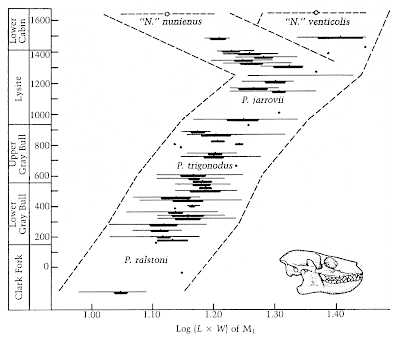
Here's Pelycodus again:

How many generations do you think are shown there?
One. One generation, many cousins. Many variations / cousins that lived at the same time and all died in the one same Flood.
Speciation can be taken as the boundary between microevolution and macroevolution, and this would be consistent with microevolution occurring within breeding populations. Generally, however, scientists don't worry so much about macro and micro, and prefer to talk about evolution and the resulting cladistic patterns.

What happens with speciation events is a division of the breeding population into two or more populations, each then free to evolve independently by microevolution within their respective breeding populations.
The ability of each population to evolve independently will continue as long as there is sufficient allelic variability for it. Back at that Creation there would have been much more than there is now so that such splits wouldn't lead to genetic reduction or depletion, even severe bottleneck splits, because all that now-dead junk DNA was functioning DNA back then. But at least since the Flood, and in more recent time, population splits may reduce genetic diversity quite a bit in a given species. The idea that microevolution just freely proceeds after such splits is the typical evolutionist assumption that doesn't recognize that these processes bring about reduced genetic diversity, which after many population divisions prevents further phenotypic changes from occurring at all. This is the basic folly of evolutionist assumption of open-ended evolution.
Creationist: No one seems interested that the best microbiology has been able to accomplish is 1+1=2. No one is interested in the boundries and limitations of mutational changes, or that just about all the changes involve loss of information. Information loss, cannot build anything new. Just faith that enough time can do the job.
Here the creationist is saying what I'm saying. Loss of information is really the same thing as reduced genetic diversity. Some alleles get left behind as new phenotypes emerge on the basis of the remaining ones. That's loss of information, although I think it's clearer to call it reduced genetic diversity.
RAZD: Perhaps that's because we've seen the evidence for 1+1+1+1+1+1+1+1+1+1=10 and know that your assertions are absolutely false.
This is just a bald assertion, where's the evidence he claims to have seen? He's not going to give any, but he'll ask the creationist to produce evidence instead.
RAZD: Of course you could try to prove me wrong by actually providing evidence of this mythic mutational barrier. See "Macro" vs "Micro" genetic "kind" mechanism? -- an 8 year old thread that asks for this mechanism, but which no creationist nor idologist has provided. Be the first
. And here's RAZD's challenge from that thread:
The whole system was supposedly set up during those original 6 days, so there must be a mechanism in place that prevents "macro"evolution ... what is the built-in biological mechanism that prevents this from happening? Where is it located? Why hasn't it been found?
Again, it's the fact that the processes of evolution can't simply keep on going because they eventually run out of alleles for genes. Evolution defeats evolution.
The creationist says: Anyone could look at old fossils and make relational assumptions. Especially if they are commonly designed.
RAZD: And those assumptions can be tested by applying the methodology of cladistics, and by having separate groups make simultaneous analysis and by comparing it with similar analysis using DNA.

Curiously this has been done, extensively. Guess what? They confirm each other. Can you tell me why the results are the same if the process is subjective
There is some sort of illusion involved in this whereby you are getting nothing more than a tautological echo of sorts. The method IS subjective. You are looking at traits and subjectively deciding how to group creatures according to their trait similarities and differences. As the creationist says, design similarity is a sufficient explanation for many similarities and your groupings can't show that it isn't simply design similarity you are grouping together. Studying DNA seems like it ought to produce an independent standard of some sort but in fact there is also a similarity of DNA design that reflects the similarity of phenotypic design and there is no way in any of this to establish actual descent from one to another.

The same is true of the supposed terrific evidence of "nested hierarchies" which gets discussed farther down the page. All this involves a subjective classification of external TRAITS, and descent is simply INFERRED, not proven.

Similar situation with RAZD's questioning the creationist about what constitutes a "large morphological change" as a definition of macro versus microevolution. The problem is that when you are dealing with morphology, just as with the nested hierarchies and the clades, it's all subjective judgment. And that includes the similarities that also are reflected in the DNA (there's bound to be a predictable correspondence between the DNA and the phenotype).
Do you want to see how large morphological changes occur and the evidence for them then you are asking for evidence of how the ToE explains changes observed in the fossil record and ends up with the diversity of morphological differences we see in the world today.

Of course, first you are going to need to define what you mean by "large morphological changes" as this is not a quantified description.

Do you think that the morphological differences between a house cat and a red fox are "large morphological changes"? Do you think they are differentiated by just a little or by lots of macroevolution?

Do you think a webbed foot is a "large morphological change" when the parents don't have webbed feet?
As long as this is all subjectively determined a creationist can say the difference between a fox and a house cat IS large enough to constitute a macro level of difference, and the evolutionist can say it isn't. But what does the DNA of the two creatures look like is the real question.

These things have to be determined at the genetic level. He asks if webbed feet from a nonwebbedfooted parent is a macro level difference or not, asking as usual for a subjective judgment of an observable trait. Seems to me it depends on whether there is the GENETIC possibility of webbedfootedness in the genome. Is there a gene for webbedness that exists in the genome or not? Is there more than one gene for the trait that could produce webbedness under certain conditions or combinations? Or allelic alternatives that could produce it? If there is then webbedness has to be one built-in variable for the particular species and is not a "large morphological change" or a macro level change. If not, then you aren't going to get webbedness in that species at all ever (except possibly as a mutation?) because it IS a macro level change that can't occur.

Saturday, March 3, 2012

The Creation Model explains the facts quite nicely

We're talking a different whole model here, one that is at least as consistent with the facts as evolutionism. At least.

In the creation model I always have in the back of my mind (some of which I certainly got from creationist sources but some is my own or at least my own way of organizing the material), species are defined at the genetic level by a particular genetic endowment that was built in at creation.

DEFINING THE ORIGINAL SPECIES, ALSO KNOWN AS THE KIND:
In the debate the evolutionists insist that creationists give a definition of a Kind or of microevolution versus macroevolution, which is of course difficult. I've given my dynamic definition of it many times and a test for it as well -- there should be measurably reduced genetic diversity after a series of population reductions as in a ring species, showing the outer limits of the Kind beyond which further evolution is impossible. But I note that Percy/Admin at EvC was apparently trying to reduce the haranguing on the subject in one thread recently by trying to give a brief definition. I think he meant to say that a change from a gray squirrel (population) to a red squirrel (population) is MICROevolution but in fact he said MACROevolution which destroyed his intent, and if so I'd have to agree with that. In general I think if you're inclined to call it by the same name as its predecessor, a "squirrel" in this case, you're talking about MICROevolution. I'm sure there are exceptions but this is most likely the rule. When you're talking about a change from a reptile to a bird or a worm to a human or an ape to a human you're talking MACROevolution.

The original genomic endowment of each species has a great deal of variability built into it that defines the limits of change available to the species, that is, there were many alleles that change the effect of particular genes, originally many more than continue today, and there were many more genes, even many for a particular trait as well, many more than today (They are all now junk DNA, but I get ahead of myself).

This is sufficient for great variability of the species as populations split off from each other down the generations.

VARIATION OR "EVOLUTION" REDUCES GENETIC DIVERSITY
Over time the variability is inevitably reduced by these splittings and isolations for any given population, but the original genetic complement was so rich that the variability remains high for many generations and it's very rare that a particular line of variation gets to the point of allelic depletion for many gene loci, such as happened with the cheetah, but it would happen occasionally with severe bottlenecks -- though originally it would have taken many bottlenecks to reduce the variability to the extent of the cheetah -- and would happen over many generations with many less drastic population splittings as well.

SOME EXAMPLES OF VARIABLES THAT WERE BUILT IN:
Among the original built-in variables for most creatures could be size differences from as big as an elephant to as small as a mouse, as big as a sabertoothed tiger but as small as a housecat, as big as a dinosaur, as small as a lizard. All within the same species. Size and shape of features and limbs would also have a fair degree of variability. Color and patterns of skin or fur or scales also. Length of fur. The excess skin of the Shar Pei is most likely also a built-in variable, one that would probably take many generations of population isolation (nature does it randomly but domestic breeding does it intentionally) to emerge according to this creationist model.

SPECIATION
So: Many variations develop from the original created Species over generations, forming new populations with their own peculiar characteristics, often to the point of "speciation" or cessation of interbreeding with former populations. Speciation in this model is simply what happens when a particular line of variation -- either by random population splitting in nature or intentional splitting by domestic breeding -- has produced a population whose genetic diversity is sufficiently reduced, or whose gene pool has become sufficiently inbred, to prevent breeding of its members with those of the population from which it originally split off. Of course breeding may cease between the two before a genetic reason for it exists, simply because of preference of members of a population for members of the same population. The effect is the same: the separate characteristics of the separated populations are preserved and so are their separate gene pools.

You NEVER get a new "species" in the sense of the original Species or Kind by any of these processes of variation, only variations on the theme of the original Species itself, but they are quite wonderfully many and diverse. So while what is called "speciation" by evolutionists clearly does happen, it's nothing more than a variation that no longer interbreeds with the rest of its Kind, so that its own pecular characteristics are preserved.

As such variations inbreed and become established in their own niches they refine their own gene pool and that further cuts them off from other members of the species.

MUTATIONS
In this model, mutations are mistakes or accidents brought about by the Fall. They have no positive function in the organism, only a negative or destructive one. They may produce no identifiable change at all, but only because the original DNA is not easily damaged. But the fact that they change anything at all in the originally perfect genetic design makes them a disease process.

Whenever I read a description of a trait as produced by a mutation I simply doubt it, recognizing it as a notion that is required by the competing model of evolution but in reality most likely simply the result of an unusual combination of the pre-existing built-in allelic possibilities that go back to the creation, brought about by many generations of population splittings and consequent reduced genetic diversity which just happened to bring this particular combination to expression.

So, I habitually reinterpret descriptions of traits that ascribe them to mutation, as in this description of the wrinkled skin of the Shar Pei dog for instance:
Scientists from the Department of Genome Sciences at the University of Washington, Seattle, announced in January 2010 that they had analysed the genetic code of 10 different pedigree dog breeds. In the Shar-pei they discovered four small differences located in the gene HAS2 which is responsible for making hyaluronic acid synthase 2. That enzyme makes hyaluronic acid, which is one of the key components of the skin. There have been rare cases in which a mutation of the same gene has caused severe wrinkling in humans as well.[3]
While this MIGHT be a mutation -- a mistake in the replication of the gene -- especially where it produces a clear deformity, it is most likely, according to the creation model, to be simply a case of a rare allele having come to expression in the breed after many generations of isolation and inbreeding.

Is it possible to tell a pre-existing normal nonmutated allele from a supposed mutation as expected by evolution? I don't think so. Mutation is simply assumed, because the theory of evolution requires it.

MACROEVOLUTION
What I'm describing is often called "microevolution" but it's the only kind of evolution that is possible, variation within the species based on the genetic endowment built in at the Creation. No other genetic input is required. For "macroevolution" to occur, however, meaning changes that transcend the Species or Kind, would require genetic input from somewhere, and this is what "mutations" are assumed by evolutionists to provide, but if they are mistakes that confer no benefit on the organism obviously this should be recognized as a dashed hope.

EVOLUTIONIST JUST-SO TALES
Also incidentally found in that same Wikipedia discussion of the Shar-Pei is the typical evolutionist tale that "explains" the survival of a particular feature, in this case the heavily wrinkled skin:
If a Shar Pei is being attacked the wrinkles keep the Shar Pei from being injured badly.[citation needed]
The sort of "explanation" that is meant to account for the persistence of the feature.

Sometimes such factors may indeed apply, but according to my creation model it's more likely that the trait simply emerged in the process of allele shufflings in population isolations over generations and wasn't a detriment so it stuck around. It may confer benefits of course, but these don't have to be the reason for its existence. The creation model produces creative variations kind-of-just-for-the-love-of-them, as it were, just for the "love" of beauty and diversity, they don't need specific reasons that enabled them to survive. So, for instance, rather than Darwin's finches having evolved their characteristic beak styles in order to fit into a niche where the particular beak was suited to the particular food, the creation model would say the finches that just happened to develop with a particular beak style gravitated to that kind of food just because the beak WAS suited to it, and over subsequent generations THEN the beak could have become established and refined for that purpose within that population.

So the idea that the wrinkled skin protects the Shar Pei from injury MAY be true enough (who knows) but it isn't necessary as an explanation for the existence of the trait. This is just the usual imaginative speculation that makes up, oh, 90% of the whole theory of evolution. It even says "citation needed." Well, maybe someone will come up with a citation to a study that seems to prove it, but evolutionists never really require such proof, the ad-hoc speculation explanation alone usually suffices.

Why aren't there any pre-human hominids (or other varieties of hominids) still running around? Oh probably because we killed them all off or ran them off the territory that sustained them and so on and so forth. They publish whole peer-reviewed papers speculating about the reasons and they'll call it science and they'll beat up creationists who continue to demur. They haven't a clue but such "likely stories" seem to be enough to keep them happy. Of course the REAL reason is that there never WERE any pre-human hominids.

How come there is a bone in the whale skeleton fossil where a hip joint would have been located? Oh that's proof that the whale evolved from a land animal. Huge huge leap but because it fits the ToE they enshrine it as ***S*c*i*e*n*t*i*f*i*c*** F*a*c*t***.

But continuing with my Creation Model:

JUNK DNA
Junk DNA is most likely the record of genetic death over the generations due to the Fall, much of it brought about by mutations that simply killed the function of gene after gene. Probably the majority of it is a record of the Great Death brought about by the Flood. If there is some function left in some of them that is all it is, a bit of crippled life that remains, that wsan't completely killed. Those creationists who want to find function in the DNA are not thinking clearly. They feel they have to prove the original perfection of the Creation and forget that the Fall has made enormous changes in the original perfection through destructive processes -- disease, death, deformity -- that had no part in the original.

NATURAL SELECTION
What about Natural Selection? In this creation model NS is one possible way variations develop, but only one of many. Simple migration will succeed at creating a new variation by isolating a new population just as well as NS will, by creating new gene frequencies, just as adapted to its situation as anything NS produces, and without the death that NS often requires. Natural Selection applies mostly to situations where there is an actual survival threat that prevents the creature from passing on its genes, such as when an aggressive predator wipes out much of the population. Some sort of defensive mechanism in a few of the prey population's members may save some of them and therefore be passed on and become characteristic of the new population. A change in the environment, say the food supply, may kill off many members of a particular population but those that have some form of adaptation to the new food situation will pass on their genes. Etc. etc. It no doubt happens, but probably is fairly rare among all the ways new populations develop from genetic variations, perhaps far more often than not simply leading to extinction rather than an adapted variation. Forced adaptation to specific situations can't be as much of a driving force for change as evolution claims. As far as new variations go, genetic drift does the same thing within a population. Bottleneck is simply a drastic version of either migration or natural selection, creating a severely reduced population with severely reduced genetic diversity in a single event. Etc. etc.

FOSSIL RECORD
What is the Fossil Record according to the Creation Model? Obviously it's overwhelmingly to be explained as the remains of the creatures that died in the Flood of Noah. Obviously.

Why is there the seeming gradation of primitive to advanced morphology in the Fossil Record? There really isn't, there is simply a sorting of creatures according to some physical principle, probably many physical principles, that occurred in the Flood. The apparent gradation is an illusion. Differences between different fossil representatives of one species to be found in different layers or different parts of the world simply demonstrate the same principle of variation I'm describing above, not evolution from one type to another. There are lots of different varieties of Trilobites in the Fossil Record for instance, each variety flocking with its own kind, which evolutionists interpret as evolution over time, presumably from less to more advanced types, but all they are really is separate populations of the many possible variations that were built into the original genome of the Trilobite species.

STRATA / GEOLOGIC COLUMN / GEO TIMETABLE
What about the existence of the strata themselves, known as the Geologic Column? Well, that is really a no-brainer. Nothing BUT a worldwide Flood could have brought about those strata. The interpretation of huge time periods attaching to separated sediments is just plain ludicrous. And don't tell me that is a wrong reading of the geo timetable. Just go look at the model of the Grand Canyon where the "time periods" are associated with the different sediments.

And so on and so forth.

The point of this post is to demonstrate that there IS a Creation Model that IS consistent with the actual facts, can account for just about everything the Evolution model attempts to account for and in my opinion way better.

There is much more that could be added here but I'll have to get back to it later or do it in another post.

==============
From Post at EvC:
No one seems interested that the best microbiology has been able to accomplish is 1+1=2.
Ok, 1 +1 =2. Then we're at 2, and 2 + 1 = 3, then we're at 3, and 3 + 1 = 4. Now we're at 4, and 4 + 1 = 5. 5 + 1 = 6. 6 + 1 = 7. 7 + 1 = 8. 8 + 1 = 9. 9 + 1 = 10.

Lots of little changes add up to a big change. What you need to do, to allow micro but deny macro, is come up with some mechanism that stops little changes from accumulating.
Easy. I told them there and I'm arguing here over and over again: THE PROCESSES THAT PRODUCE VARIATIONS / CHANGES IN THE PHENOTYPE / SPECIATION / "EVOLUTION" ULTIMATELY LEAD TO REDUCED GENETIC VARIABILITY OR DIVERSITY, WHICH EVENTUALLY PUTS AN END TO THE POSSIBILITY OF MORE CHANGES. This end point defines the outer limit of a Species or Kind. That's your "mechanism." It should be testable, both in the wild and in a laboratory.

Wednesday, February 29, 2012

Just another Evolutionist PRATT, the usual paradigm-bound misconception of Speciation

Somebody just started a new thread at EvC titled An example of speciation in action? giving an example of reproductive isolation bringing about changes between two separate populations of a bird called a Blackcap. Differences in appearance between the two are minimal but differences in behavior are enough to keep them apart.

This is treated as some kind of wonderful event, at least a step on the way to macroevolution, which makes it just another evolutionist PRATT (Point Refuted a Thousand Times). I for one have answered it over and over both at EvC and on my blog, and I can't be the only one.

All this is merely one of the ways variation naturally occurs in species because of built-in genetic variability. It's nothing more than normal "microevolution," changes that are expected because of this built-in genetic variability, which can come about through anything that isolates a portion of a population from another so that they don't interbreed. Genetic drift within populations even does this but populations may also become physically separated from one another and go on to develop their own characteristics different from each other. This occurs because reproductive isolation brings about different gene frequencies in the new populations as compared to the original population. Really, it's to be expected that reproductive isolation would bring about changes between populations in this way. No mutations need be involved and there's no reason to suppose they are EVER involved.

It's simply a matter of different combinations or frequencies of alleles becoming characteristic in each of the separated populations. This is the natural result of the differences in gene frequencies working their way through each population over a few generations. Over time this brings about changes in the phenotypes characteristic of the new populations as a whole that differentiates them from each other more and more, sometimes to the point of approaching what the evolutionists would be inclined to call speciation. That depends on the degree of genetic variability that remains. The less genetic variability there is compared to the original population the more dramatic its changes will be, and the more likely it is that the populations will develop inability to interbreed with one another.

Is this speciation? This is an arbitrary definitional matter. It doesn't matter at what point population changes get called speciation, whether at this stage of practical differences bringing about lack of opportunity to interbreed, or behavioral disinclination to interbreed, or at the stage when isolation has brought about complete inability to interbreed because of genetic incompatibility, the effect is always that in isolation each population continues to elaborate its own separated gene pool and diverges further from the other.

Again, you don't need mutations to bring this about, merely different frequencies of alleles in each population.

And, as I've argued from the beginning of this blog, the result of these changes over time, especially with further splittings of the populations and further elaborations of the new gene frequencies brought about by the splitting, is reduced genetic variability that makes further evolution less possible, and ultimately impossible. The more evolution you have, the less evolution is possible. Evolution defeats evolution.

Oh well, they don't listen to such obvious simple contradictions of their beliefs. Maybe a creationist will come along and make the point eventually, and they'll ignore that too because they really don't care about science, only about justifying evolution.

But there's a brief statement of it just for the record.

========================
By the way, they often complain that creationists offer no evidence for many interpretations such as the above, without ever recognizing that they have no evidence for their opposing interpretations either, but have only the familiar just-so story line.

They interpret the changes brought about by reproductive isolation as steps in open-ended evolution, simply because that's what the theory requires, not because they have any evidence for it. To their mind the simple fact that such changes do occur IS the evidence -- evidence for the theory of evolution. But there is no evidence for the open-endedness of the change process itself, that's just assumed. Darwin assumed it and it continues to be assumed.

Likewise they assume mutations as the engine that keeps it all going because the theory requires such an engine. You can get different kinds of finches out of the built-in genetic complement that belongs to finches, but you can't get an iguana out of a finch without the input of new genetic material or "information."

So instead of even recognizing that there is such a thing as a built-in genetic complement that defines a species (which is really the definition OF a species or Kind at the genetic level, that elusive definition they keep haranguing us creationists to produce), they assume that ALL genetic material is constantly being created by the processes of mutation and natural selection. Again, there is no evidence for this, they have to assume it because the theory requires it.

As a creationist I interpret the changes brought about by reproductive isolation as the effect of shuffling the frequencies of alleles that belong to the built-in genetic complement for the species. There is a natural limit to the changes possible BECAUSE there is this original complement of genetic potentials that can only be shuffled and reshuffled. It CAN play out to less and less genetic variability down any particular line of variation brought about by reproductive isolation, especially a series of reproductive isolations such as in a ring species. What is called "speciation" is really the result of this reduced genetic variability. New phenotypes develop from new frequencies of genes, but reproductive isolation itself over time reduces the genetic variability. This can produce dramatic new phenotypes, but there is a point that is reached when further variation becomes impossible. You may have a striking new variation (they call it a new species) but it may have such reduced genetic variability it can't change any further at all. Yes, like the cheetah. Thus bringing the processes of evolution to an end for that line of variation.

Mutations are of absolutely no use in this scenario, they only interfere with it, and in reality that does appear to be what happens, which is evidence for the scenario right there -- thousands of genetic diseases, thousands of "neutral" mutations that have simply not produced anything identifiable (although they have to be deleterious because they change the genetic code, which was originally perfect), and a very few known "beneficial" mutations that are highly questionable. These are the facts, although the theory of evolution says the opposite and has to interpret them away, as by claiming the beneficial mutations made the entire genetic code so are therefore hard to detect. The known facts, however, are on the creationist's side.

I have also suggested a scientific test that could prove all this, which is more than the evolutionist side can offer. All they have is theory, elaborated by theory, multiplied by theory, developed by theory and validated by theory. Fantasy in other words. No evidence.

Sunday, February 19, 2012

Ad Hoc = Fantasy explanations mistaken for science shown again on thread about lack of hominid transitionals

A new creationist at EvC called CrytoGod is now trying his hand at getting them to acknowledge that all they have is speculation /conjecture/ fantasy /imaginative constructs /ad hoc explanations / just-so stories, all stuff made up off the top of the head / off the cuff, whatever synonymous expression you prefer, to explain anything the theory of evolution requires. Are they going to acknowledge that? Of course not.

The subject is why there aren't any intermediate ape-human types wandering around.

Why should there be? was somebody's disingenuous answer. Well, because Darwin for one realized that there had to be for the theory to hold water. LOTS of transitionals with many small gradations as a matter of fact, not just the occasional specimen of a creature that has characteristics of a couple of other species. OK, he was talking about FOSSILS, but the same reasoning implies that there ought to be LOTS of living transitionals as well if the theory were correct. Darwin was clear: you gotta have LOTS of them and LOTS of gradations between them. He tried to get away with explaining their lack by the imperfection of the "fossil record" (one of HIS ad hoc explanations that can't be proved or disproved) but if that fossil record were really a record of evolution down the millions of years you'd nevertheless have to see some evidence of what he had in mind and you don't. ALL we see are complete forms, forms with variations such as occur all the time in living nature too, but not the transitionals the theory requires. And that's just the fossil record. LIVING transitionals are an even more reasonable expectation from the theory as you can't argue "imperfection" of the living record. As CtG says, it's just too too convenient that there aren't any.

What can they do but assert that there aren't any intermediate ape-human types wandering around just because there aren't, because they went extinct, and make up explanations why that might possibly be the case, although CrytoGod specifically asked them to avoid ad hoc explanations and give only scientific explanations. Well, CtG knows as well as I do that there AREN'T any scientific explanations, ONLY made-up stuff that they nevertheless call fact or science. ALL the evos can do is posture and expostulate, insinuate that the creationist's evidence is flawed somehow or other [it's "old"], and denounce him as stupid and ignorant, and aggressively declare whatever they can invent to support the theory as if it were fact, because that's all they ever do and all they CAN do because there IS no science that supports this stuff.

He who has eyes to see...

I cry to God also, that He would open the eyes of these blind.

===========

Much later. I keep wanting to get back to this post but never quite make it, too much else going on, but will at least say here, in case I can never get back to it, that the thread I'm talking about above goes on with plenty of examples of this kind of ad hoc / make-it-up-as-you-go thinking, which is really THE "methodology" of The Sciences of the Past, both evolutionism or biology of the past, and Old Earthism or geology of the past. Anybody's guess will do to explain whatever the theory tells them must be true. That's the Fantasy of Evolution for ya right there.

Friday, February 17, 2012

Just another anti-Flood posturing at EvC mistaking the usual fantasy for science

Just another typical comment on another Flood thread at EvC.
We can tell from your last post that you still believe the geologic record is consistent with a flood, but you ignored all the posts explaining why a flood doesn't deposit sediments in ways that resemble the layers of the geologic record.
Well, of course, and I generally ignore them too because it can only be the usual fantasizing in the service of their bias. They can never imagine the Flood properly and only impose their own speculations on it based on their own biases. Why is it so hard for them to honestly recognize that is what they are doing? There can't be the sort of evidence they so aggressively insist be acknowledged because there can't be the sort of similarity between an ordinary everyday flood and THE Flood. Of COURSE we ignore such supposed explanations. All daydreams from the Darwinian presupposition.
How much credit do you think you deserve for ignoring all this information? If what we post to you doesn't matter, why should we bother?
Why don't you require of yourselves that you recognize your own methods aren't really scientific but just as speculative as any Floodist's? And the Floodist has the advantage of an ancient revelation against your purely invented theory.
While there are some people who will always be snarky , even normally polite people will become snarky when ignored.
No doubt, even though all they've had to offer is just more variations on the usual fantasy.
Debate isn't you talk, I talk, you talk, I talk. Debate is you talk, I react to what you say, you react to what I say, etc. What you've got going here is you talk, we react to what you say, you talk, we react to what you say, you talk, etc. How about responding to the information you've been provided?
What, information about how a local flood proves THE Flood didn't happen? Yes, I suppose our creationist should take more care to address the opposition's posts but since all they could possibly be is imaginative efforts at shooting down his points rather than taking them seriously I can understand why he might not. Yes, I know, I could be wrong, this could be one of those threads where the creationist really is out of bounds, but the complaint from the other side just sounds awfully familiar.

They are awfully certain that the evidence does not support a worldwide Flood, and yet every explanation offered for how the strata could have formed piecemeal over millions/billions of years is far more irrational than what they think they are answering.

And an earlier post shows that as usual it's really all about authority anyway. All those geologists just can't be wrong.
In order for there to have been a recent world-wide flood, generations of geologists and their research going back to the late 1700's would have to be wildly wrong. For so many geologists over so long a period of time to be so wrong would require the source of the error to be incredibly well hidden
. Yes, it IS well hidden, it's in the basic assumptions of the whole invented fantasy edifice that they keep mistaking for science.
It is unlikely to be found in a blender of dirt and water or anything else so simplistic.
True, it won't be found in any one bit of data but even that bit of data might contain truth that simply can't be seen because of the prejudices that prevent it. But more to the point it won't be found in ANY bit of data put forward by a creationist there because of the strong bias against it and the ease with which contrary interpretations can be pulled out of a hat to serve as a rebuttal. [In this particular case the creationist was answering an assertion about how the flood would have left things jumbled and mixed. It's a perfectly decent answer. If you stir up sediments with water in a blender they sort out into layers. It's a good answer. A worldwide Flood would not have left things jumbled but in layers. Instead of accepting it as a good answer they object that such an example doesn't describe the layering actually seen. As if the blender example were meant to account for the whole geo column. No, it was meant merely to demonstrate that swirling water deposits sediments in layers, and it ought to be accepted as a reasonable answer.]

Creationists often don't argue these things very well and even the better ones shouldn't even be trying. But that doesn't change the fact that the evolutionists are deceived from the getgo and the whole debate itself is a big joke.

He goes on to object that the creationist simply doesn't know enough Geology and that his focus on God keeps him from desiring to study it. This may be true of this particular creationist, or it may not be. This is a standard position there but just reading up on basic Geology doesn't tell you much about the issues under debate. So far Dr. Adequate has put up a great deal of basic Geology and so far it doesn't even touch on anything that supports or denies the possibility of the Flood. The only thing that did relate was a post that was more of an aside than a lesson in Geology, in which he gave his own beliefs about buried "landscapes." So I'm still waiting. In other words, one could know a great deal of basic Geology without finding anything of much value in this debate.

===========================

Upthread from this conversation is a post by Coyote who always argues the same line, claiming to have given the evidence that completely does in the Flood claims:
Given the massive amount of contrary evidence in the archaeological and geological record, I can't believe anyone could support the notion of a global flood during relatively recent times, ca. 4,350 years ago. The early creation geologists gave up on that idea just about 200 years ago--and they set out to prove the flood! Evidence showing the global flood never happened during recent times has only accumulated since then, while no credible evidence has been found to support such a flood.

In my career as an archaeologist I have tested probably over 100 sites whose time spans included the date most often attributed to the global flood by biblical scholars, ca. 4,350 years ago. I have never found evidence of either massive erosion or sedimentary deposition at that time period.

What I have found instead is continuity of human cultures, mtDNA, fauna and flora, and sedimentation. The things that must have occurred if there was a global flood at that time--discontinuities in all of those areas--are not found.

The same results are reported by my colleagues elsewhere in the United States and around the world.

But lest you think that we are idiots and can't see evidence for floods, I would direct you to various websites on the Channeled Scablands in eastern Washington. Post-glacial floods repeatedly scoured that area as ice dams in western Montana periodically held back and released meltwaters. We can establish the dates of the floods and their extent. Here are a couple of good websites for your edification:

http://www.cr.nps.gov/...logy/publications/inf/72-2/sec5.htm

http://hugefloods.com/Scablands.html
Coyote accepts without question the dating methods of today's science. That's the beginning of the problem. They will not consider that methods that deal with the past can't be hard and fast as they claim they are. As usual they talk as if they were fact, as if they could prove their claim in the laboratory, which of course they cannot. Their tone of certainty is unscientific and perhaps would never have been adopted if they didn't feel the need to quell the creationist claims. A creationist cannot and will not accept their dates. What's the point of continuing to debate such things since there will always be this impasse?

Coyote's argument in fact should be regarded as a PRATT (Point Refuted A Thousand Times) on the evolutionist side because it's certainly been answered over and over.
I can't believe anyone could support the notion of a global flood during relatively recent times, ca. 4,350 years ago. The early creation geologists gave up on that idea just about 200 years ago--and they set out to prove the flood! Evidence showing the global flood never happened during recent times has only accumulated since then, while no credible evidence has been found to support such a flood.
Unfortunately the early creationist geologists were looking for the wrong kind of evidence for the Flood, as are the archaeologists Coyote is talking about.
In my career as an archaeologist I have tested probably over 100 sites whose time spans included the date most often attributed to the global flood by biblical scholars, ca. 4,350 years ago. I have never found evidence of either massive erosion or sedimentary deposition at that time period.
Of course he can't find evidence of the Flood. He's looking for specifics he's dreamed up that are way too small for such a Flood. Just like those early creationist geologists.

Of course their timing is wrong to begin with. All settlements that would be studied by archaeology, same as all the great empires including the Egyptian, that science places back before the Biblical time of the Flood, do not go that far back, were all built since the Flood.

"Massive erosion?" -- Try erosion on the scale of entire continents being denuded of their sediments, which were then redeposited in layers all over the earth. You won't find this at a particular depth in an archaeological dig. You're going to have to stand up and survey the entire landscape. You can't dig down to find the evidence, because in reality it's everywhere. ALL the strata are evidence of the Flood, all those layers of sediments that have been given names and time estimates in the millions by modern Geology. That's the evidence for the Flood.

What I have found instead is continuity of human cultures, mtDNA, fauna and flora, and sedimentation. The things that must have occurred if there was a global flood at that time--discontinuities in all of those areas--are not found.
Not if what you're digging around in all occurred since the Flood. You're looking for paltry "discontinuities" among post-Flood phenomena.

And then the usual argument about the ancient limited floods:
But lest you think that we are idiots and can't see evidence for floods, I would direct you to various websites on the Channeled Scablands in eastern Washington. Post-glacial floods repeatedly scoured that area as ice dams in western Montana periodically held back and released meltwaters. We can establish the dates of the floods and their extent. Here are a couple of good websites for your edification:

http://www.cr.nps.gov/...logy/publications/inf/72-2/sec5.htm

http://hugefloods.com/Scablands.html

Yes, they can see THAT evidence, though they misread the timing as usual since they have to conform it all to the Geo Time Table. It's interesting to read about those floods, the draining of massive lakes, and there is no reason to doubt that they are interpreting the data correctly as far as the physical events go. Lake Missoula was rapidly and catastrophically drained, possibly in two days, according to the article, but since that seems a little too fast for them they suggest perhaps it took a month.

These facts are consistent with the usual Floodist interpretation. After the Flood it should be expected that there would have been standing bodies of water, including those HUGE standing bodies of water, Lakes Missoula, Lahontan and Bonneville in the western USA. Since Floodists also believe that tectonic and volcanic forces were released during and after the Flood, it would make sense that the dams that held back these lakes could have been suddenly broken as the land to the east rose and the Rockies were formed in that area by tectonic movement.

But the scientists insist on their own methods and conclusions, especially their ridiculous timing, instead so what's the point of arguing any of this?

Wednesday, January 25, 2012

"Sea Monsters" -- antediluvian life forms or creatures evolved over millions of years?

Watching a film at Netflix by National Geographic titled Sea Monsters. (I tried but couldn't get the "embed" function to work for the trailer.)

The film shows some geologists on a fossil hunt in Kansas, finding bones of prehistoric reptilian dinosaurian type sea creatures. They also find the more common ammonite fossil -- and it's interesting to see this as I had no idea what size to picture those creatures, and the fossil is a lot larger than I had visualized, about the diameter of a good sized serving platter I'd say.

It's the ammonite fossils they say tell them when all these creatures in the same vicinity lived, which is of course based on their Geologic Time Table that layers the physical world in time periods, just as Dr. A does as quoted in the post below. They always speak of the time element as fact although it is nothing but an imaginative construct that they impose on the sedimentary and fossil phenomena.

Speaking of it as fact is what I call "word magic." They don't need the actual processes of science to reify an imaginative construct into Reality and enforce it with indignant denunciations as "anti-science" of anyone who isn't convinced. "The poetry of reality" as Dr. A says, although it's just the poetry of fantasy.

Most of the film is animation of the creatures reconstructed from their fossils and shown swimming in the seas that supposedly covered the area for some huge length of time in the "Cretaceous" period, and the "Triassic" and "Jurassic." They do show the sea that bisected the continent of North America at one time, and I have no doubt there is evidence in shorelines that identify such a body of water that stood long enough for such markers to be evident, but of course I don't buy the millions of years explanation for anything.

No, I'm watching this as an interesting imaginative reconstruction of life forms that lived before the Noachian Flood and that were no doubt transported by that Flood to their resting places where they were buried and fossilized and where these geologists now find them.

The "sea" that bisected the continent was of course a temporary stage of the Flood after it had receded or at least begun to recede, as were all the ancient extinct large lakes of western North America such as Missoula and Lahontan and Bonneville. Simply large lakes that stood for some time after the Flood and then finally drained away, in some cases suddenly and catastrophically, probably due to the tectonic forces that occurred after the Flood and also built the Rockies. The catastrophic draining of one such great standing body of water is one very plausible explanation for the carving out of the Grand Canyon. Not a feat any ordinary river could have accomplished.

One funny thing: A few large fossils were found with food in their stomachs, one rather "stuffed to the gills" as it were, which prompted the speculation that it must have died of gluttony. Of another the narrator wondered why it would have died so suddenly after a good meal. Of course they conjured an explanation out of a hat as usual, but duh, folks, obviously the most reasonable explanation is that they were all caught in the same catastrophic event at the same time, some having just filled their stomachs.

Same phenomena, different interpretation, just as reasonable, no, really, more reasonable than the establishment interpretation.

Dr. A's course in geology finally approaches the controversial questions

I'm still following Dr. A's Geology presentations, though not intensively. Today he added a comment that is really the first time he's brought up anything controversial, so I have to at least note it.
There is an inordinate number of different kinds of sediment. This is just how it is. This makes the study of geology different from studying (for example) the theory of gravity. Instead of Einstein's single equation, geologists must study a vast variety of things that happen on the face of the Earth. Dust-storms blow, trees fall, the tide goes in and out, turbidity currents do their thing, glaciers do theirs, peat-swamps form, rivers dposit point-bars, inevitable chemical processes gnaw at the rocks, desert sand is piled up by the wind, coccoliths drift with immense slowness towards the seafloor, the tide makes flaser deposits ... and so on and so on.

And you don't quite see it all until you see it all. Before I undertook my own study of geology, I regarded sediment as the dirt one finds fossils in. Now I see landscapes. "Here" (we say) "are the remains of ancient mountains, long gone. Over their cloud-capped heads, the storm broke, and angry torrents flowed down and dwindled into the rain-shadowed desert when dinosaurs walked --- look, here are their footprints around the ancient oases. Vast was that expanse of sand, which the wind sifted for tens of millions of years. It was bordered by a great yet shallow sea ..."

In writing this textbook, I have to deal with this one sediment at a time, one ripple in the mud, one lamina in the sand, but when we look at it all together, we see vanished landscapes, lost worlds. Piece by piece we put it together, until we see the whole.

"Science is the poetry of reality."
This synthesis he makes from the great variety of geological phenomena, involving former "landscapes" that span huge periods of time, interpretive scenarios that he places in ancient time periods, is of course the standard Old Earth way of construing it. It's an imaginative construct laid over the phenomena, and of course the most predictable imaginative construct, and it is given without giving the logical steps by which he arrived at it. It's SOME kind of "poetry" but more like the poetry of biased imagination than the poetry of reality.

He promised to give the reasons "how we know" this or that as he goes, and he's been doing that but not on anything particularly controversial until now. In this comment he does not even try to say "how we know" about these landscapes, he simply says this is how he now sees it, how he puts it all together, which of course is how the establishment puts it all together.

But not how a Floodist would put it all together, and until he provides us with the logical steps that lead to his conclusion he deprives a Floodist of the necessary material to falsify his claims, just as this kind of "science" always does, always leaping to the imaginative Big Picture, always Telling the Story of past events as they dream them up and letting that stand for Science, while slighting the particular phenomena that led them to their interpretation.

THIS is where you need to tell us "how you know" all this, Dr. A., and of course this is exactly where you DON'T tell us that. Please correct course. Thank you.